Balochistan disappearances surge 308%: U.S. urged to sanction Pakistan

&imwidth=600&imheight=450&format=webp&quality=medium "Balochistan disappearances surge 308%: U.S. urged to sanction Pakistan")
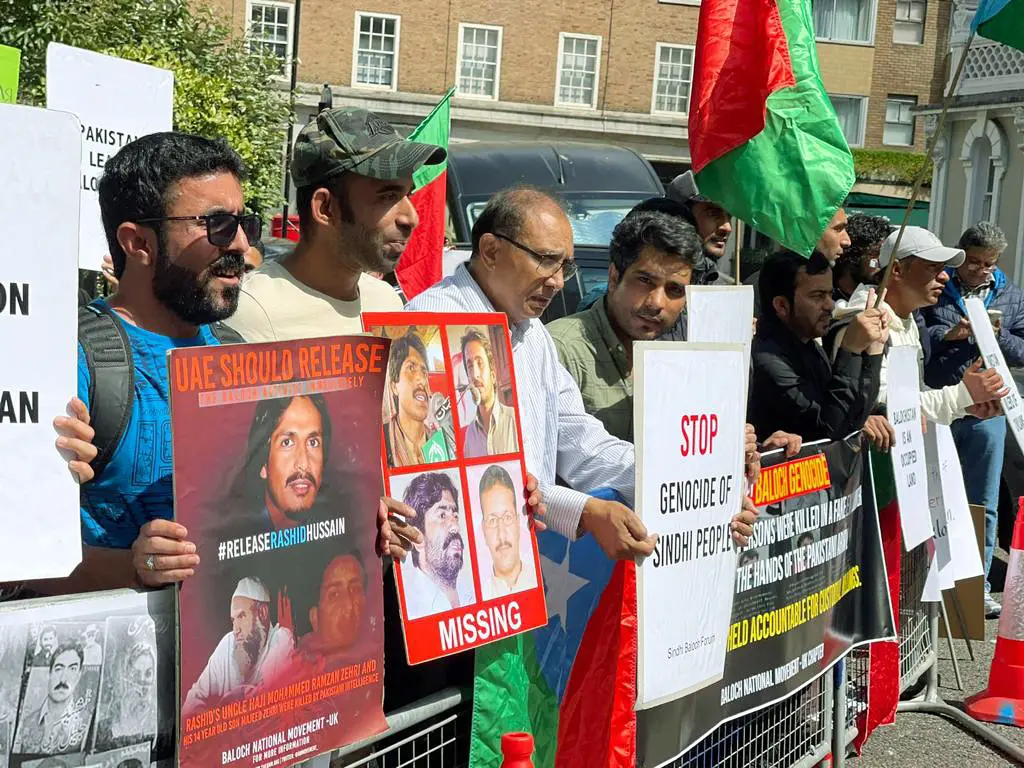
Baloch National Movement (BNM) members stage a protest in front of Pakistani High Commission against Pakistani atrocities in Balochistan, in London on Wednesday. Photograph: (ANI (File Photo)
Enforced disappearances in Balochistan have surged in recent years, prompting fresh concerns over human rights violations, lack of accountability and calls for US sanctions against Pakistani entities and personnel.
Imagine if a person's loved ones are forcefully picked up by security agencies and kept in arbitrary detention for years without any disclosure of their whereabouts.
Well, this is a stark reality for thousands of families in Balochistan.
Under Pakistani Army chief Asim Munir's watch, enforced disappearances have skyrocketed. In the garb of counter-terrorism, Pakistani forces have used enforced disappearances as a tool to silence the voices of political opponents, human rights activists, students, women and children.
For instance, human rights activist Mahrang Baloch, who led multiple protests against enforced disappearances in Balochistan, was arrested in March last year. Subsequently, she was sentenced to life imprisonment over the murder of a paramilitary personnel.
According to a latest report published by an NGO named Asian Centre for Human Rights, over 1,400 cases of enforced disappearances were reported in Balochistan last year.
This was a staggering rise of 308% as compared to five years ago.
Trending Stories
)
)
)
)
)
)
)
)
)
)
)
)
)
)
)
)
)
)
)
)
)
)
)
)
)
)
)
)
)
)
)
)
)
)
&im=FitAndFill=(700,400))
)
)
)
)
In the first seven months of 2026 alone, it flagged 793 enforced disappearances, which amounts to nearly four cases per day.
Now, the Pakistani government itself acknowledged the gravity of the issue by forming a Commission of Inquiry on Enforced Disappearances in March 2011.
Until 2026, it received close to 11,000 cases, the maximum of which were from Khyber Pakhtunkhwa, followed by Balochistan.
However, it is important to remember that the official figures may not reflect the full scale of the problem, as many cases remain unreported or unregistered.
While Pakistan has claimed that over 7,000 persons have been traced, over 1,000 of them are detained in illegal internment centres, whereas 740 others are in jail.
Around 1,400 individuals are yet to be traced.
This is not all.
309 people were found dead.
What is glaring, though, is the sheer lack of accountability.
According to the UN Working Group on Enforced Disappearances, no perpetrator has been held accountable in any case so far.
Now, the consequences for the families of the disappeared are severe.
They are often socially ostracised, emotionally drained and financially vulnerable, with no closure, and continue to be harassed by the authorities for demanding justice.
Last month, UN experts expressed concern over the enforced disappearance and extrajudicial killing of Balochistan-based student Imran Ali.
They said, and I am quoting them:
"Any deprivation of liberty followed by the authorities’ refusal to acknowledge the detention or by the concealment of the fate or whereabouts of that person is an enforced disappearance."
Thereafter, they urged Pakistan to conduct an impartial probe into his death.
In the wake of a spike in Balochistan's enforced disappearances, the Asian Centre for Human Rights called upon the US to sanction Pakistani entities and personnel involved in this major human rights violation.
Now, Pakistan's crackdown on civilians has also led to fierce retaliation from rebel groups such as the BLA.
In 2026 so far, 572 incidents of killing have taken place in Balochistan, in which 705 Pakistani security personnel have been killed.