World Asteroid Day: Hazardous asteroids flagged to hit Earth and current status

&imwidth=600&imheight=450&format=webp&quality=medium "World Asteroid Day: Hazardous asteroids flagged to hit Earth and current status")
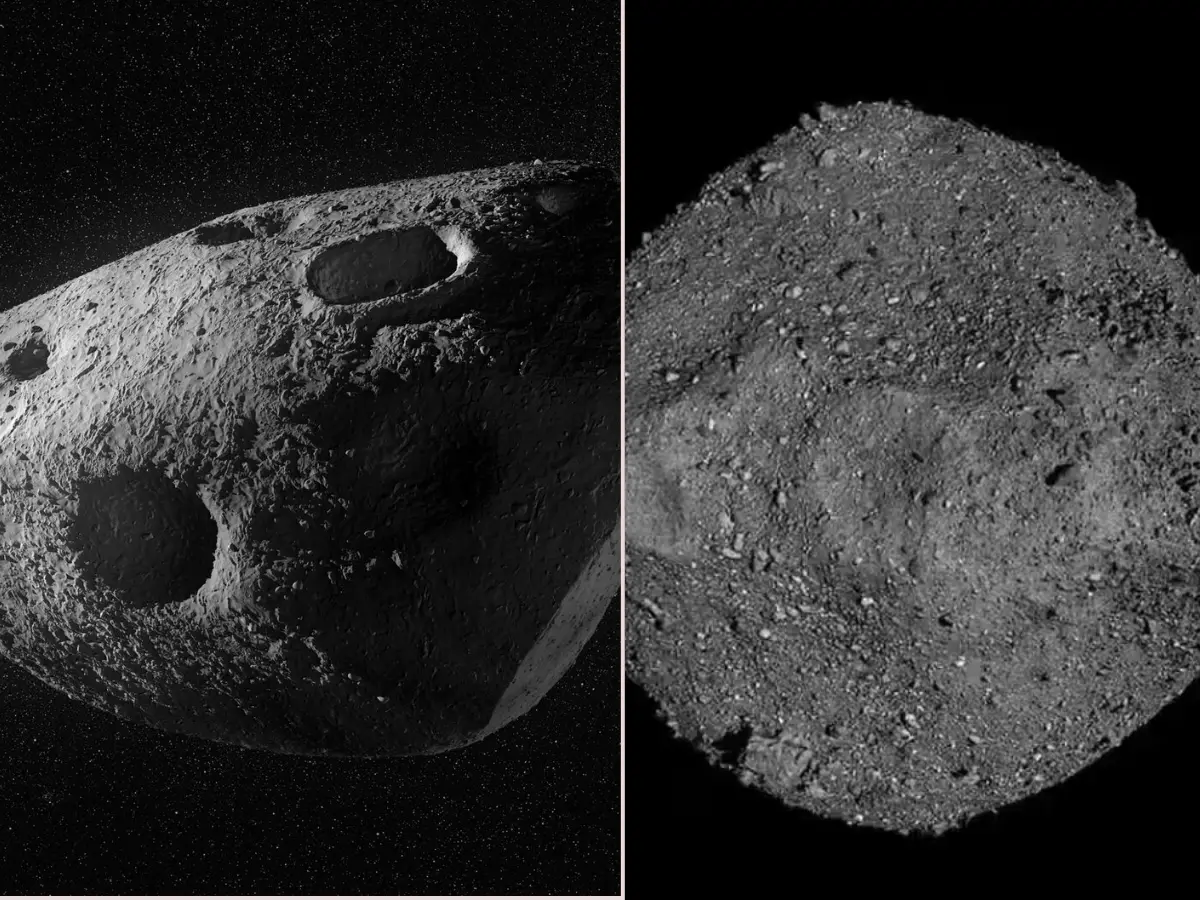
Asteroid Apophis (L) and Asteroid Bennu Photograph: (ESA - NASA)
World Asteroid Day: Here is a list of asteroids flagged to pose a threat to Earth in the future. One of them is visiting this decade, while another is slated for early next year. Will they collide with Earth? Here are the details.
NASA's Asteroid survey program aims to scan space to detect space rocks that lurk near Earth. As of 2026, over 40,000 near-Earth asteroids (NEAs) have been catalogued by the space agency. NASA also regularly releases a list of asteroids that will skim past our planet, which happens fairly regularly. The Catalina Sky Survey (based in Arizona), Pan-STARRS (based in Hawaii) and NEOWISE (an orbital space telescope framework) are three observatories funded by NASA and part of the Planetary Defense Coordination Office (PDCO).
With all this technology in place, NASA has created a platform which detects hazardous asteroids, ones that could pose a threat to Earth. This is how scientists have discovered not only the asteroids that would zoom past Earth safely, but also ones that were seen as a danger to our planet. Here are some such asteroids and their risk status.
Asteroid 2024 YR4
This near-Earth Apollo-type asteroid was discovered in 2024 by the ATLAS telescope in Chile. At the time, calculations showed that it would collide with Earth in the year 2032. It is estimated to be roughly 174 to 220 feet in diameter, and immediately led scientists across the world to make more observations. It briefly reached level 3 on the Torino scale.
Current status: Asteroid 2024 YR4 will miss Earth, trajectory calculations made using several instruments, primarily the James Webb Space Telescope, showed in February 2026. However, it was estimated to crash into the Moon, and the chances of this happening kept on increasing. But now, it has been confirmed that the asteroid will safely fly by the Moon at a distance of over 20,000 km.
Trending Stories
)
)
)
)
)
)
)
)
)
)
)
)
)
)
)
)
)
)
)
)
)
)
)
)
)
)
)
)
)
)
)
)
)
)
&im=FitAndFill=(700,400))
)
)
)
)
99942 Apophis
Named after the ancient Egyptian god of chaos, darkness, and destruction, this asteroid was estimated to slam into Earth in 2029. It is nearly 1230 feet in diameter and was discovered in 2004. Pretty soon, it triggered an alarm about an impending collision with Earth. NASA said that it could hit Earth in 2029, 2036, or 2068. Scientists continued to study Apophis using optical telescopes and ground-based radar.
Current status: NASA has ruled out any impact from Apophis for at least the next 100 years. However, it will be 32,000 kilometres at its closest point to our planet’s surface, closer than many satellites in geosynchronous orbit. NASA and ESA have planned missions to study the asteroid when it visits. NASA’s OSIRIS-REx was sent to Apophis in 2023, while the European Space Agency is also sending a spacecraft to the space rock.
The Rapid Apophis Mission for Space Safety (Ramses) has been launched in collaboration with the Japan Aerospace Exploration Agency (JAXA) and will accompany Apophis as it flies past Earth. It will be launched in late April to mid-May 2028 and will start observing Apophis from February, two months before the flyby. It will take before and after photos to capture how its rendezvous with Earth changes it.
101955 Bennu
About the height of the Empire State Building, Bennu has been the focus of several observations, with some showing it holds the building blocks of life. It is estimated to collide with Earth on September 24, 2182. NASA used this early detection to send the OSIRIS-REx spacecraft to the asteroid and return samples.
Current status: Bennu has a cumulative impact probability of about 1-in-2,700 over the next three centuries.
29075 (1950 DA)
Humans also know about an asteroid that could hit Earth in the next 854 years. Nearly 1.3 km wide, this asteroid is capable of causing global climate disruption. The exact date calculated is March 16, 2880.
Current status: Calculations show that there is roughly a 1-in-51,000 chance of this asteroid hitting Earth. But since this will happen way into the future, scientists are using this time to study it and even launch a mission like DART if possible, to deflect it.