'We function as a start-up': India's student-led Orion Racing shines at international Formula Student events

&imwidth=600&imheight=450&format=webp&quality=medium "'We function as a start-up': India's student-led Orion Racing shines at international Formula Student events")
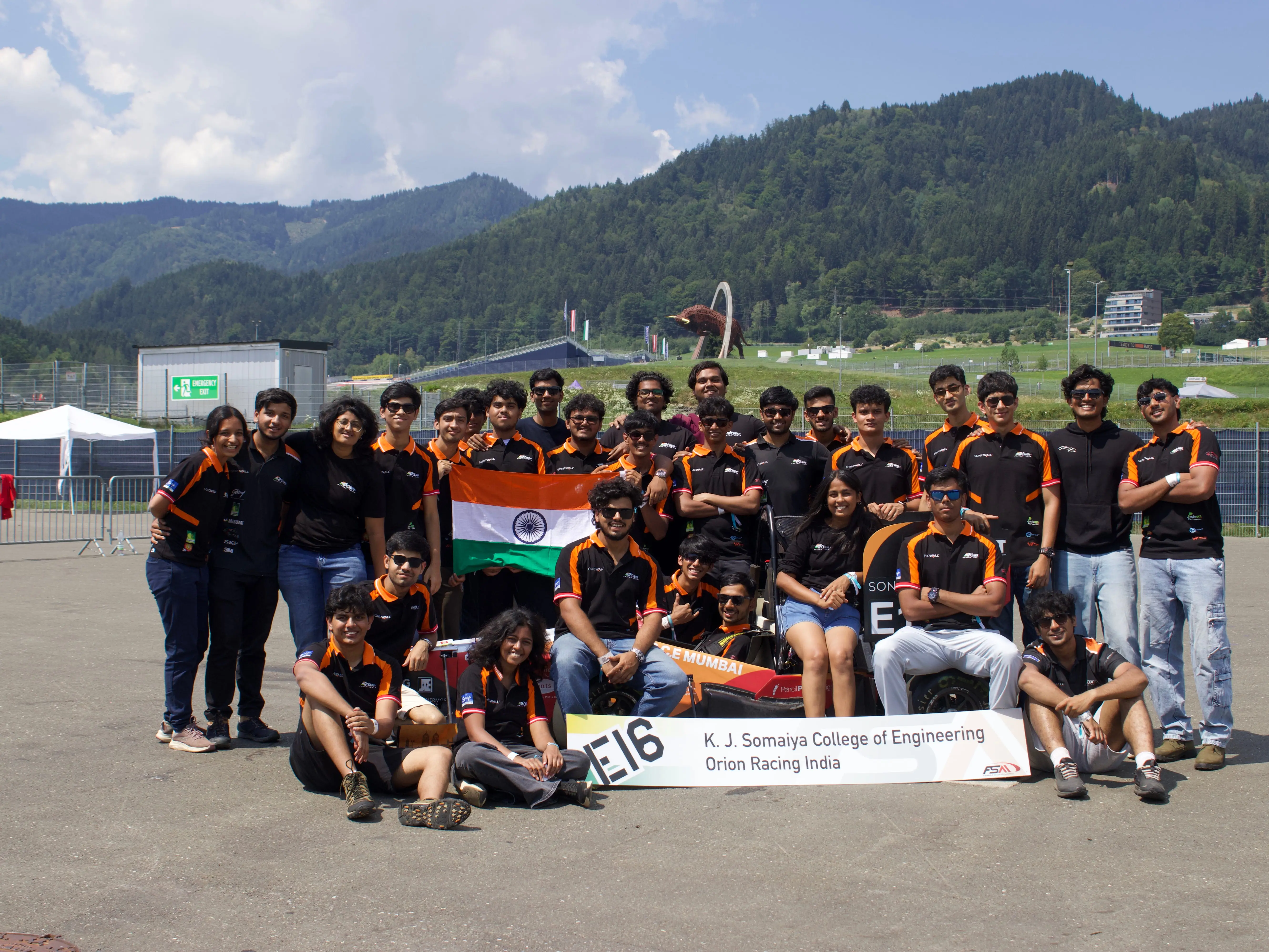
Mumbai-based KJ Somaiya College of Engineering's Orion Racing team Photograph: (WION)
Mumbai-based Mumbai-based KJ Somaiya College of Engineering's Orion Racing team finished 28th in Austria and 61st in Germany at Formula Student with their 4th EV prototype, balancing strict safety protocols, simulations, and FMEA risk management.
MUMBAI: Formula car racing is a niche sport with a lot of technicalities and rules, apart from the thrill of speed. The technical details and the perfection required to put a car out on a track don't stop Formula teams from having fans behind them all the way to support them. With the Indian government announcing a plan to bring Formula 1 – the top tier of Formula car racing – back to the country, a bunch of college students has made the country proud at Formula Student events in Austria and Germany.
Earlier this year, Orion Racing from the Mumbai-based KJ Somaiya College of Engineering, affiliated with Somaiya Vidyavihar University, participated in Formula Student Austria and Germany. The team, participating with its 4th EV prototype, finished 28th overall at the Red Bull Ring in Austria and 61st in Germany.
The team, in an interaction with WION, recently spoke in detail about its functioning, car, safety protocols, and more.
Tell us about the structural and organizational setup of Orion Racing.
We function as a startup. There are three different departments – management, mechanical, and electrical – and every system has a system lead. We take decisions together after discussions, which are long, but always to the benefit of the team.
Abhishek, Adarsh, and Niranjan, all final-year students, handle the management, electrical, and mechanical departments, respectively. The team consists of over 25 students including from first year freshmen to waiting in wings third year seniors as well.
Trending Stories
&imwidth=280&imheight=210&format=webp&quality=medium)
&imwidth=280&imheight=210&format=webp&quality=medium)
&imwidth=280&imheight=210&format=webp&quality=medium)
&imwidth=280&imheight=210&format=webp&quality=medium)
&imwidth=280&imheight=210&format=webp&quality=medium)
&imwidth=280&imheight=210&format=webp&quality=medium)
&im=FitAndFill=(700,400)&imwidth=280&imheight=210&format=webp&quality=medium)
&imwidth=280&imheight=210&format=webp&quality=medium)
&imwidth=280&imheight=210&format=webp&quality=medium)
&imwidth=280&imheight=210&format=webp&quality=medium)
&imwidth=280&imheight=210&format=webp&quality=medium)
&imwidth=280&imheight=210&format=webp&quality=medium)
&imwidth=280&imheight=210&format=webp&quality=medium)
&imwidth=280&imheight=210&format=webp&quality=medium)
&imwidth=280&imheight=210&format=webp&quality=medium)
&imwidth=280&imheight=210&format=webp&quality=medium)
&im=FitAndFill=(700,400)&imwidth=280&imheight=210&format=webp&quality=medium)
&imwidth=280&imheight=210&format=webp&quality=medium)
&imwidth=280&imheight=210&format=webp&quality=medium)
&imwidth=280&imheight=210&format=webp&quality=medium)
&imwidth=280&imheight=210&format=webp&quality=medium)
&imwidth=280&imheight=210&format=webp&quality=medium)
&imwidth=280&imheight=210&format=webp&quality=medium)
&imwidth=280&imheight=210&format=webp&quality=medium)
&imwidth=280&imheight=210&format=webp&quality=medium)
&imwidth=280&imheight=210&format=webp&quality=medium)
&imwidth=280&imheight=210&format=webp&quality=medium)
&imwidth=280&imheight=210&format=webp&quality=medium)
&imwidth=280&imheight=210&format=webp&quality=medium)
&im=FitAndFill=(700,400)&imwidth=280&imheight=210&format=webp&quality=medium)
&imwidth=280&imheight=210&format=webp&quality=medium)
&imwidth=280&imheight=210&format=webp&quality=medium)
&imwidth=280&imheight=210&format=webp&quality=medium)
&imwidth=280&imheight=210&format=webp&quality=medium)
&imwidth=280&imheight=210&format=webp&quality=medium)
How do you ensure the safety of the car, and how do you go about the safety drills?
We have a rule book, just like the one in Formula 1. The governing competition is Formula Student Germany, as they were the first ones to start this (Formula Student) competition. The rule book is centered around safety, just like a Formula 1 car, with the basic design philosophy but on a smaller scale, and every safety aspect is ensured in the vehicle.
For example, in electronics, there is an IMD system which monitors that there is no short circuit happening in the car or insulation leaks. If such an issue is present, it will not allow us to switch on the car battery.
There is also a brake test where all four wheels have to lock once the driver presses the brakes, and then there is a rain test where they (competition organizers) pour sprinkler water on the car, and if there are any insulation leaks, then you are not allowed to run the car. The rule book ensures that the standard is maintained and there are no mishaps happening in terms of safety for any individual working on the car.
Formula One is moving towards sustainability with electrical power introduced this year, but that has cost them speed. Yours is also an electric car, and when you participate in the tournaments, how do these things matter or affect your performance?
After a point when we are developing these systems, a lot of the teams reach pretty much the same hardware level. After that point, what mainly matters is how good our simulations are, how well we are validating our data, and how well our tunings are for all our control systems.
The frequent simulations running, validating those simulations with real-life data, and actually coming up with proper strategies allow us to have a consistent pace. We also don't want transient events – that is, suddenly there is an acceleration spike or there is a certain loss of throttle – and we ensure that by implementing proper signal processing in control electronics, in battery packs, and in motor control systems.
On the management side, how do you reach a conclusion between what you can afford and what is necessary, or whether it is electrical or mechanical over the other when it comes to money distribution? How do you decide on that?
At the start of the discussion, we establish a team goal and a vehicle goal regarding what main innovation we will bring to the car. We also prioritize systems that are very critical to the running of the car.
Also, we need to keep some funds for the logistics of the car for national and international competitions because it costs more than 20 lakhs for shipping, which is mandatory, and there's no other option.
When participating in competitions, do you look at other cars for improvement or inspiration, or cars that have similar designs to yours?
There is a lot of idea borrowing within Formula Student. Even at the start of the season, we might take a few teams as examples and try out their concepts at the beginning, and then see what works for our vehicle geometry because there are a lot of variables, and we can't just copy the whole car. But it is quite a fun process, actually, just looking at what sort of evolutions the teams are doing and then pursuing our own philosophy that can take elements from other teams or maybe create something new altogether with what they are doing.
Talking about the racing philosophy, what do you think is more important in the end – the car or the driver?
It is a fusion of both. When we start recruiting our drivers, there is a process. Firstly, we have a written test where we think the driver should at least know the basic knowledge of vehicle dynamics or how our car functions as a whole. The drivers who have driven for the car team then take interviews, and then we shortlist the candidates based on karting times. In the end, we go to a go-kart track, and then there is a shootout to decide who is the fastest one out of them, and then we go on to select drivers. At the end of the day, the main job of the drivers is to give good feedback about the car.
How do you deal with the expectations or things that might put pressure on you in a situation like a failure of some component or not being able to qualify?
To ensure the components are smoothly running, we do something called FMEA – Failure Modes and Effects Analysis – which is required by a lot of competitions including Formula Student. What we do in FMEA is, for every system, the team will sit down and will deliberate on what failures on the car can occur, how they can occur, how severe they are, and how to deal with them.
In the end, there is a complete spreadsheet of 100–200 entries which is made for all of those failures, depending on what failure we are thinking of, how it may occur in the car, and what global or local consequences it will have for the vehicle. We also come up with contingencies in that sheet alone, which helps us be prepared mentally when we're taking the car out on the track and be ready for whatever eventuality can happen to the car.

