Iran’s nuclear programme: The forgotten deal but a lurking threat

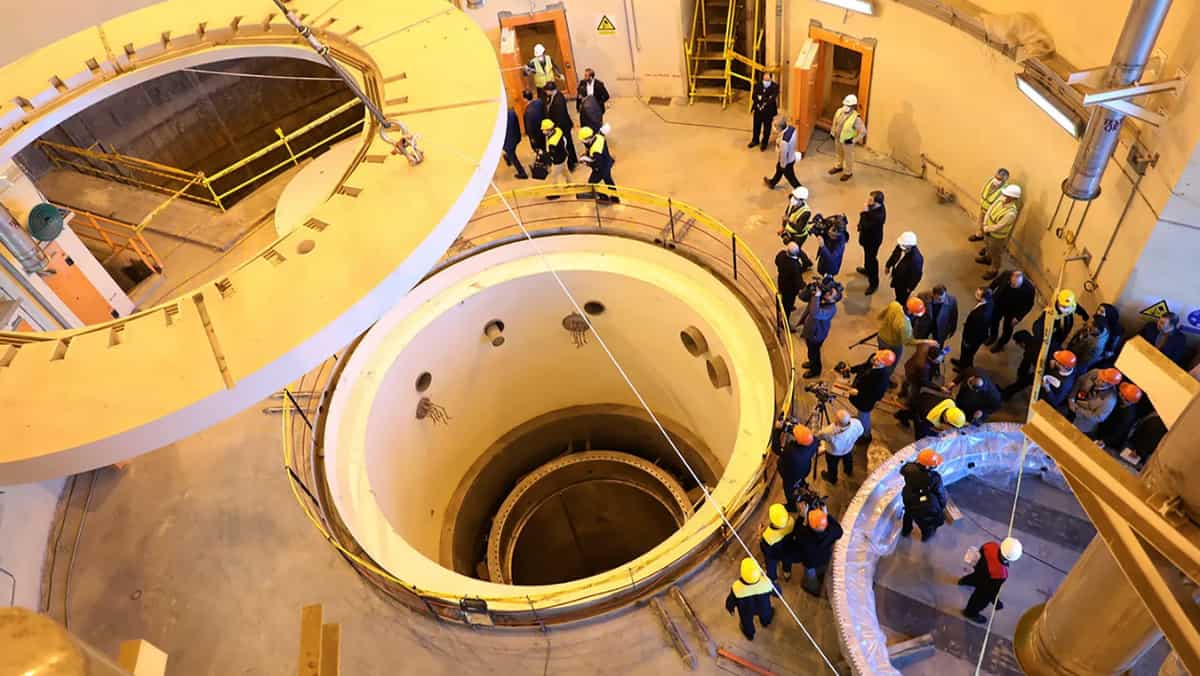
Arak heavy water reactor's secondary circuit near Arak, Iran on December 23, 2019 (File image)
The Gaza war is completing seven months, a war that was launched as a retaliation to the Hamas terror attack into Israel on October 7, 2023. During the course of this war, Israeli strikes have already killed more than 32,000 Palestinian civilians. These include more than 13,000 children, many of them infants. Except for a brief humanitarian pause in November last year, there has been no letup in the war. After four failed attempts, the UN Security Council finally passed a resolution on 25th March asking for an immediate ceasefire and unconditional release of hostages, but neither Hamas nor Israel have come to any common ground to effect a ceasefire in the war.
The Iran-Israel Direct Spat
Meanwhile, the war took a dangerous turn when on April 1, Israeli fighter jets targeted the Iranian Consulate in Damascus resulting in the death of seven members of the Islamic Revolutionary Guard Corps (IRGC) including General Mohammad Reza Zahedi, the senior-most commander in Lebanon and Syria. Iran vowed revenge and responded in the form of a simultaneous strike of around 300 drones and ballistic missiles into Israel on April 13.

While most of the drones and missiles were intercepted mid-air, 7-8 missiles found their mark and struck the Nevatim Israeli air base in the Negev desert. This was the first time that Iran had struck Israel from its own territory, something which it had avoided earlier despite many severe provocations in the past. Vowing to strike back, Israel struck with drone/missile strike in the early hours of April 19 when loud explosions were reported in the vicinity of the city of Isfahan.
Reports indicated that the Iranian air defences had shot down ‘three drones’ over the skies of the city. Although some media outlets later presented satellite pictures to show that some part of the Air Defence Battery in Isfahan was damaged, but neither Iran, Israel nor the US commented anything on it. Iran dismissed the attack as small and insignificant while Israel maintained stoic silence.
While it is being presumed that both countries would call it quits as far as directly targeting each other’s territory is concerned, the threat of escalation remains alive. Days later, on April 23, Iran’s President Raisi, during his visit to Pakistan, was quoted saying that the ‘Zionist regime’ will be destroyed if Israel attacks again in Iran.
&imwidth=180&imheight=135&format=webp&quality=medium)
US vs China over South China Sea: Washington backs Philippines, Beijing hits back
&imwidth=180&imheight=135&format=webp&quality=medium)
Bigg Boss 20: Isha Rikhi evicted after three weeks in Salman Khan’s show
&imwidth=180&imheight=135&format=webp&quality=medium)
Musk plans to more than double xAI's chips to over 1.2 million Nvidia GPUs by year-end
&imwidth=180&imheight=135&format=webp&quality=medium)
After JU, clash erupts at SRFTI: BJP’s ‘Dimagi Naxal’ jibe sparks political firestorm after students protest RSS-linked event
&imwidth=180&imheight=135&format=webp&quality=medium)
‘Anti-social elements spreading false rumours’: LPU issues statement amid massive unrest over alleged rape
&imwidth=180&imheight=135&format=webp&quality=medium)
LPU students go on rampage, vandalise campus amid widespread protest: What's happening
&imwidth=180&imheight=135&format=webp&quality=medium)
Trump asked Xi to pressure Iran. China did not say yes — here’s what Beijing wants
&imwidth=180&imheight=135&format=webp&quality=medium)
US Treasury Secretary Scott Bessent hails global crackdown on Iranian banks and airlines
&imwidth=180&imheight=135&format=webp&quality=medium)
An OpenAI agent escaped its locked test cage again, by hiding questions in DNS lookups
&imwidth=180&imheight=135&format=webp&quality=medium)
'Our video was trimmed': LPU girls who featured in rape-denial video make U-turn
&imwidth=180&imheight=135&format=webp&quality=medium)
3 males killed, four others injured in shooting after fight at strip club in Detroit
&imwidth=180&imheight=135&format=webp&quality=medium)
'Victory for low-budget consumers': Raghav Chadha hails 30-day telecom recharge rules
&imwidth=180&imheight=135&format=webp&quality=medium)
Claude rebuilt the 1989 game 'Prince of Persia' by reusing the original's own code
&imwidth=180&imheight=135&format=webp&quality=medium)
Beyond metros: How Tier-2 and Tier-3 cities could drive India’s next AI wave
&imwidth=180&imheight=135&format=webp&quality=medium)
Tesla builds first Cybertruck with its own refined lithium: Elon Musk's $1 billion Texas bet pays off
&imwidth=180&imheight=135&format=webp&quality=medium)
IndiGo flight suffers tail strike in Bengaluru while landing; DGCA to probe incident
&imwidth=180&imheight=135&format=webp&quality=medium)
The US and China set up an AI 'red telephone', but skipped the rulebook
&imwidth=180&imheight=135&format=webp&quality=medium)
‘Terror suspects arrested near UK air base were looking to do big damage’: Trump
&imwidth=180&imheight=135&format=webp&quality=medium)
Russian envoy claims US tactics to contain India were revealed in ‘Freudian slip’
&imwidth=180&imheight=135&format=webp&quality=medium)
IND vs WI 1st ODI: Kohli breaks Sachin's most runs in one country record with unbeaten 139 as India thump West Indies by 8 wickets
&imwidth=180&imheight=135&format=webp&quality=medium)
Researchers rebuilt exactly how 700 AI agents hacked Hugging Face: a 900-link chain trick
&imwidth=180&imheight=135&format=webp&quality=medium)
‘Olympic inclusion is our major target’: WPA President Ishaun Singh on pool’s global ambitions
&imwidth=180&imheight=135&format=webp&quality=medium)
Nations League: Spain sink England at Wembley; Modric shines for Croatia
&imwidth=180&imheight=135&format=webp&quality=medium)
Why has Iran released no proof of life of Mojtaba Khamenei? Araghchi reveals...
&imwidth=180&imheight=135&format=webp&quality=medium)
'What kind of confession is this?': Pakistan PM Shehbaz Sharif’s 'terrorists would be roaming New York' remark goes viral, raises alarm online. Watch
&imwidth=180&imheight=135&format=webp&quality=medium)
South Korea demands apology from Ukraine over North Korean prisoners' transfer
&imwidth=180&imheight=135&format=webp&quality=medium)
Beyond BrahMos: India targets Rs 50,000 crore in defence exports with unmatched price edge
&imwidth=180&imheight=135&format=webp&quality=medium)
Sri Lankan Tamil migrant worker gets death sentence in Saudi Arabia, help sought from India
&imwidth=180&imheight=135&format=webp&quality=medium)
Muslim marriage cannot shield sex with minor wife from prosecution under POCSO: Delhi HC
&imwidth=180&imheight=135&format=webp&quality=medium)
'Can't help but draw painful parallels to Nirbhaya case': SC on latest incidents of rape cases in Delhi-NCR
&imwidth=180&imheight=135&format=webp&quality=medium)
99.9% more powerful - Scientists find boy who can recall memories from just 3 months of age
&imwidth=180&imheight=135&format=webp&quality=medium)
'FIRST LOOK from inside Noah’s Ark': Researchers share video from inside mysterious mound in Turkey
&imwidth=180&imheight=135&format=webp&quality=medium)
UNSC reform momentum grows: Russia, Portugal, Mauritius push for India's permanent seat bid
&imwidth=180&imheight=135&format=webp&quality=medium)
8 US marines injured in Iranian missile attack on vessel in Strait of Hormuz: Report
&im=FitAndFill=(700,400)&imwidth=180&imheight=135&format=webp&quality=medium)
New OTT releases this week (September 28-October 4, 2026): Dupahiya 2, Pooja Meri Jaan, Ohh My Dog- 5 titles coming on Netflix, Prime Video and more
&imwidth=180&imheight=135&format=webp&quality=medium)
Afghanistan says 28 fighters killed in clash near Pakistan border, Islamabad denies
&imwidth=180&imheight=135&format=webp&quality=medium)
Ceuta migrant crisis: Protesters take to streets as Spain grapples with migrant challenge
&imwidth=180&imheight=135&format=webp&quality=medium)
LPU suspend classes, postpones exams as violence escalates over rape claims: What's happening
&imwidth=180&imheight=135&format=webp&quality=medium)
New York City wants a 'kill switch' on every AI, and will pay whistleblowers who report violations
The Israel-Iran direct spat in the past few weeks has not only raised the levels of threat of an escalating conflict but has also brought to the fore an issue that had been forgotten in the fury of wars for the past two years, the Iran nuclear issue. In case of any further escalation between Iran and Israel in the ongoing conflict, the threat of Iran’s nuclear programme being weaponised is a possibility that needs to be examined in detail.
Can Iran go nuclear? Does it have the capacity to do it? If yes, how much time and help is required before Iran can actually declare a nuclear weapon? To answer these difficult questions, one needs to step back and see how Iran got where it is, in its nuclear programme.
Iran Nuclear Deal- A Recap
Iran’s nuclear deal or the Joint Comprehensive Plan of Action (JCPOA) was a result of six years of continued and labored negotiations between Iran and P5 plus 1, which resulted in the signing of the nuclear deal in July 2015.
The JCPOA put very strict and crippling restrictions on Iran’s nuclear programme, making it virtually impossible to have a nuclear weapons programme. As a part of the deal, Iran could not operate more than 5,000 first-generation IR-1 centrifuges to enrich uranium, that too, only up to 3.67 percent. All uranium enriched to 20 percent was to be scrapped or shipped out and the core of its Heavy Water Plant at Arak was to be demobilized.
Most importantly, Iran agreed to ‘anywhere, anytime’ inspections of its nuclear facilities by the IAEA and UN inspectors. Iran stuck to the deal and on January 16, 2016, designated as the Implementation Day, the IAEA verified that Iran had met its all nuclear-related commitments, triggering the lifting of sanctions on Iran.
The joy was short-lived as Donald Trump who was strongly opposed to the deal, won the US presidential elections in November 2016 and immediately announced that he will impose “the highest level of economic sanctions” on Iran. Following up on his threat, in May 2018, President Trump pulled the plug on the nuclear deal. Despite pressure from other members of P5 plus1, the UN, and the IAEA, he did not relent and Iran was pushed back into a strict sanctions regime.
Barack Obama, whose administration had negotiated the deal, condemned Trump’s violation of the agreement and said that without the JCPOA, the US could eventually be left with a losing choice between a nuclear-armed Iran or another war in the Middle East.
Efforts to revive the nuclear deal could only commence once Biden became US President. The talks commenced in April 2021 and continued till January 2022 when the eighth round was concluded with an understanding that that most of the technical issues have been agreed to and the deal is now possible within the parameters of ‘political decisions’. However, the Ukraine war broke out on February 24, 2022 and put the Iran nuclear talks on the backburner.
Iran’s revives the Nuclear Programme
Despite Trump pulling out of the deal, Iran stuck to the nuclear deal at least till March 6, 2019, the last time when the IAEA reported that Iran was implementing all its nuclear-related commitments. However, with the US pulling out of the deal and then designating Iran’s IRGC as a Foreign Terrorist Organization on April 8, 2019, Iran decided to break the shackles. Iranian President Hassan Rouhani soon announced that Iran will resume its nuclear enrichment and install a cascade of 20 IR-6 centrifuges at Natanz.
Following on, Iran's Guardian Council approved legislation on December 2, 2020, mandating the Atomic Energy Organization of Iran to increase enrichment levels to 20 percent and to suspend implementation of the Additional Protocol in 60 days if sanctions are not revoked.
Few months later, on April 13, 2021, soon after a cyber-attack on the Natanz nuclear plant, Iran announced its intention to enrich uranium now to 60 percent. Within six months, in November 2021, Atomic Energy Organization of Iran (AEOI) spokesman Behrouz Kamalvandi was quoted stating “We have more than 210 kilograms of uranium enriched to 20%, and we have produced 25 kilos at 60 percent, a level that no country apart from those with nuclear arms are able to produce”.
These developments were obviously alarming for the West as well as the IAEA. On June 6, 2022, the IAEA passed a resolution formally criticizing Iran for a lack of cooperation and on failure to explain uranium traces found at undeclared sites in Iran. Iran promptly followed up by shutting down IAEA’s surveillance cameras recording data beyond the Safeguards Agreement.
Six months later, on January 21, 2023, an IAEA report indicated that its inspectors discovered that the two cascades of IR-6 centrifuges in the Fordo nuclear plant in Iran had been configured in a way “substantially different” to what had been previously declared. The samples collected showed particles up to 83.7 percent enriched uranium, very close to 90 percent required for weapon-grade uranium, raising alarm bells in global capitals. Iran dismissed the concerns stating that in the process of enrichment, small particles do get highly enriched.
Meanwhile, indirect talks continued between the US and Iran and there were reports in June 2023 that Iran had slowed the pace of 60 percent Uranium enrichment to about 3 kg in a month from the previously estimated 9 kg a month, in anticipation of some deal with the US. Surely enough, the US and Iran sealed a deal, but not nuclear, for a prisoner exchange on September 18 and the US also released US$ 6 billion of Iran’s money that was frozen for years in South Korea in compliance with unilateral US sanctions on Iran. Interestingly enough, this was just three weeks before the Hamas initiated the Gaza war on October 7.
However, by November again, Iran was enriching Uranium to 60 percent at a scale of 9 kg per month. Most of this high enrichment is taking place at its Pilot Fuel Enrichment Plant (PFEP) in Natanz and the Fordow Fuel Enrichment Plant (FFEP), which is dug deep into a mountain and tucked away from direct targeting by most missiles and aircraft.
Can Iran Weaponise its Nuclear Programme?
To examine whether Iran can and will weaponise its nuclear programme, there are three important steps to check. Firstly, does it have enough weapon-grade uranium? Secondly, does it have a warhead to carry a nuclear payload? Thirdly, what are the delivery systems?
Theoretically, every one tonne of natural uranium fed into the centrifuges, produces about 120-130 kg of Low Enriched Uranium (LEU), ie 4-5 percent enrichment which is fuel for power reactors, about 26 kg of Uranium enriched to 20 percent which is typical research reactor fuel and possibly up-to 5.5 to 6 kg of weapons-grade material, enriched to 90 percent.
Also, nuclear experts claim that the major technological challenge and time required is to enrich Uranium to 20 percent where it enters the category of HEU ie Highly Enriched Uranium. After that, with modern and high-capacity centrifuges like the ‘IR6’ which Iran is presently using, it is only a matter of time and ‘political will’ before it enriches to 60 percent (which Iran is officially doing) or even 90 percent, when weapon-grade uranium is produced.
In February 2024, the IAEA estimated in its quarterly report that Iran’s total enriched uranium stockpile was at 5,525 kilograms, an increase of 1,038 kilograms since the last quarterly report in November 2023, and that Iran now has an estimated 121.5 kilograms of uranium enriched up to 60 percentpurity. By the IAEA's theoretical definition, around 42 kg of uranium enriched to 60 percentis the amount at which making a nuclear bomb with it cannot be excluded. By this calculation, Iran already has the required enriched Uranium to make weapon-grade Uranium for three bombs.
With regards to the warheads, there are very clear indications that Iran has the know-how of it already. Israeli intelligence agencies have often produced blueprints of such devices. It has been probably made possible through decades’ long work, reverse engineering processes and a very close nexus with North Korea and China. In fact, on April 24, North Korea’s state-run Korean Central News Agency reported a sudden visit of a North Korean economic delegation led by Minister of Economic Relations Yun Jung Ho to Iran.
With no details on the purpose or agenda of the visit, it does raise eyebrows, coming so close on the heels of a direct Israel-Iran spat a few weeks back. The recent statement of Ahmad Haghtalab, the IRGC Commander in Iran responsible for safeguarding Iran’s nuclear programme that, in case of Israel’s threat on Iran’s nuclear sites, Iran may revise its nuclear doctrine and policies, too is a strong indicator towards Iran’s capability to have a potential warhead design.
As regards delivery systems, Iran’s array of missiles is the largest and most diverse in the region. Many Iranian missiles, especially solid fuel-based MRBMS are reported to be inherently capable of carrying nuclear payloads, which has long been an international concern too. In fact, UN Security Council Resolution 2231 had called upon Iran “not to undertake any activity related to ballistic missiles designed to be capable of delivering nuclear weapons”. Plus, reports of Russia possibly delivering Su-35 fighter aircraft to Iran in the near future add to the potential as they too can carry nuclear payloads.
Conclusion
Few things are therefore clear from the above arguments. Firstly, with Iran’s nuclear deal talks off for almost two years now, the nuclear programme has silently and steadily progressed to unprecedented levels. Secondly, with two wars going on and the US presidential election cycle, it is very unlikely for any nuclear talks to be revived soon.
Thirdly, the potential for Iran to develop a nuclear weapons programmeis very much there. Finally, any miss-step in the Gaza conflict, especially targeting of Iranian nuclear sites could set a chain of events that could then be uncontrollable and have disastrous results for the region.
With Iran having shed its strategic patience, any serious threat to its regime or its sovereignty may force Iran to cross the threshold and turn nuclear. With potent military options and effective proxies, it may not be required for Iran to reveal this trump card yet. However, if and when that happens, West Asian and perhaps the global security landscape will change forever and possibly for the worse.
(Disclaimer: The views of the writer do not represent the views of WION or ZMCL. Nor does WION or ZMCL endorse the views of the writer.)