Explainer: ISRO plans SPADEX-2 and 3 space docking experiments

&imwidth=600&imheight=450&format=webp&quality=medium "Explainer: ISRO plans SPADEX-2 and 3 space docking experiments")
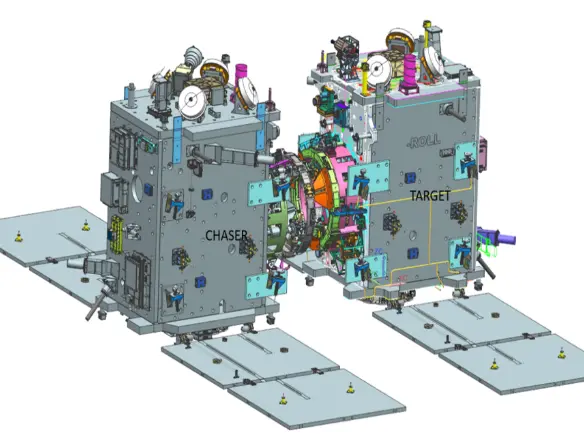
A render of ISRO's twin satellites involved in the SPADEX-1 mission Photograph: (ISRO)
For Chandrayaan-4, docking would have to be carried out while the satellites are in a highly elliptical (egg-shaped) orbit. The Indian Government has revealed that SPADEX-2 would involve the docking and undocking of two spacecraft in a highly elliptical orbit.
After successfully demonstrating India's first space docking experiment, SPADEX, in 2025, the country's Space agency, ISRO, is now carrying out studies for its successor missions, SPADEX-2 and SPADEX-3. Space docking is the intricate process of bringing two satellites close to one another and mechanically attaching them into one unit, all while they are travelling at velocities over 28,000 kilometres per hour. Docking is a crucial enabling technology that facilitates the transfer of astronauts, cargo, or fuel from one spacecraft to another. India's ambitions of returning samples from the moon (Chandrayaan-4) and building the country's own space station require mastery over docking technology.
As per details revealed by the Indian Government in Parliament, ISRO is studying two orbital docking experiments: SPADEX-2 for replicating the Chandrayaan-4 (Lunar Sample Return), and SPADEX-3 as a precursor mission for docking in Bharatiya Space Station.
Why is docking tech mandatory for Chandrayaan-4 ?
India has envisioned its fourth lunar mission, Chandrayaan-4, as a sample return mission. Chandrayaan-4 will not stop with a soft landing on the moon. After landing, it will collect lunar samples, vertically liftoff from the moon, and carry the samples to our home planet.
For this ambitious venture, ISRO is working towards building two crafts, each weighing around 4,750kg. Instead of launching one massive craft, ISRO would launch two of these crafts into space using two LVM3 rockets. Thereafter, these crafts would have to perform docking and undocking in space as part of the mission. During the SPADEX-1 mission, ISRO carried out docking while the satellites were orbiting the Earth in a circular orbit.
Trending Stories
)
)
)
)
)
)
)
)
)
)
)
)
)
)
)
)
)
)
)
)
)
)
)
)
)
)
)
)
)
)
)
)
)
)
&im=FitAndFill=(700,400))
)
)
)
)
For Chandrayaan-4, docking would have to be carried out while the satellites are in a highly elliptical (egg-shaped) orbit. The Indian Government has revealed that SPADEX-2 would involve the docking and undocking of two spacecraft in a highly elliptical orbit, and a sample would be transferred between the two crafts. Therefore, SPADEX-2 is intended to simulate the conditions that Chandrayaan-4 would have to operate under.
Why is docking tech mandatory for operating a space station?
To build a space station, which is a massive orbiting lab, multiple modules(parts) need to be launched from Earth in a phased manner. Gradually, these modules have to be assembled in space to create a fully functional space station. India has ambitions to build its own space station that would eventually house astronauts. As part of SPADEX-3, ISRO envisions docking and undocking between two pressurised modules using Bharatiya Docking System (BDS), which is a homegrown docking mechanism.
Pressurised docking is a specialised form of space docking designed to create an airtight, structurally robust tunnel to move astronauts and cargo between two spacecraft. When astronauts live aboard a space station, they would need to move from one module of the station to another, just like how one would need to go from one room to another at home. Therefore, the connections between all modules need to be maintained at equal pressure, to provide breathable air, temperature control, and ideal habitable conditions.
What makes space docking so complicated?
When a one spacecraft is approaching the other spacecraft, the relative velocity between the two (the difference in velocity between the two) must be controlled very carefully. If the relative velocity is too high, the docking attempt can fail, causing damage or collisions. If it is too low, it may take too long to complete the approach, which could lead to fuel inefficiencies or mission delays.
When the spacecraft docks, their relative velocity must be near zero. This means that the two spacecraft must be moving at the same velocity and in the same direction at the time of docking to ensure a smooth connection without any impact forces. This requires careful coordination and manoeuvring, all done fully autonomously.
