Amid domestic launch slowdown, four Indian startups' payloads fly on SpaceX rocket

&imwidth=600&imheight=450&format=webp&quality=medium "Amid domestic launch slowdown, four Indian startups' payloads fly on SpaceX rocket")
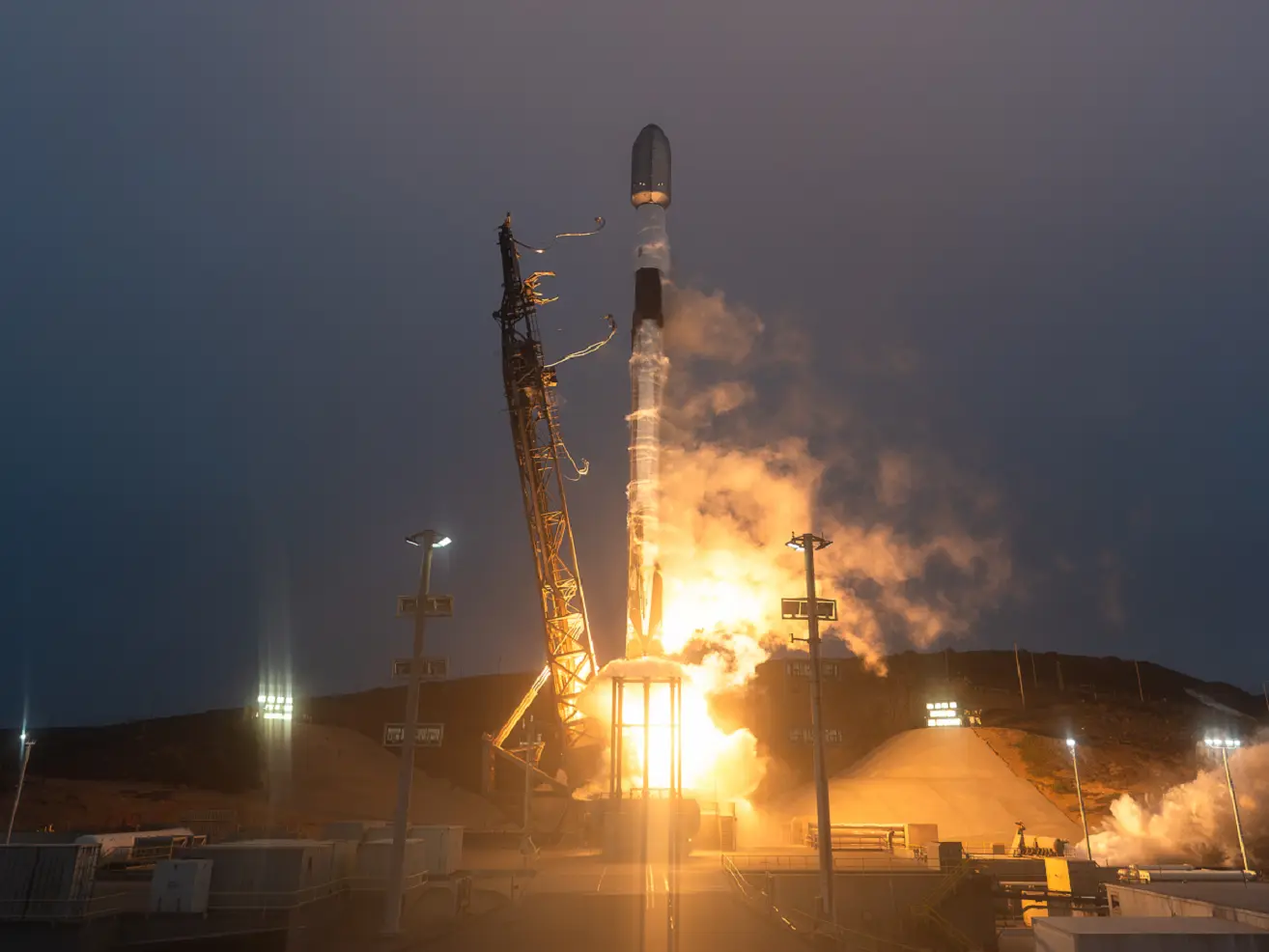
File images of Falcon-9 rocket launch Photograph: (Courtesy: SpaceX)
Earth-imaging satellites capture vast amounts of data when passing over their areas of interest. However, that massive quantity of data has to be sent back to Earth and then it has to be filtered and analyzed to derive meaningful insights, a time consuming process.
As Indian spacefaring rocketry is going through its most concerning and complicated slowdown in recent years (three launches in 2026: two government launches and one private launch), payloads from four Indian startups will by flying to space on Elon Musk's SpaceX Falcon-9 rocket. The four payloads from the Indian startups (TakeMe2Space, EON Space Labs, SatLeo Labs, DhruvaSpace), will be among 130 that are scheduled to reach Low Earth orbit (about 500kms above Earth) in the wee hours Indian time, Friday, (2nd October). The mission titled 'Transporter 18' is reportedly the 110th flight of the Falcon 9 rocket in this year. For context, India's highest number of launches (space launches and tests) were witnessed in the years 2018 and 2023, when government-run ISRO executed eight and seven launches, respectively.
The three rockets that launched from Indian soil this year are: ISRO PSLV-C62 that launched in January; private firm Skyroot Aerospace Vikram-1 that launched in July; ISRO GSLV-F17 that launched in September. The PSLV-C62 mission was a mid-flight failure, which led to the loss of all 15 satellites from India and abroad. This failure was also similar to the PSLV-C61 failure that took place in May 2025. The repeat failure of ISRO's workhorse PSLV rockets and the related probe are some among the many reasons that have slowed down the launch pace.
Indian payloads riding on SpaceX Transporter-18 mission
MIRA Earth-imager by EON Space Labs
EON Space Labs which has been developing electro-optical imaging systems for Earth-observation and surveillance is flying its miniaturised space telescope 'MIRA' to space. It is integrated with Indian startup TakeMe2Space’s MOI-1A satellite that will capture and process images in space. Weighing merely 502 grams, 'MIRA' enables imaging that supports diverse applications such as agriculture, marine, mining, supply-chain management and insurance.
Punit Badeka, Co-founder, EON Space Labs told this author that the firm is building the entire optics in-house, with the goal of reducing import dependence on optical imaging technologies. He added that they are leveraging their patented technology to build ultra-long-range electro-optical imaging systems for the Indian Army and Indian Navy.
Trending Stories
)
)
)
)
)
)
)
)
)
)
)
)
)
)
)
)
)
)
)
)
)
)
)
)
)
)
)
)
)
)
)
)
)
)
&im=FitAndFill=(700,400))
)
)
)
)
MIRA flew on the ISRO PSLV-C62 mission which failed in January 2026. Punit recalled that it took over three years to develop the technology, while it took six months to build 'MIRA' for the first time. If we import an imaging system, it takes at least six months to get it. Queried about how they bounced back from the failure and re-built the hardware, he said that it now takes about four or six weeks to build the imaging hardware at their facility and that they are able to do it at scale. Given the very nature of space tech, we had contingency plans in place.
'MOI-1A' in-orbit data processing satellite by TakeMe2Space
Earth-imaging satellites capture vast amounts of data when passing over their areas of interest. However, that massive quantity of data has to be sent back to Earth and then it has to be filtered and analyzed to derive meaningful insights, a time consuming process. While this may seem practical for some purposes, it does not support the needs of defence and certain time-bound commercial applications. "What if the data captured and stored in the satellite, can be processed by an AI model running on the satellite? Then, we can access only the relevant information and send that specific, small quantity data to the user on Earth. This significantly saves time and also reduces the amount of data that needs to be sent down," Ronak Kumar Samantray, Founder and CEO, TakeMe2Space explained to this author.
According to the firm, their 14-kg satellite carries 117 trillion operations per second (TOPS) of onboard computing capacity, 2 TB of storage and a nine-band multispectral imager supplied by EON Space Labs. These capabilities are designed support applications such as agricultural monitoring, mining and supply-chain intelligence.
The company said it has signed up 23 customers for its in-orbit inference services. The upcoming mission marks a step towards commercial delivery of these services and the company’s longer-term development of orbital computing infrastructure.
'TAPAS-1' by SatLeo Labs: Thermal Infrared imaging from space
'TAPAS-1' (Thermal Access Platform for Analytics & Solutions), developed by SatLeo Labs, is a commercial CubeSat-category thermal payload. It uses Thermal Infrared (TIR) sensing, to capture temperature information invisible to conventional optical imagery, enabling in-orbit demonstration and validation of SatLeo's technology.
According to the firm, this mission lays the foundation for their next-generation thermal intelligence platforms, with applications spanning climate monitoring, agriculture, urban heat mapping, disaster management, and infrastructure monitoring, and represents a key step toward PYRO, SatLeo's flagship thermal constellation.
"Our payload weighs about 1.5kg and it is flying on Indian firm DhruvaSpace Leap 2 satellite platform. Thermal data of Earth's surface that we capture from space can be used for monitoring agriculture, forest fires, urban landscapes, heat index, and even defence applications. It can also be used to identify some issues in the power transmission infrastructure," explained Ranendu Ghosh, a former ISRO Scientist, who is the co-founder and CTO of Satleo Labs.
LEAP-2 by Dhruva Space
According to the firm, 'Launching Expeditions for Aspiring Payloads - 2' (LEAP-2) is Dhruva Space’s second commercial endeavour on the P-30 satellite platform, hosting multiple In-Orbit Demonstration (IOD) missions for global customers: a star tracker by France-based Sodern ArianeGroup; and TAPAS-1 by India-based Satleo Labs.
Dhruva Space has also undertaken the end-to-end launch integration of the LEAP-2 satellite with SpaceX’s Falcon 9 launch vehicle, building on its experience with LEAP-1, where Dhruva Space became the first private Indian company to undertake the launch vehicle integration of its satellite in-house, it was added.
LEAP-2 will also be supported by Dhruva Space’s growing global ground infrastructure, including its owned and operated ground station in Luleå, Sweden; the first NGE-owned and operated ground station outside India, authorised by the Government of India to provide Ground-Station-as-a-Service, the firm said.
Why Indian startups chose to fly on a SpaceX rocket?
Queried about their Satleo Labs' choice of a foreign launch vehicle, Ranendu pointed out that they did not find any option in India in accordance with their requirements. However, he added that they were in talks with ISRO's commercial arm NSIL for launching their TAPAS-2 satellite. "The choice of rocket should be available (in India) and it should be cost-effective," he added.
Samantaray from TakeMe2Space highlighted that they chose SpaceX Falcon 9 based on the availability of the rocket and also the urgency to reach space, demonstrate their technology and immediately deliver the services for their customers, especially after the failed launch on PSLV-C62 in January this year. Asked about whether he had insured his satellite for the SpaceX flight, Samantaray revealed that he had not insured the satellite that flew on PSLV-C62. However, he had learnt his lesson and accordingly taken pre-launch, launch and third-party insurance for this satellite flying on SpaceX. On whether SpaceX offered a cheaper ride to space than ISRO,
Samantaray mentioned that the SpaceX flight cost three times as much as the ISRO flight. However, he explained that slots on SpaceX rockets are among the cheapest when booking three years in advance, while booking months before a launch can prove very expensive.
For EON Space Labs, the decision to fly SpaceX was based on urgency to reach space and prove their technology. Punit admitted that they did not find a launch from India within their desired timeframe. Further, he added that they were planning a few future launches on ISRO rockets.
India's space launches: The gap between rhetoric and reality
In February 2024, for the first time ever, Indian Government agency IN-SPACE (established by the Modi Government to support Indian space startups) had publicly released an "Integrated Launch Manifesto 2024-25". In the document, IN-SPACE mentioned that ISRO (Indian Space agency), ISRO's commercial arm NewSpace India Limited (NSIL), and startups would perform up to 30 rocket launch missions in the 15-month period between January 2024 and March 2025.
Rhetoric aside, India executed only 7 of these 30 rocket launch missions in the said period. This amounts to meeting 23% of the target stated in the Government agency IN-SPACE's launch manifesto. Of the seven launch missions in the 15-month period, ISRO executed five, NSIL executed one mission for a foreign customer, and a private firm carried out a test launch. Space industry insiders told this author that Government agency IN-SPACE had decided to stop releasing launch manifestos after the debacle with their first.
Let alone 30 launches in 15 months, there have only been 14 launches from Indian soil (12 ISRO and 2 private) in the 33 months between January 2024 and September 2026!
For example, SpaceX which does the most number of space launches globally, had targeted 148 launches of their Falcon series of rockets in the year 2024, of which they accomplished 134 launches. SpaceX met 90% of its annual target, and has been drastically increasing its launch targets with every passing year. Every year, SpaceX gets within touching distance of its publicly stated target.
Likewise, Rocket Lab, an American private firm that launches small spacefaring rockets had projected 22 launches in 2024, and ended up accomplishing 16 launches. Rocket Lab met 72% of its annual target. Though a small firm when compared to giants like SpaceX, Rocket Lab has been consistently increasing its number of launches with every passing year.
Apart from the Government-run ISRO, only the private firm Skyroot Aerospace has launched to space from India. In July this year, private firm Skyroot Aerospace achieved what very few agencies or private firms have done: achieve orbit on their first launch. Skyroot's Vikram-1 is India's first privately designed and developed rocket, and its first flight was meant to test and validate all its systems and sub-systems. Skyroot's Founder and CEO Pawan told this author that the firm is targeting its second launch by the end of the year. While there are several other Indian startups racing to build their spacefaring rockets, they haven't reached orbit yet.
Even the efforts by the L&T-HAL consortium to build and launch their first "industry-built" ISRO PSLV rocket (in a mission dubbed PSLV-N1) is a work in progress. The launch that was initially planned around mid-2024 has seen multiple postponements, with no clear new launch date in sight. With more ISRO rockets such as SSLV and LVM3 being sold to Indian industry by IN-SPACE, and unrest brewing within ISRO ranks regarding the overreach of IN-SPACE, questions remain about regular rocket launches from home soil.