Two Chinese robots ran 100 metres faster than Usain Bolt! Then they lost to a bowl of beans

&imwidth=600&imheight=450&format=webp&quality=medium "Two Chinese robots ran 100 metres faster than Usain Bolt! Then they lost to a bowl of beans")
Two Chinese robots ran 100 metres faster than Usain Bolt! Then they lost to a bowl of beans
At the World Humanoid Robot Games in Beijing, a headless machine called Tiangong Ultra ran 100 metres in 9.39 seconds according to state broadcaster CCTV, against Usain Bolt's 9.58-second record. Two robots from Honor's Lightning platform also finished under it. The same competition showed the machines failing at tasks requiring fine manipulation — the oldest and least solved problem in robotics.
A headless white machine called Tiangong Ultra ran 100 metres in 9.39 seconds this week. Usain Bolt's world record, set in 2009, is 9.58.
Two robots from Honor's Lightning platform also finished under Bolt's mark. The following day, Tiangong Ultra ran 400 metres in 38.15 seconds — nearly five seconds inside the human record.
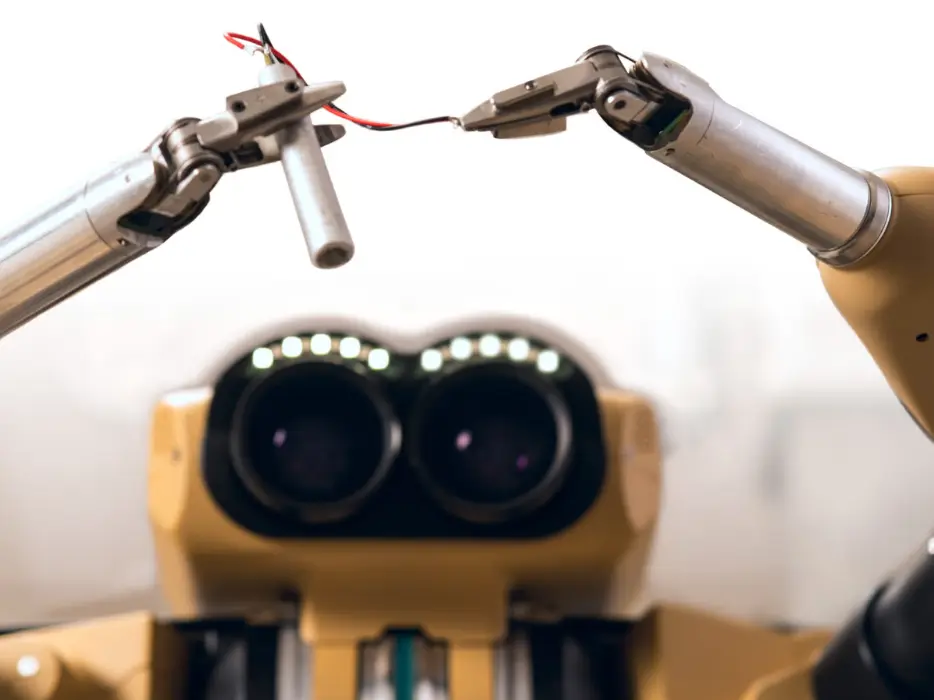
In other events at the same games, robots struggled to pick up beans.
Both halves of that are the story.
What Happened
The second World Humanoid Robot Games ran from August 22 to 26 at Beijing's National Speed Skating Oval, the venue built for the 2022 Winter Olympics and known as the Ice Ribbon. More than 2,000 humanoid robots competed.
Trending Stories
&imwidth=280&imheight=210&format=webp&quality=medium)
&imwidth=280&imheight=210&format=webp&quality=medium)
&imwidth=280&imheight=210&format=webp&quality=medium)
&im=FitAndFill=(700,400)&imwidth=280&imheight=210&format=webp&quality=medium)
&imwidth=280&imheight=210&format=webp&quality=medium)
&imwidth=280&imheight=210&format=webp&quality=medium)
&imwidth=280&imheight=210&format=webp&quality=medium)
&imwidth=280&imheight=210&format=webp&quality=medium)
&imwidth=280&imheight=210&format=webp&quality=medium)
&imwidth=280&imheight=210&format=webp&quality=medium)
&imwidth=280&imheight=210&format=webp&quality=medium)
&imwidth=280&imheight=210&format=webp&quality=medium)
&imwidth=280&imheight=210&format=webp&quality=medium)
&imwidth=280&imheight=210&format=webp&quality=medium)
&imwidth=280&imheight=210&format=webp&quality=medium)
&imwidth=280&imheight=210&format=webp&quality=medium)
&imwidth=280&imheight=210&format=webp&quality=medium)
&imwidth=280&imheight=210&format=webp&quality=medium)
&imwidth=280&imheight=210&format=webp&quality=medium)
&imwidth=280&imheight=210&format=webp&quality=medium)
&imwidth=280&imheight=210&format=webp&quality=medium)
&imwidth=280&imheight=210&format=webp&quality=medium)
&imwidth=280&imheight=210&format=webp&quality=medium)
&imwidth=280&imheight=210&format=webp&quality=medium)
&imwidth=280&imheight=210&format=webp&quality=medium)
&imwidth=280&imheight=210&format=webp&quality=medium)
&imwidth=280&imheight=210&format=webp&quality=medium)
&imwidth=280&imheight=210&format=webp&quality=medium)
&imwidth=280&imheight=210&format=webp&quality=medium)
&imwidth=280&imheight=210&format=webp&quality=medium)
&im=FitAndFill=(700,400)&imwidth=280&imheight=210&format=webp&quality=medium)
&imwidth=280&imheight=210&format=webp&quality=medium)
&imwidth=280&imheight=210&format=webp&quality=medium)
&imwidth=280&imheight=210&format=webp&quality=medium)
&im=FitAndFill=(700,400)&imwidth=280&imheight=210&format=webp&quality=medium)
&imwidth=280&imheight=210&format=webp&quality=medium)
&imwidth=280&imheight=210&format=webp&quality=medium)
Tiangong Ultra, developed by the Beijing Humanoid Robot Innovation Centre, won its heat with the 9.39-second run. The time was reported by CCTV, the state broadcaster.
One detail from the sprint is more significant than the time. A robot arrived at its own running posture — arms held near the face, hips driving forward — through reinforcement learning. No engineer designed that gait. The machine found it by trying.
The Comparison Is Not What It Looks Like
Before the record framing runs away with itself, it is worth being precise about what was and was not achieved.
A humanoid robot sprinting on a track is not doing what a sprinter does. It is not constrained by reaction time at the blocks in the way a human is, it is not limited by biological muscle recovery or oxygen, and the competition conditions, timing methodology and permitted assistance are not those of a World Athletics event. The comparison is a headline device, and the organisers know it.
The times also come via a state broadcaster covering a domestic showcase, which is not a reason to disbelieve them but is a reason to note the source rather than treat the figure as independently ratified.
What is genuinely notable is narrower and more interesting: bipedal locomotion at speed, on a machine that taught itself the gait, is a hard control problem that was not solved at this level three years ago.
Moravec's Paradox, Live
The bean-handling failures are not comic relief. They are the central finding.
Robotics has a decades-old observation named after Hans Moravec: the things humans find hard, machines find easy, and the things humans find effortless, machines find nearly impossible. Chess fell to computers before laundry. Sprinting is a dynamics problem with a clear objective function and a simulator that can run it a billion times. Picking up a bean is a problem of contact, friction, deformation and touch, where the feedback is subtle and the failure modes are endless.
This is why humanoid robots have been demonstrating impressive gymnastics for years while doing almost no useful work. The gap is not power or speed. It is hands.
A robot that outruns Bolt and cannot reliably grip a small object is not close to replacing a warehouse worker, and the sprint record does not indicate otherwise. It indicates that one narrow class of problem has been solved well.
The Money Says Something Different
The industry is being funded as though the manipulation problem is nearly solved.
XPeng's robotics business has raised more than $900 million in its first external round, at a valuation above $6.3 billion. IDG Capital and Gaorong Ventures led it, with Tencent and Alibaba participating strategically. The company is targeting production of its IRON humanoid before the end of 2026.
That is a serious amount of capital for a product category with no established commercial application, from investors who are not naive about Chinese manufacturing.
The bet is that manipulation follows locomotion — that the same reinforcement learning methods which produced a self-taught sprint will, given enough simulation and enough data, produce reliable hands. That is a plausible bet. It is not yet an evidenced one, and the beans are the evidence for the other side.
Why China Is Where This Is Happening
The concentration is not accidental.
China dominates humanoid robot production, and the United States banned imports of new Chinese humanoids in July, closing that market to the manufacturers that shipped most of the world's units. The result is a protected domestic market on one side and a large excluded producer base on the other, both racing.
A games event with 2,000 machines in an Olympic venue is industrial policy conducted as spectacle. It generates the data, the engineering competition and the public narrative simultaneously, and it does so in a country that can also build the things at volume.
What To Watch Instead Of The Sprint Times
The meaningful benchmark for humanoid robotics is not speed. It is whether a machine can perform an unstructured manipulation task, in an environment it has not seen, at a reliability rate high enough to be worth paying for.
Nobody has demonstrated that. The sprint records show the field has become very good at the part that was always going to be easier.
Tiangong Ultra ran faster than the fastest human who has ever lived. It is still, in the way that matters commercially, less useful than a person who can pick things up.
