Who was Stephen Hawking? All about his life, books and greatest discoveries that reshaped modern Physics

&imwidth=600&imheight=450&format=webp&quality=medium "Who was Stephen Hawking? All about his life, books and greatest discoveries that reshaped modern Physics")
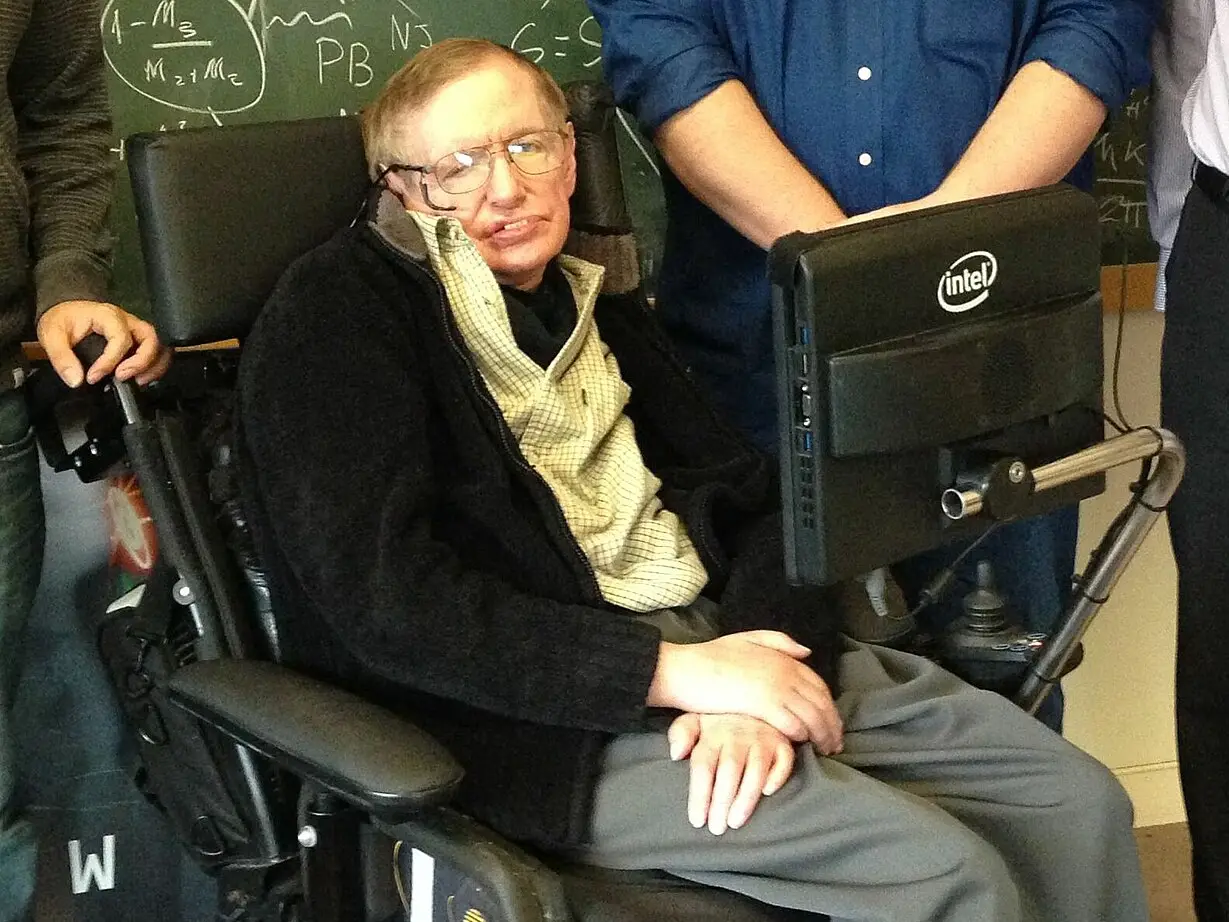
File photo of Stephen Hawking. Photograph: (Wikimedia Commons)
Hawking extensively studied the nature of space-time, including wormholes and their physical feasibility. Recognising their implications for time travel, he proposed the chronology protection conjecture, arguing that the laws of physics prevent travel into the past.
Stephen Hawking was a British theoretical physicist, cosmologist and author whose study and work on black holes and the universe made him one of the most recognisable figures in the field of science. He was born in Oxford to a medical family in 1942, where he studied physics at University College, Oxford (graduating in 1962), then pursued cosmology at Trinity Hall, Cambridge.
At the age of 21, Hawking was diagnosed with amyotrophic lateral sclerosis (ALS). As a result, he said that he will remain alive only for two years; however, Hawking defied the prognosis and stayed alive until 76, while gradually losing physical control. To stay alive, he used a speech synthesiser after losing his speech, voicing iconic lines like “women” in 2014.
What were Hawking's greatest contributions to Science?
Singularities
As per the report in the Space, Stephen Hawking made groundbreaking contributions to understanding gravity under extreme conditions, beginning with his work on singularities. Building on Roger Penrose’s proofs, Hawking demonstrated that singularities are not limited to black holes but also exist at the birth of the universe, showing that the Big Bang began from a point of infinite density.
Black hole physics
Trending Stories
&imwidth=280&imheight=210&format=webp&quality=medium)
&imwidth=280&imheight=210&format=webp&quality=medium)
&imwidth=280&imheight=210&format=webp&quality=medium)
&imwidth=280&imheight=210&format=webp&quality=medium)
&imwidth=280&imheight=210&format=webp&quality=medium)
&imwidth=280&imheight=210&format=webp&quality=medium)
&imwidth=280&imheight=210&format=webp&quality=medium)
&imwidth=280&imheight=210&format=webp&quality=medium)
&imwidth=280&imheight=210&format=webp&quality=medium)
&imwidth=280&imheight=210&format=webp&quality=medium)
&imwidth=280&imheight=210&format=webp&quality=medium)
&imwidth=280&imheight=210&format=webp&quality=medium)
&imwidth=280&imheight=210&format=webp&quality=medium)
&imwidth=280&imheight=210&format=webp&quality=medium)
&imwidth=280&imheight=210&format=webp&quality=medium)
&imwidth=280&imheight=210&format=webp&quality=medium)
&imwidth=280&imheight=210&format=webp&quality=medium)
&imwidth=280&imheight=210&format=webp&quality=medium)
&imwidth=280&imheight=210&format=webp&quality=medium)
&imwidth=280&imheight=210&format=webp&quality=medium)
&imwidth=280&imheight=210&format=webp&quality=medium)
&im=FitAndFill=(700,400)&imwidth=280&imheight=210&format=webp&quality=medium)
&imwidth=280&imheight=210&format=webp&quality=medium)
&imwidth=280&imheight=210&format=webp&quality=medium)
&imwidth=280&imheight=210&format=webp&quality=medium)
&imwidth=280&imheight=210&format=webp&quality=medium)
&imwidth=280&imheight=210&format=webp&quality=medium)
&imwidth=280&imheight=210&format=webp&quality=medium)
&imwidth=280&imheight=210&format=webp&quality=medium)
&imwidth=280&imheight=210&format=webp&quality=medium)
&im=FitAndFill=(700,400)&imwidth=280&imheight=210&format=webp&quality=medium)
&imwidth=280&imheight=210&format=webp&quality=medium)
&imwidth=280&imheight=210&format=webp&quality=medium)
&imwidth=280&imheight=210&format=webp&quality=medium)
&imwidth=280&imheight=210&format=webp&quality=medium)
He then revolutionised black hole physics by discovering that black holes are not completely black. By combining general relativity with quantum mechanics, Hawking showed that black holes emit radiation, now known as Hawking radiation, causing them to slowly lose mass and eventually evaporate. This insight led him to develop the laws of black hole thermodynamics, revealing a deep connection between gravity, energy, heat and entropy.
Cosmology
In cosmology, Hawking played a crucial role in developing the theory of cosmic inflation. While Alan Guth first proposed rapid expansion in the early universe, Hawking helped turn inflation into a rigorous and testable framework. He also explored the earliest moments of the Big Bang, questioning whether the universe truly had a beginning and how quantum mechanics shapes its origin.
Time travel
Hawking extensively studied the nature of space-time, including wormholes and their physical feasibility. Recognising their implications for time travel, he proposed the chronology protection conjecture, arguing that the laws of physics prevent travel into the past. Although not focused on creating a single “theory of everything,” Hawking’s work on quantum gravity profoundly influenced the field. His ideas, especially on black holes and inflation, continue to guide efforts to unify quantum mechanics and gravity.
He also collaborated on string theory, M‑theory and quantum gravity, consulted on films (Star Trek, The Simpsons) and advocated for space exploration, artificial intelligence risks and climate action. Awarded CBE (1982), Companion of Honour (1989), and Presidential Medal of Freedom (2009), he died at 76 in Cambridge.
Hawking's Books
Hawking also popularised science through books: A Brief History of Time (1988) sold over 25 million copies, explaining cosmology accessibly; The Universe in a Nutshell (2001), A Briefer History of Time (2005), The Grand Design (2010) with Leonard Mlodinow, and Black Holes and Baby Universes (1993).

