Africans knew how to build 20-storey skyscrapers 2,800 years ago

&imwidth=600&imheight=450&format=webp&quality=medium "Africans knew how to build 20-storey skyscrapers 2,800 years ago")
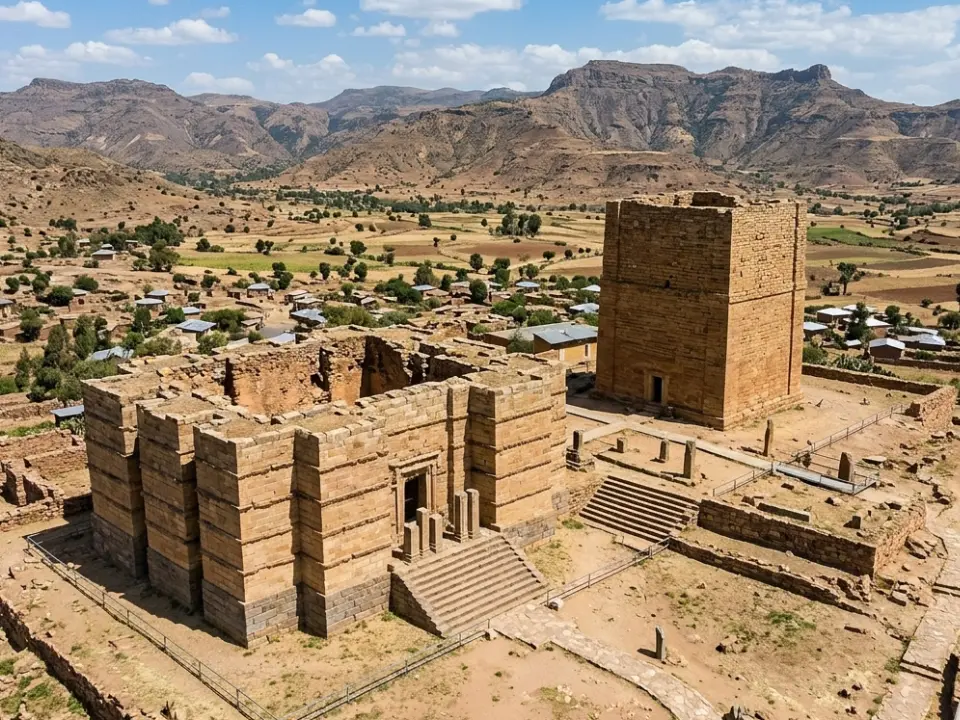
AI image depicting what the Palace of Yeha and the surrounding places would have looked like. Photograph: (AI-Generated image)
Ethiopia's skyline could have once featured tall buildings with as many as 19 storeys. Experts say this was possible even though reinforced concrete or structural steel beams were not even a concept at the time. These skyscrapers could have stood tall, bearing all the weight.
German archaeologists have suggested that Ethiopia was once home to skyscrapers, with buildings up to 20 stories once part of the skyline of East Africa. While they have known about this for a while, a new study has shown that they built these buildings even when they had no technology for reinforced concrete or structural steel beams. The study was published in the journal Heritage.
Experts reanalysed the architecture of Grat Be'al Gibri, or Grat Be’al Geubri, located in the Tigray Region of northern Ethiopia. It was an ancient palace built around 800 BCE, which is in ruins today. It sat at the centre of the city of Yeha, and experts believe it was a huge, multi-storey building unlike anything one would expect in this era.
The ancient palace Grat Be’al Gibri is believed to have spread over an area of approximately 196 by 196 feet, the largest palace in the area at the time. The pillar at the entryway was supposedly 33 feet tall. When considered in conjunction with the remains of the stairs, the building would have spanned three stories.
Tall towers in East Africa
Tall buildings were supposedly common in this period. Ancient texts and images hint at the presence of buildings with 20 storeys. Rock art discovered in South Arabia shows that the region had massive complexes with at least nine storeys. The most intriguing part is that they achieved this feat even when they didn't have the technology around reinforced concrete or structural steel beams.
The new study has shown that the designers combined stone and timber in a distinct pattern, similar to reinforcing ribs. They laid wooden beams flat within the rubble masonry, using the "timber-laced masonry" technique that was found across parts of southern Arabia and northeastern Africa during this time. It has also made a return to modern architecture, as builders use hybrid timber construction to construct high-rise buildings.
Trending Stories
)
)
)
)
)
)
)
)
)
)
)
)
)
)
)
)
)
)
)
)
)
)
)
)
)
)
)
)
)
)
)
)
)
)
&im=FitAndFill=(700,400))
)
)
)
)
Simulations showed 19-story buildings were possible
The team combined all this data- a wall corner and a doorway and fed it into a 3D model to know the load-bearing capacity. They created several virtual reconstructions until they reached the maximum number of stories at which the tower would no longer remain standing. They ran several simulations and found one scenario where 19-story buildings could actually exist. While the findings match written records, it is not clear whether the designers actually pushed to the maximum limit.

