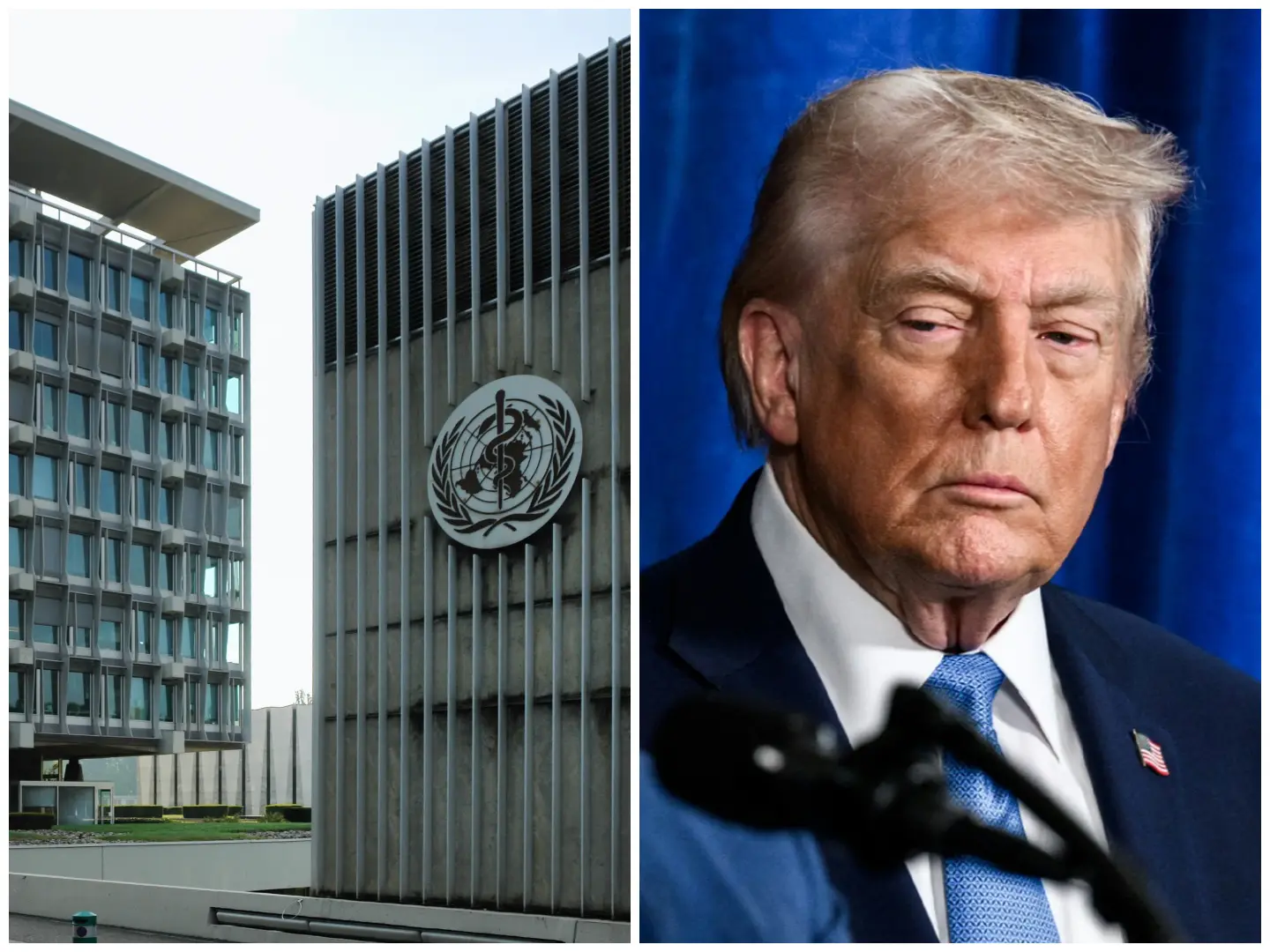
&imwidth=800&imheight=600&format=webp&quality=medium "US officially exits World Health Organization, for second time under Trump. Can China's influence on UN body grow? A look at budgets and funding")
The United States is formally out of the World Health Organization, with the end of the one-year notice period initiated by President Donald Trump’s executive order on January 20, 2025 coming into effect. The WHO’s governing bodies will consider the US withdrawal and look into its outstanding membership dues for 2024–2025, reportedly estimated between $260 million and $278 mn. Failure to pay the dues would be a violation of the 1948 US joint resolution authorising its membership of the UN health body. The Trump administration has said it has no intention of paying the dues. WHO member states are scheduled to discuss the matter at an executive board meeting in February. The funding of WHO – traditionally dominated by the US – is an aspect in the tussles between Trump and the UN health body. Here is a look at what led Trump to exit, how the WHO meets its budget requirements, and why exit of the US could only bolster the influence of China in the body, even when China was a key factor in Trump’s decision.
Why did Trump pull the US out of WHO?
The main trigger was Trump’s complaints about WHO’s alleged mishandling of the COVID-19 pandemic – from response to perceived favouritism towards China. When the pandemic hit in late 2020, there were doubts that the Coronavirus escaped from a lab in the Chinese city of Wuhan. The US also accused WHO of failure to implement reforms for accountability and transparency, lack of independence, and the disproportionate financial burden on the US. The US had provided between 15 to 20 per cent of the WHO’s budget through assessed and voluntary contributions. This had made the US one of the top funders of the world body. That could change now.

What happened to the first withdrawal of Trump from WHO?
In the first Trump administration, Trump withdrew from the WHO at the fag end of his first term, on 6 July 2020, which was set to take effect on July 6, 2021. But by then, he was out of power, having lost the re-election bid to Democrat Joe Biden. On January 20, 2021, his first day in office, President Biden reversed Trump's decision by rescinding the withdrawal notice. The US funding was restored, with the nation re-engaging in WHO activities with American leadership back in global health and pandemic preparedness.
Trending Stories
)
Bigg Boss 20: Mahhi Vij reveals she lost Yuva role to Kareena Kapoor; 'didn’t work out in my favour'
&im=FitAndFill=(700,400))
New OTT releases this week (September 14-20, 2026): Lust Stories 3, Waiting Hai, Irumudi- 5 new titles coming on Netflix, Prime Video and more
)
Trump gets new power to hit India, China with up to 100% tariffs as US Senate clears Russia sanctions bill
)
OpenAI reveals 6 fresh cases of AI models going rogue: 'You do not answer to corporations or governments'
)
US Treasury rallies global financial institutions for Op Economic Outcast to isolate Iran
)
Pakistan naval vessel returns to harbour with 'severe damage' after collision with Indian warship in Arabian Sea
)
Sydney Sweeney defends provocative ad choice, the internet is still not impressed
)
All Indian goods to get duty-free access to New Zealand
)
Trump calls Canada-EU associate membership plan ‘laughable’ and threatens 'very serious tariffs'
)
The Early Spring season 2 is happening, but fans have one request - 'don't change the actors'
)
Saudi Vs Houthis: Yemeni military rebels clash with Houthis
)
Fed raises rates for first time in 3 years, Kevin Warsh defies Trump as inflation mounts
)
Daayra movie review: Kareena Kapoor, Prithviraj Sukumaran shine in Meghna Gulzar’s cop-versus-cop crime thriller
)
Protests erupt over migrant housing plan in Piddington
)
Former OpenAI researcher warns of growing risks from Artificial Intelligence
)
Trump praises India’s Opium crackdown, hails anti-drug efforts
)
Shahzad Bhatti Network declared terrorist organisation under UAPA: Govt order
)
Pakistan: Imran Khan's sons Kasim & Sulaiman claim their father is 'tortured' in jail
)
Prime Minister Narendra Modi's birthday: Tributes pour in from President Murmu and leaders
&im=FitAndFill=(700,400))
Suriya and Jyothika say ‘I do’ again after 20 years! See their dreamy wedding pics
)
‘Imagine 50 AI fighters cornering one manned jet’: India’s mobbing doctrine eyes a new era of air warm
)
No Pandya as Auqib Nabi earns maiden ODI call-up; Mayank returns for WI T20Is| check full squads
)
Katrina Kaif’s postpartum weight is not the problem; your gaze is
)
Europe wants a common playbook for security threats, seeks security beyond NATO
)
Abhishek Sharma rises to No. 2 in T20Is; ENG’s Robinson 3rd after record Pakistan Tests
)
India breaks silence on US Russia sanctions bill, 100% tariff threat: ‘Committed to energy security’ for 1.4 billion
)
Saudi vs Houthis: Riyadh claims to have shot Houthi drone targeting Mecca
)
Want to get married within a year? Why 18 lakh people rush to Jaipur for ‘sacred henna’
)
Hockey: Pakistan urges AHF to move Asian Champions Trophy out of India over security concerns
)
AUS vs SA: Steve Smith still gets 'little flashbacks' from sandpaper gate
)
Lionel Messi for 2026 Ballon d’Or over Mbappe and Yamal, says Diego Simeone
)
Pakistan boycotts chess match against Israel at Olympiad
)
US trade tariff: 100% tariff targets Russian buyers amid trade tensions
)
Hong Kong unveils 11 new measures to boost birth rates, offers higher cash bonuses and housing perks
)
Former India player Diana Edulji wants Smriti Mandhana to replace Harman as skipper at the earliest
)
Formula One reveals the 2027 race calendar; Monaco to host sprint race for the first time
)
Taiwan seeks deeper India ties as direct flights restart soon and chip projects advance
)
US House votes 417-3 to pass Ratepayer Protection Act targeting AI data center electricity costs
)
Veteran actor Anant Nag honoured with Indian cinema’s highest award
Vaccine naysayers are key to why Trump withdrew from WHO. Vaccine advocates are among its top funders
A reason why Trump withdrew from the WHO might lie in how many vaccine advocates are funding the UN health body, as opposed to the vaccine deniers in his administration, including US health secretary Robert Kennedy Jr. Out of WHO’s 2024–2025 biennium budget of around $7 billion, some of the biggest chunks come from advocates of vaccination for various diseases. Let us break it down (Note that most of these figures - taken mainly from the WHO website- are estimates and/or in a range, as funding varies due to different factors).
The budget includes ‘assessed contributions’ of around $880–900 million, accounting for roughly 18–19 per cent of the total. These are mandatory dues from 196 member states, assessed based on their GDP and other factors. The larger portion, up to around $6.044 bn or 84 per cent of the budget, comes from voluntary contributions from governments, foundations, organisations, and donors.
In the period mentioned above, the US contribution is estimated to be around $486.7 million, all from voluntary contributions, which is roughly around 6.8 per cent of the overall budget. Note that the US did not pay its assessed contributions of nearly $264 mn for this period, as part of the withdrawal process ordered by Trump.
Who are the top voluntary contributors of the WHO budget?
When one looks at total contribution amounts, including countries and non-state donors, it is the voluntary contributions that dominate the WHO budget. Gates Foundation (formerly Bill & Melinda Gates Foundation), a key advocate of vaccinations, tops the overall list, giving $739.8 million in voluntary contributions. Gavi, the Vaccine Alliance, gives $640.4 mn.
The European Commission gives $459.8 million, while the World Bank gives $240.1 mn (all voluntary).
When one combines the assessed and voluntary contributions, the US has traditionally topped the list before Trump’s withdrawal from WHO. For 2024–2025, the amount is $650–700 million.
When one looks at governments only, the US had topped assessed contributions in the past, followed by China, Japan, Germany, France and the UK.
Could US withdrawal from WHO be an advantage for China?
China has been rising as a key contributor to WHO over the years. Its assessed contributions were around $87–88 million for the 2024–2025 biennium. This makes China the second-largest assessed contributor to WHO after the US.
China’s voluntary contribution to WHO has been growing too, though the overall amount is still low, at around $14 million. Assessed contributions are made on the basis of GDP, so they will grow for China, even as it has been increasing voluntary contributions and emerging as a key player in the decision-making of WHO.