Who is the new living goddess of Nepal? Two-year-old Aryatara Shakya chosen during 'Dashain' festival

&imwidth=600&imheight=450&format=webp&quality=medium "Who is the new living goddess of Nepal? Two-year-old Aryatara Shakya chosen during 'Dashain' festival")
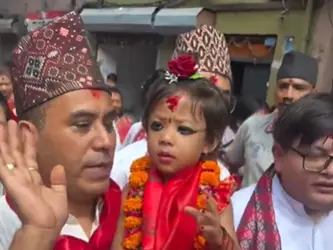
Aryatara Shakya, the new living goddess of Nepal. Photograph: (X/@Nepali_Comrade)
Before entering the temple palace, family, friends, and devotees paraded the new Kumari through the streets of Kathmandu, Nepal. Now, the temple will be the new home for Kumari for several years.
A two-year-old girl has been chosen as the new living goddess of Nepal. She was carried by her family members from their home in a Kathmandu alley to a temple palace on Tuesday, coinciding with the longest and most significant Hindu festival of Nepal. The occasion fell on the eighth day of the 'Dashan' festival, the 15-day festival symbolising the triumph of good over evil.
Over this day, offices and schools were shut as people celebrated with their families. Before entering the temple palace, family, friends, and devotees paraded the new Kumari through the streets of Kathmandu. Now, the temple will be a new home for Kumari for several years, according to a report in Associated Press.
Devotees queued to bow at her feet—a revered Hindu gesture, while presenting flowers and money. On Thursday, the living goddess is set to bless devotees, including Nepal’s president. “She was just my daughter yesterday, but today she is a goddess,” said her father, Ananta Shakya.
He also said that there were already signs she would be the goddess prior to her birth. “My wife during pregnancy dreamed that she was a goddess and we knew she was going to be someone very special,” he added.
Who is the 2-year-old girl new living goddess of Nepal?
A 2-year-and-8-month-old girl named Aryatara Shakya, has been selected as the new Kumari or “virgin goddess." She replaces Trishna Shakya, who has been Kumari since 2017 and stepped down upon reaching puberty.
Trending Stories
)
)
)
)
)
)
)
)
)
)
)
)
)
)
)
)
)
)
)
)
)
)
)
)
)
)
)
)
)
)
)
)
)
)
&im=FitAndFill=(700,400))
)
)
)
)
Any new Kumaris in Nepal are chosen from the Shakya clans of the Newar community, which is indigenous to the Kathmandu valley. It is revered by both Hindus and Buddhists in the predominantly Hindu nation.
The girls are usually picked between the ages of 2 and 4 and are required to have unblemished skin, hair, eyes and teeth. They must possess the ability not to be afraid of the dark.
Meanwhile, at the Indra Jatra festival earlier this month, the outgoing Kumari was paraded on a chariot drawn by devotees. Traditionally, the Kumari dresses in red, wears her hair in topknots, and has a painted “third eye” on her forehead.
Indra Jatra, which spans a week, marks the start of a festive season in Nepal, followed by Dashain, the country’s biggest celebration, and Tihar, or Diwali, the festival of lights in October.

