WATCH | Scientists capture rare footage showing sperm whales assisting mother during birth

&imwidth=600&imheight=450&format=webp&quality=medium "WATCH | Scientists capture rare footage showing sperm whales assisting mother during birth")
Screenshot from the video Photograph: (Project: CETI)
Scientists observed sperm whales working together to help a mother give birth, revealing rare evidence of social cooperation in marine animal childbirth
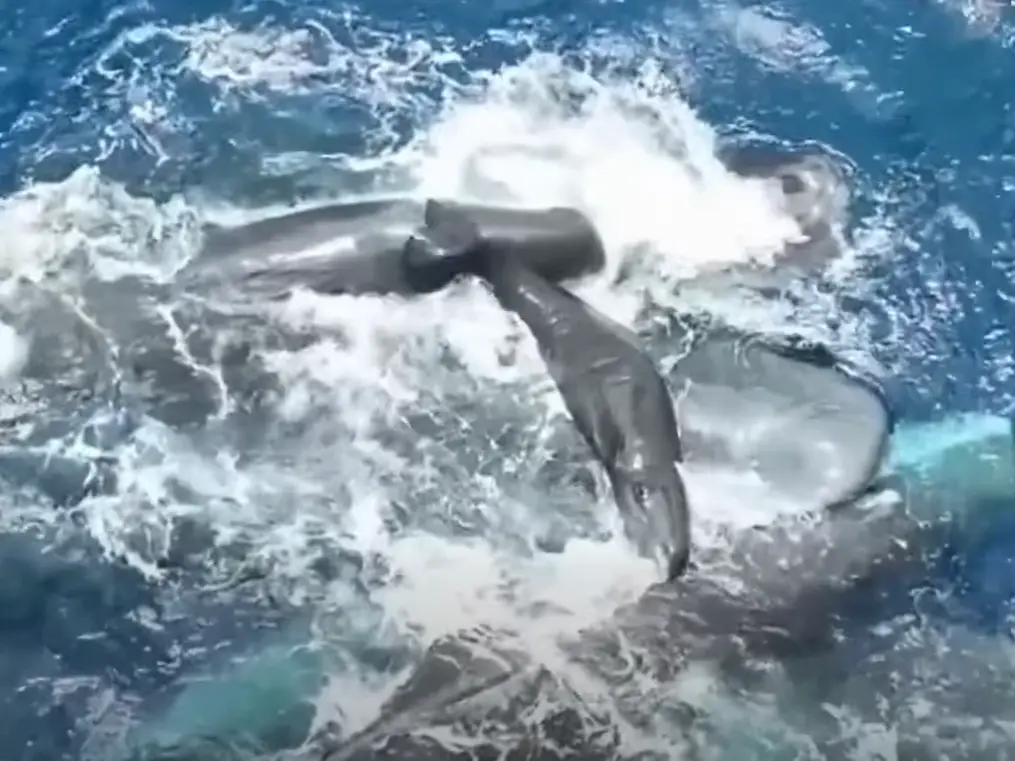
At first, the researchers observing from boats couldn’t make sense of what they were seeing beneath the ocean’s surface. Eleven sperm whales had gathered tightly together, floating unusually still and occasionally dipping shallowly underwater. After nearly an hour, the calm shifted, there was sudden thrashing, and blood spread through the water. The team initially suspected a predator, perhaps a shark. But the reality was far different.
Out of the group, a much smaller twelfth whale emerged. The others worked together to lift it toward the surface so it could take its first breath. This moment, detailed in two studies published in Science and Scientific Reports, adds to growing scientific evidence that humans are not the only species where mothers receive assistance during childbirth. “I don’t think it’s midwives or doulas in our human perspective, but there was definitely assistance and support for both the mother and the calf,” said Alaa Maalouf, one of the authors and a specialist in machine learning and robotics with Project CETI, the nonprofit whale research group that happened upon, documented and analyzed the birth.
Watch the video here
Interestingly, about half of the whales involved were not related to the mother. For scientists, this is especially meaningful, it suggests that cooperation may be driven not just by genetics, but also by social bonds and mutual support. Birth in wild animals remains rarely observed, largely because it typically happens away from view. Many social species, such as lions and chimpanzees, isolate themselves during labor, possibly to protect newborns from threats like aggressive males.
For a long time, researchers believed assisted birth was unique to humans, largely due to the challenges of human anatomy. But that assumption has been steadily challenged as more species, from primates to dolphins and even rodents, are seen providing care and protection during childbirth. Among whales, birthing behavior varies by species. Baleen whales tend to give birth alone, with mothers independently guiding calves to the surface. In contrast, toothed whales like sperm whales appear to rely on group involvement during labour.
Sperm whales, once heavily hunted for oil and immortalized in “Moby-Dick,” are now considered vulnerable. Project CETI is dedicated to studying them, with an ambitious goal: using artificial intelligence to interpret their clicking sounds and potentially translate them into human-understandable communication. Some scientists remain skeptical, suggesting that these clicks, known as codas, might resemble musical patterns rather than structured language. Still, the initiative has brought together experts from multiple disciplines. In 2024, the team even identified what they described as a “phonetic alphabet” in sperm whale communication.
The observed birth took place in July 2023 near Dominica in the Caribbean. With drones, underwater audio equipment, and visual documentation, researchers gathered detailed data. Marine biologist Shane Gero, who has studied this group since 2005, identified the whales and their relationships. He recognized the mother, called Rounder, whom he had followed since her youth when she was cared for by her own mother, Lady Oracle, also present during this birth and closely attending to Rounder beforehand.
Sperm whale calves are born tail-first, an adaptation that helps prevent drowning. In a rare and fortunate moment, Rounder shifted her body just as the calf’s tail appeared, allowing a drone to capture the scene. The full delivery took 34 minutes. Using machine learning, researchers analyzed how the whales positioned themselves, interacted, and coordinated their movements. The data showed clear patterns: during labor, the group oriented toward the mother; afterward, their focus shifted to the newborn.
Trending Stories
)
)
)
)
)
)
)
)
)
)
)
)
)
)
)
)
)
)
)
)
)
)
)
)
)
)
)
)
)
)
)
)
)
)
&im=FitAndFill=(700,400))
)
)
)
)
Newborn calves struggle to swim, so several whales, especially Rounder, her sister Aurora, and a young unrelated whale named Ariel, spent significant time helping keep the calf afloat. However, every member of the group contributed at some stage, including a young male named Allan, who had begun transitioning to a more solitary life but still returned for the event. The calf was almost constantly in contact with others, often being touched by multiple whales at once.
The study also suggests that a female relative, likely Lady Oracle, played a leading role in assisting before the birth, supported by close positioning and synchronized movements captured on video.
A separate analysis of the whales’ vocalizations revealed changes in their clicking patterns, including shifts in rhythm and density during key moments. Researchers are continuing to study the event, including the presence of other species like short-finned pilot whales. It remains unclear whether they were drawn by curiosity, opportunity, or something else entirely.

