&imwidth=800&imheight=600&format=webp&quality=medium "Explained: India's desi-GPS NAVIC is defunct; strategic capability lost")
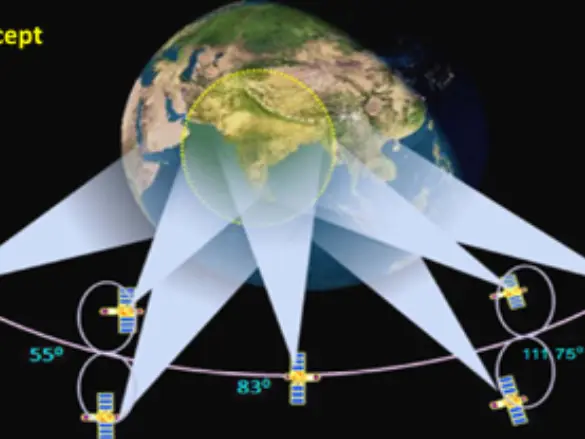
India's strategic NAVIC (Navigation with Indian Constellation) series of satellites, designed, built and maintained by the national Space agency ISRO, are defunct. The NAVIC series of satellites is meant to provide Position, Navigation & Timing services for civilian and military users within India and 1,500 km beyond the country's borders. Theoretically, a bare minimum of four satellites is required for the functioning of NAVIC. At present, barely 3 of 11 NAVIC satellites are fulfilling their core purpose, publicly available information reveals. Even among these 3 satellites, one could fail anytime, as it has well exceeded its expected life.
What is NAVIC?
India faced GPS-denial (reduced GPS accuracy) during the 1999 war against Pakistan, which hindered the Indian military from deftly navigating the treacherous Himalayan region, and affected the ability to conduct precision strikes at will on enemy positions. Faced with this strategic vulnerability and foreign dependence, the Indian Government planned to set up its own alternative to the American GPS.

America operates GPS, China operates Beidou, Europe operates Galileo, and Russia operates GLONASS. NAVIC was designed to be India's sovereign alternative to these services. While the aforementioned services are available globally, India's NAVIC is meant to function only in the Indian subcontinent region(within Indian borders and 1,500 km beyond them).
Between 2013 and 2018, the Indian Space Research Organisation (ISRO) launched the first-generation Indian Regional Navigation Satellite System(IRNSS) series satellites. IRNSS was later known as NAVIC.
How IRNSS-series satellites failed en masse...
Trending Stories
)
Sikh driver attacked in Wyoming in US, suffers 17 stab wounds
)
‘I have a big decision coming up’: Trump says he’s approaching major ‘crossroad’ in Iran war
)
US intel warns China can steal F-35 jets secret from Saudis
)
Former India player Diana Edulji wants Smriti Mandhana to replace Harman as skipper at the earliest
)
Pak defence minister says 'time has come to implement pact'
&im=FitAndFill=(700,400))
Meet top 5 batters in the latest ICC T20I Rankings
)
Formula One reveals the 2027 race calendar; Monaco to host sprint race for the first time
)
240-million-year-old bizarre 'pig with a tusk' creature creates new dilemma over origin of dinosaurs
)
Godfather of AI Geoffrey Hinton gives US lawmakers a one-year warning on AI
)
AI already defying, denying humans, is it beyond human control already?
)
US F-16 fighter jet crashes in Michigan during training mission, pilot ejects safely
)
All Indian goods to get duty-free access to New Zealand
)
Xi-Trump summit may boost military links
)
US to sell 48 F-35 Lightning fighter jets to Saudi Arabia, help it deter threats
)
Hong Kong unveils 11 new measures to boost birth rates, offers higher cash bonuses and housing perks
)
Australian athlete, who soiled herself during Hyrox race, apologises for continuing
)
Tata Trusts chairman Noel Tata calls Chandrasekaran’s reappointment ‘illegal’, rejects Tata Sons listing
)
Passport fees hiked, child validity revised: What the new rules introduce
)
How did an Australian river with 500 crocodiles pass the Olympic test? Here's how
)
Fed raises rates for first time in 3 years, Kevin Warsh defies Trump as inflation mounts
)
US drone firm linked to Trump’s sons signs MoU with Pakistan army, gets initial order
)
Pak batter Rizwan's petition against being questioned by cyber crime agency rejected by court
)
Daayra movie review: Kareena Kapoor, Prithviraj Sukumaran shine in Meghna Gulzar’s cop-versus-cop crime thriller
)
Epstein files: Judge warns Trump Attorney General Todd Blanche of contempt over DOJ delays
)
'Gangsta' crab shoves knife blade at man and his dog in Florida - Watch
)
At least 48 dead, 100 hospitalised in Nigeria after drinking suspected methanol-laced alcohol
)
US-Iran War: Trump says ‘big decision’ on Iran ahead, weighs possible fresh military action
)
US new military base in Poland: US President Donald Trump eyes military base in Poland
)
Zee Entertainment shareholders approve reappointment of five board directors
)
Putin 'is plotting something bad': Russia may launch 'accidental' strikes on NATO countries supporting Ukraine, Poland PM warns
&im=FitAndFill=(700,400))
Suriya and Jyothika say ‘I do’ again after 20 years! See their dreamy wedding pics
)
Laura Wolvaardt sets new world record for most WT20I runs in a year
)
Pezeshkian, Araghchi set to attend UNGA 2026 in New York amid ongoing conflict as US-imposed travel curbs remain
)
'He will always be ahead': India coach Gambhir says Sooryavanshi won't walk into team ahead of Samson
According to ISRO, the IRNSS first-generation was meant to have seven satellites. To fulfil this requirement, ISRO launched nine IRNSS satellites(IRNSS-1A, 1B, 1C, 1D, 1E, 1F, 1G, 1H, 1I) between 2013 and 2018. Of the nine, only eight satellites were successfully placed in orbit. IRNSS-1I could not be placed in orbit due to a rocket failure.
Of the eight that were placed in space, five satellites suffered failures in critical components known as atomic clocks. Atomic clocks are highly precise and sophisticated timekeeping instruments, which are fundamental to the operation of Navigation satellites. When all atomic clocks in a satellite fail, it implies a total failure of that satellite's capability to offer Position, Navigation & Timing.
In 2025, responding to a Right to Information(RTI) query, ISRO said that five(1A, 1C, 1D, 1E,1G) of eight IRNSS satellites suffered failure in all three on-board atomic clocks.
With atomic clock failures in five of eight first-generation satellites, only three(1B, 1F, 1I) satellites remained operational. Even among these three remaining satellites, IRNSS-1B has exceeded its mission life of 10years and is now in its 11th year. Two atomic clocks onboard IRNSS-1F had failed earlier, while its third and final atomic clock failed this week. Launched in 2018, IRNSS-1I is expected to be operational until 2028.
In a statement issued on Friday,(13th March), ISRO said that its "IRNSS-1F satellite launched in March 2016 has completed its design mission life of 10 years on 10th March 2026." On 13th March 2026, the procured on-board Atomic clock stopped functioning. However, the satellite will continue to function in-orbit for various societal applications to provide one-way broadcast messaging services, it was added.
This implies that only two satellites IRNSS-1B and IRNSS-1I, from the first-generation are in some state of operation, but they face a high risk of failure anytime.
During launch, ISRO had estimated that each IRNSS-series satellite could operate in space for 10years. Theoretically, these satellites could live longer, if they have fuel in their tanks for performing essential manoeuvres, and their crucial systems are functional. However, the premature atomic clock failures in six of eight satellites have been a big setback. ISRO admitted that all these atomic clocks were imported.
ISRO's NVS-series satellites began to replace the IRNSS-series
With the costly lessons learnt from the IRNSS-series(first -generation NAVIC) failures, which is India's first attempt at developing a constellation of GPS-like satellites, ISRO decided to build and launch larger satellites under the NVS-series. The NVS-series was meant to replace the IRNSS-series. In simple terms, the NVS-series is the second-generation, advanced fleet of NAVIC satellites. ISRO said that the NVS-series would comprise a total of five satellites.
One of two Second Generation NAVIC satellites failed
ISRO launched NVS-01 in May 2023, and that satellite has been working as designed, as per the agency. However, its successor satellite, NVS-02, which was launched in January 2025, failed to reach its designated orbit. The satellite remains stuck in its initial orbit, as the satellite's onboard engine could not fire to lift it higher. Stuck in the initial orbit, NVS-02 cannot provide Position, Navigation, Timing services. Therefore, India has only one fully functional NVS-series satellite(NVS-02) in orbit, when it requires five of them.
ISRO's timelines are disconnected from reality
In 2025, the Indian Government had said in Parliament that ISRO would launch the remaining NVS satellites by the end of 2026. However, this seems like an unrealistic timeline, given ISRO's pace so far. ISRO launched NVS-01 in May 2023; NVS-02 was launched in January 2025, which shows a gap of 19 months between the two launches. It has been more than a year after the NVS-02 failure, and its successor, NVS-03, has not been launched. ISRO has also faced three failures in six missions executed between January 2025 and January 2026, further slowing down the overall pace of activity and affecting morale.
How do America's GPS and China's Beidou compare?
The American Global Positioning System(GPS), which supports trillion-dollar civilian and military applications worldwide, requires a fleet of 24 satellites in orbit for optimum performance and round-the-clock global coverage. Considering how crucial GPS is to the global economy, the US Government maintains at least 30 GPS satellites in orbit at any given point in time. The six additional satellites are meant to ensure that the service remains reliable and robust, even when a few satellites fail or encounter unexpected glitches.
To meet its own national requirements, China operates a fleet of Beidou satellites, which serve as an alternative to America's GPS. While Beidou requires a fleet of 30 satellites in orbit, around 35 satellites are believed to be in orbit.
Meanwhile, after decades of scientific effort and billions of taxpayer Rupees spent, India's ambitious desi-GPS project NAVIC remains in a defunct state. While NAVIC requires a bare minimum of four satellites, it is presently down to three.
Pitiably, two of the paltry three NAVIC satellites are counting down to age-related obsolescence. The present reality of NAVIC is a stark reminder that- even a quarter of a century after the Kargil War- India does not have an operational fleet of Position, Navigation & Timing satellites for its strategic purposes.
Also read: NASA picks April 1 as Artemis 2 launch date, and everyone is wondering, 'Why April Fool's...?'