Early medieval stone coffins found hiding in plain sight below the streets of a French city

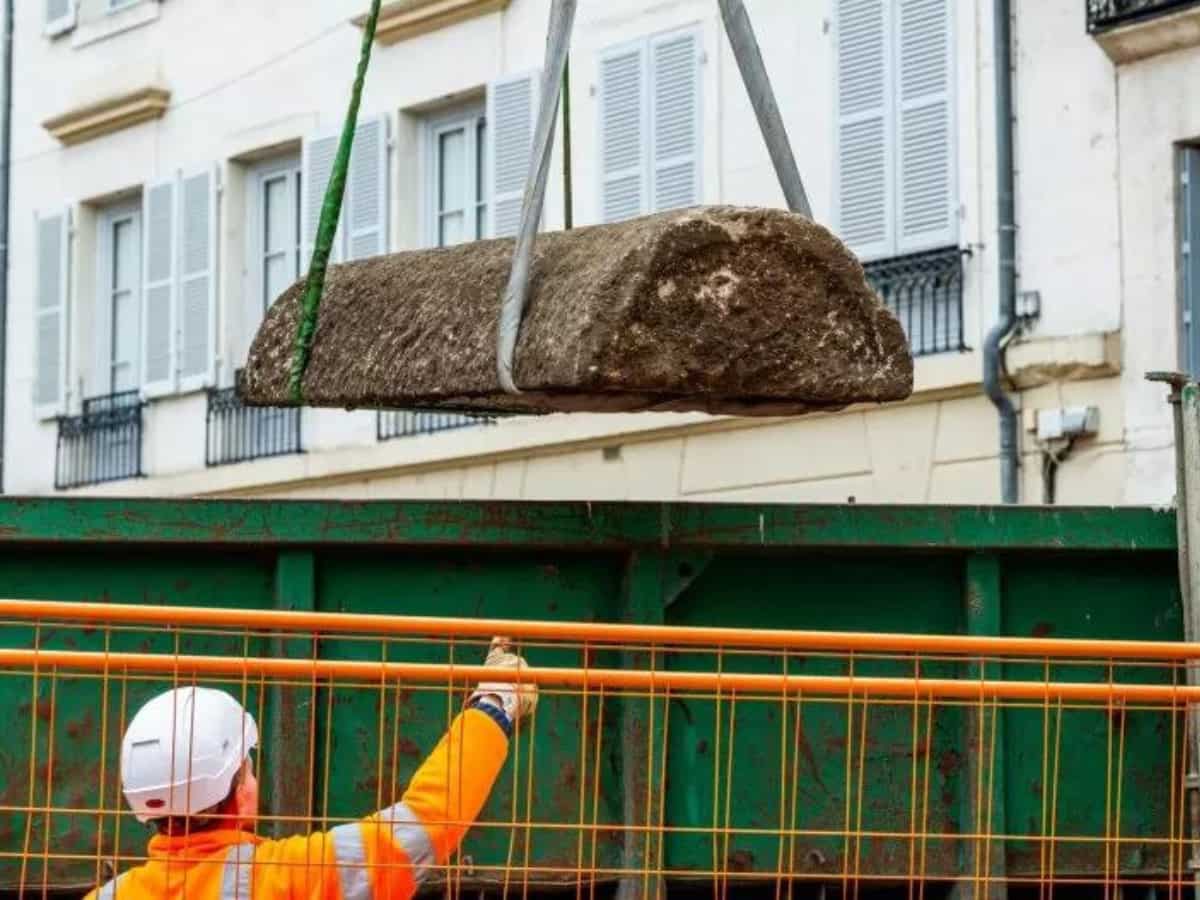
Stone coffins found in France
Archaeologists have recovered antique treasure hiding in plain sight below the streets of a French city. The newly found antiquity of several sandstone sarcophagi was uncovered in the downtown of Dijon, in eastern France. The sarcophagi are stone coffins typically adorned with a sculpture or inscription.
These sarcophagi, found during excavations conducted by the National Institute of Preventive Archaeological Research (INRAP), belong to the early medieval period, announced INRAP in a press release.
Also Read |Breakthrough black hole map reveals vast expanse of universe

The exact site of excavations was at the foot of the Church of Saint-Jean in Dijon, which is an interesting site for historians and archaeologists alike for its long-standing history.
Medieval stone coffins found below the streets of a French city
The sarcophagi found in Dijon were made of sandstone and had a trapezoidal shape. These shapes are characteristic of the Merovingian period, which dates back to the 6th-8th century, as per the excavating team. Hence, these sarcophagi are more than 1200 years old and some were found in damaged form due to overlapping burials.
&imwidth=180&imheight=135&format=webp&quality=medium)
Poland: 19-year-old stabs several at Polish vocational school
&imwidth=180&imheight=135&format=webp&quality=medium)
'Baseless and misconceived': India issues statement after Elon Musk's 'oligarchs' claim over Starlink delay
&imwidth=180&imheight=135&format=webp&quality=medium)
‘Team first and team ahead’: India coach Gambhir pens heartfelt wish for chief selector Ajit Agarkar
&imwidth=180&imheight=135&format=webp&quality=medium)
October 7 mystery: Warnings, IDF response, Hannibal Directive, Nova festival
&imwidth=180&imheight=135&format=webp&quality=medium)
Trump's naked 23-karat gold statue unveiled near European Parliament
&imwidth=180&imheight=135&format=webp&quality=medium)
Russia warns Lithuania over nuclear weapons, Europe braces for massive hybrid attack | Gravitas
&imwidth=180&imheight=135&format=webp&quality=medium)
Captain Smit Machchhar on feet again, walks 10 steps as recovery continues after Flydubai flight attack
&imwidth=180&imheight=135&format=webp&quality=medium)
'They came in, they hit us': New videos show Iranian attacks on US Camp Buehring in Kuwait | Watch
&imwidth=180&imheight=135&format=webp&quality=medium)
Trump distances himself from senior political advisers over work for pro-Russian government
&imwidth=180&imheight=135&format=webp&quality=medium)
Narendra Modi Stadium bomb threat declared hoax; India & Australia U19 squads safe
&imwidth=180&imheight=135&format=webp&quality=medium)
US midterms 2026: Why the Latino vote could shape control of Congress
&imwidth=180&imheight=135&format=webp&quality=medium)
US Midterms 2026: Barack Obama hits campaign trail to boost Democratic candidates
&imwidth=180&imheight=135&format=webp&quality=medium)
Shia LaBeouf and Mia Goth head for divorce after nearly 10 years
&imwidth=180&imheight=135&format=webp&quality=medium)
Nicolas Maduro, wife likely to face new charges over alleged torture of US citizens: Report
&imwidth=180&imheight=135&format=webp&quality=medium)
Texas man executed by lethal injection; first US execution since botched Christa Pike execution
&imwidth=180&imheight=135&format=webp&quality=medium)
Christa Pike wakes after failed execution, asks 'Where am I and who are you?'
&imwidth=180&imheight=135&format=webp&quality=medium)
Christa Pike 'angry' and 'confused' after failed execution; judge orders to preserve evidence
&imwidth=180&imheight=135&format=webp&quality=medium)
Nigerian President Bola Ahmed Tinubu hails Modi’s 25-year leadership milestone, calls for deeper Nigeria-India strategic ties
&im=FitAndFill=(700,400)&imwidth=180&imheight=135&format=webp&quality=medium)
US midterms 2026: 10 leaders and candidates to watch in the battle for Congress
&imwidth=180&imheight=135&format=webp&quality=medium)
Africans knew how to build 20-storey skyscrapers 2,800 years ago
&imwidth=180&imheight=135&format=webp&quality=medium)
First signs of Planet Nine may have been finally detected
&imwidth=180&imheight=135&format=webp&quality=medium)
Veteran actor Nana Patekar dies at 75 after suffering cardiac arrest
&imwidth=180&imheight=135&format=webp&quality=medium)
Musk alleges ‘oligarchs’ blocking Starlink in India, here is what we know so far
&imwidth=180&imheight=135&format=webp&quality=medium)
Lightning strikes IndiGo Patna-Lucknow flight at 17,000 feet, damages nose; all 110 safe
&im=FitAndFill=(700,400)&imwidth=180&imheight=135&format=webp&quality=medium)
New OTT releases this week (October 5-11, 2026): Reporting Live, Animals, Carrie- 8 new titles coming on Netflix, Prime Video, JioHotstar and more
&imwidth=180&imheight=135&format=webp&quality=medium)
‘Hinduism is inclusive, Abrahamic faiths inherently exclusive,’ says Madras HC, rejects FCRA registration plea
&imwidth=180&imheight=135&format=webp&quality=medium)
Mall of America attack: FBI arrests man over alleged ISIS-inspired mass shooting plot with AK-47 and 200 rounds
&imwidth=180&imheight=135&format=webp&quality=medium)
'I should win it': Trump renews Nobel Peace Prize claim ahead of 2026 announcement
&imwidth=180&imheight=135&format=webp&quality=medium)
IndiGo flight struck by lightning at 17,000 feet, nose of Patna-Lucknow flight damaged
&im=FitAndFill=(700,400)&imwidth=180&imheight=135&format=webp&quality=medium)
World’s top vehicle producers: Top 10 countries making the most cars. Check where India stands
&imwidth=180&imheight=135&format=webp&quality=medium)
ICC Rankings: Shreyas Iyer breaks into top 10 after maiden T20I hundred in Lucknow
&imwidth=180&imheight=135&format=webp&quality=medium)
Trump to honour Elon Musk, Sergey Brin and Jensen Huang with top science honour at White House. Check the full list here
&imwidth=180&imheight=135&format=webp&quality=medium)
'We don't think so': Trump says Russian plague lab worker's death not linked to bio-weapon
&imwidth=180&imheight=135&format=webp&quality=medium)
France protests: How a Gen Z school movement turned into a political war | The Verdict
Apart from these medieval-era stone coffins, archaeologists also unearthed limestone sarcophagus with a cuboid shape and a heavy, curved lid. The team said that this stone coffin appears to be much older than the sandstone ones, perhaps dating to the 5th century.
Three skeletons were also foundinside the limestone coffin, indicating that it was once used for multiple burials over different periods. Researchers at INRAP will now deep dive into these skeletons to find their exact date of origin.
The Church of Saint-Jean was once described as a “funerary basilica” by Merovingian author Gregory of Tours. The present standing building there is, though, quite different from what Gregory described in his books.
The current building was constructed at the site during the 15th century in the Gothic style and the structure underwent various modifications in the subsequent centuries. During the French Revolution, the building became national property and subsequently served multiple secular uses. Finally, it became the Parvis Saint-Jean Theatre in 1974, which is still operating today.
Also Read |Scientists reveal 16-million-year-old fossilised skull of ancient Amazon river Dolphin
In the early Middle Ages, Dijon was a fortified town with a necropolis outside the city walls, next to the site of the church.
In addition to the sarcophagi, excavations have unveiled numerous other graves within this necropolis, notably consisting of tombs crafted from stone slabs. Of particular interest are the abundant child burials, indicative of the period spanning the 11th to 13th centuries.
Post the 15th century,the necropolis shrank to a single region south of the Church of Saint-Jean, housing burials possibly extending as late as the 18th century.
(With inputs from agencies)