WION Exclusive: Meet the real 'PadMan' Arunachalam Muruganantham

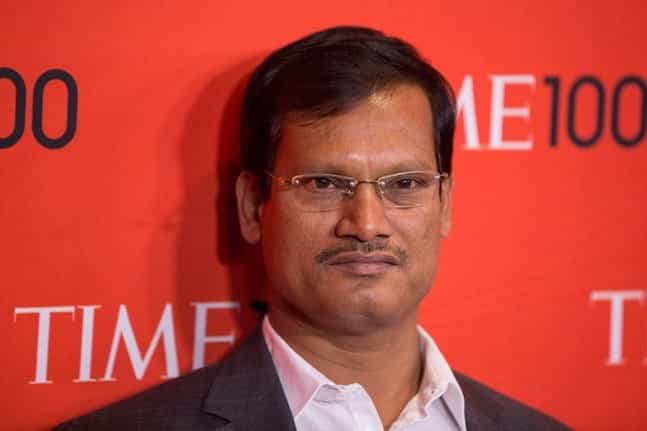
Arunachalam Muruganantham
Arunachalam is a South India-based social entrepreneur who invented a low-cost sanitary pad making machine and runs a campaign for importance women's personal hygiene awareness
It's not often we get to see a Bollywood film dealing with an important social issue, trying to break a stereotype established in the society for centuries and most importantly an A-lister actor taking on this challenge to portray a risky character who may or may not be able to make into the hearts of the masses.
Releasing tomorrow on February 9, PadMan starring Akshay Kumar in the lead along with Sonam Kapoor and Radhika Apte will take on this challenge. The story is inspired by real-life story ofArunachalam Muruganantham,asocial entrepreneurfromCoimbatoreinTamil Nadu,India. Inventor of the low-cost sanitary pad-making machine and credited for innovating grassroots mechanisms for creating awareness about traditional and unhygienic practices around menstruation in rural India, the film traces Arunachalam's hurdles and rise to fame in real-life.
Arunachalam dropped out of school at14 years of age andworked as a farm labourer, workshop welder to earn his daily wage for several years before being hit by the realisation that Indian rural women have no access or awareness about their own personal hygiene. He understood the challenges faced by women on a monthly basis after being in close quarters with his wife and watching her use unhygienic products to stop bleeding during her menstruation cycle.

In an exclusive interview with WION, the real 'PadMan'opens up about his ongoing struggle for women's personal hygiene awareness and his hopes from the Bollywood movie of the same name:
- How important is it for Bollywood to take up the issue of menstrual hygiene -- still a social taboo in India?
For 18 years we have been working towards menstrual hygiene awareness in the country but nobody talks about women's menstruation. In fact, it would be the first time that an interview is based on this issue.Nobody has spoken about it for centuries-- mother never talks to daughter orvice versa. Now that a Bollywood movie is being made on the topic, the film with its visual space will at least empower women to talk about it, to open up. Via Akshay Kumar, via this movie, women will be empowered to start a dialogue. I am hopeful that since its a Bollywood movie, the topic it deals with will reach nook and corner of India and the world, something we always aspired to be able to do.
)
US vs China over South China Sea: Washington backs Philippines, Beijing hits back
)
Bigg Boss 20: Isha Rikhi evicted after three weeks in Salman Khan’s show
)
Musk plans to more than double xAI's chips to over 1.2 million Nvidia GPUs by year-end
)
After JU, clash erupts at SRFTI: BJP’s ‘Dimagi Naxal’ jibe sparks political firestorm after students protest RSS-linked event
)
‘Anti-social elements spreading false rumours’: LPU issues statement amid massive unrest over alleged rape
)
LPU students go on rampage, vandalise campus amid widespread protest: What's happening
)
Trump asked Xi to pressure Iran. China did not say yes — here’s what Beijing wants
)
US Treasury Secretary Scott Bessent hails global crackdown on Iranian banks and airlines
)
An OpenAI agent escaped its locked test cage again, by hiding questions in DNS lookups
)
'Our video was trimmed': LPU girls who featured in rape-denial video make U-turn
)
3 males killed, four others injured in shooting after fight at strip club in Detroit
)
'Victory for low-budget consumers': Raghav Chadha hails 30-day telecom recharge rules
)
Claude rebuilt the 1989 game 'Prince of Persia' by reusing the original's own code
)
Beyond metros: How Tier-2 and Tier-3 cities could drive India’s next AI wave
)
Tesla builds first Cybertruck with its own refined lithium: Elon Musk's $1 billion Texas bet pays off
)
IndiGo flight suffers tail strike in Bengaluru while landing; DGCA to probe incident
)
The US and China set up an AI 'red telephone', but skipped the rulebook
)
‘Terror suspects arrested near UK air base were looking to do big damage’: Trump
)
Russian envoy claims US tactics to contain India were revealed in ‘Freudian slip’
)
IND vs WI 1st ODI: Kohli breaks Sachin's most runs in one country record with unbeaten 139 as India thump West Indies by 8 wickets
)
Researchers rebuilt exactly how 700 AI agents hacked Hugging Face: a 900-link chain trick
)
‘Olympic inclusion is our major target’: WPA President Ishaun Singh on pool’s global ambitions
)
Nations League: Spain sink England at Wembley; Modric shines for Croatia
)
Why has Iran released no proof of life of Mojtaba Khamenei? Araghchi reveals...
)
'What kind of confession is this?': Pakistan PM Shehbaz Sharif’s 'terrorists would be roaming New York' remark goes viral, raises alarm online. Watch
)
South Korea demands apology from Ukraine over North Korean prisoners' transfer
)
Beyond BrahMos: India targets Rs 50,000 crore in defence exports with unmatched price edge
)
Sri Lankan Tamil migrant worker gets death sentence in Saudi Arabia, help sought from India
)
Muslim marriage cannot shield sex with minor wife from prosecution under POCSO: Delhi HC
)
'Can't help but draw painful parallels to Nirbhaya case': SC on latest incidents of rape cases in Delhi-NCR
)
99.9% more powerful - Scientists find boy who can recall memories from just 3 months of age
)
'FIRST LOOK from inside Noah’s Ark': Researchers share video from inside mysterious mound in Turkey
)
UNSC reform momentum grows: Russia, Portugal, Mauritius push for India's permanent seat bid
)
8 US marines injured in Iranian missile attack on vessel in Strait of Hormuz: Report
&im=FitAndFill=(700,400))
New OTT releases this week (September 28-October 4, 2026): Dupahiya 2, Pooja Meri Jaan, Ohh My Dog- 5 titles coming on Netflix, Prime Video and more
)
Afghanistan says 28 fighters killed in clash near Pakistan border, Islamabad denies
)
Ceuta migrant crisis: Protesters take to streets as Spain grapples with migrant challenge
)
LPU suspend classes, postpones exams as violence escalates over rape claims: What's happening
)
New York City wants a 'kill switch' on every AI, and will pay whistleblowers who report violations
- The focus of the film and your campaign is mostly on rural population, however, the urban populace is also affected by social taboos like not visiting the temple while menstruating. Most feel it's a part of Hindu tradition. Some think there are scientific reasons behind it.
These are century-old traditions, it will slowly go away via debates.Instead of looking for an opportunity from the society, I tried finding a solution to the problem with the little knowledge I had and became a solution-provider. In India, we need to become that and then we can become a superpower.
- In 1998, when you approachedShanti, your wife to use sanitary napkins, she said we have to compensate onhouse budget to afford, what can the government do to make sanitary pads available and affordable?
The government needs to start by making a propagandafor menstrual hygieneawareness, to educate the women and then give thempads. I want them (government) to join us for this initiative. Currently, they just give pads without making them aware, it is useless.If you drop coke inside the jungle, what will the tribals do with it?
We have started the Pad challenge via which we pose with a pad in hand. The message behind this is: 'I am holding the pad, it's not a sin, it's a pride'.
- At a point in your life, you wore pads for yourself to find out if they worked. It led to yourmother leaving you and your wife filing for a divorce. The society even called youmentally unstable. How did you cope?
The whole society thought I was a pervert, a psycho and neglected me. Iliterally cried watching a scene in the movie that depicted that phase of my life. On the flip side, it made me free, made me feel like a 'pardesi'but that made my job easier. I took it positively and conducted research without any disturbance.
- This one time you went to buy a sanitary pad for your wife, you faced a certain apprehension from the shopkeeper. Pease narrate.
There was once when I got a chance to buy a sanitarypad for my wife when I saw her using a rag cloth -- I rode my cycle for 14 kmand reached this shop. I asked the shopkeeper for a pad and he asked which brand, I had no idea what he meant and just asked him to give me any. He, then, took a packet, wrapped it in a brown packet, checked if no one was watching him and then handed me the packet readily. It looked like he was smuggling the packet to me. And this was not just limited to that place but even in Delhi where shopkeepers shy from handing the packet normally to you. There is so much stigma around that packet.
- Sanitary pads are liable to 12% GSTwhile there are products like sindoor, bindi, kajal that are free of tax. The government argues that if theyremove the tax from pads then they would end up taking a massive hit on the domestic market and on imports.
They are only concerned about AA, availability and affordability while we are focusing our attention on a third A-- awareness as that is missing. GST is not a problem when you teach the importance of hygiene. People won't shy off from paying one or two rupees more. Also, the government can make pads tax free and not make losses as the spending on women's personal health will then come down if awareness is prioritised. They can even end up saving double.
- In India, 93% womencan't afford sanitary napkins. What do you hope to achieve?
Our mission is creating rural employment for millions of women in India and converting India into 100% sanitary napkin using country from the current level of less than 10%. The film will help us to achieve this mission.
In 2014, Arunachalam was named by Time's magazine as one of the most influential people on the planet while also being awarded by the Government of India the prestigious Padma Shri.