

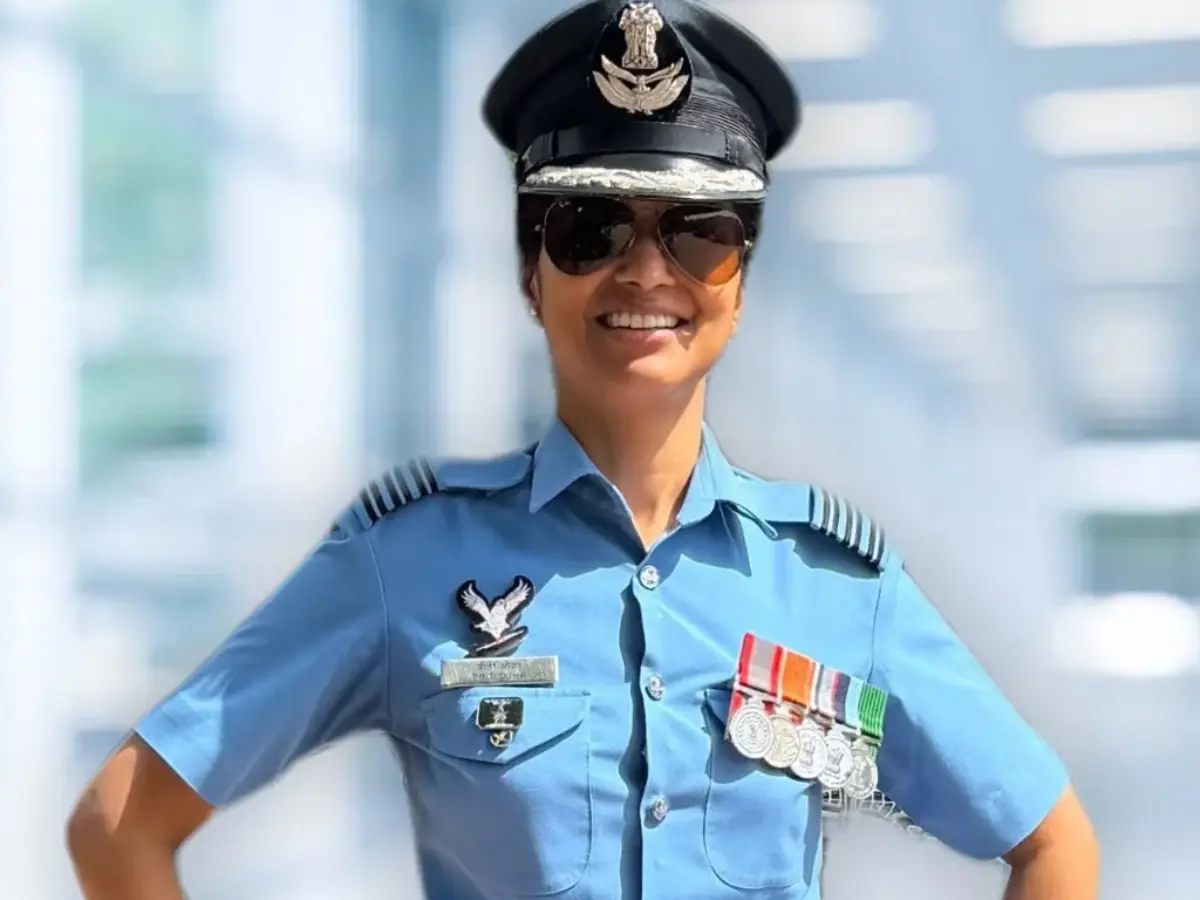
&imwidth=800&imheight=600&format=webp&quality=medium "‘Battlespace has expanded’: Wg Cdr Priti Ojha (Retd) reflects on changing face of air power on IAF Day")
In an exclusive interview with WION on Indian Air Force Day, retired IAF Wing Commander Priti Ojha reflects on a range of issues – from how India’s security environment and the nature of warfare has evolved since she joined the Indian Air Force in 2004 to what it means to be a women in uniform. Drawing on her experience as a Fighter Controller, she explains why modern air power has evolved into aerospace power and why the IAF must be prepared for simultaneous threats across multiple fronts. Ojha also speaks about the importance of information networks in modern warfare and why professionalism, rather than gender, should define an woman officer’s role in the IAF.
Also Read: The new air threat on India's two fronts
Excerpts from her interview to WION:
You joined the IAF at a very different point in India's strategic history. When you look at the security environment India faces today, what strikes you as the biggest change and challenge?
Wg Cdr Priti Ojha (Retd): I joined the IAF in 2004 and, after one year of rigorous training, was commissioned in 2005. The biggest change that has surfaced over the years is our own perception and response to terrorist activities. From an almost muted standpoint to the way we have responded to the Pulwama attack and the Pahalgam attack, our approach has grown tremendously over these years. We are now acknowledged as a country with the resolve to retaliate and stand against terrorism with full force.
Also, alongside conventional military threats, we now have cyber warfare, drones, space-based capabilities, information warfare and the growing use of technology and artificial intelligence (AI). The battlespace has expanded far beyond the traditional air, land and sea domains. Having served as a Fighter Controller, I have always understood the value of having the right information at the right time—and today, that principle has become even more important.
Trending Stories
&imwidth=180&imheight=135&format=webp&quality=medium)
Sri Lankan Tamil worker gets death sentence in Saudi Arabia over blasphemy, calls for pardon intensify
&imwidth=180&imheight=135&format=webp&quality=medium)
Atlantic hurricane Isaias could make landfall as a strong Category 2 storm, tornado warnings issued
&imwidth=180&imheight=135&format=webp&quality=medium)
US readying to strike Iran? Report suggests Trump preparing to put on show of strength ahead of US midterms
&imwidth=180&imheight=135&format=webp&quality=medium)
Captain Smit Machchhar on feet again, walks 10 steps as recovery continues after Flydubai flight attack
&imwidth=180&imheight=135&format=webp&quality=medium)
Narendra Modi Stadium bomb threat declared hoax; India & Australia U19 squads safe
&imwidth=180&imheight=135&format=webp&quality=medium)
France holds talks with Taliban government amid diplomatic outreach
&imwidth=180&imheight=135&format=webp&quality=medium)
Christa Pike 'angry' and 'confused' after failed execution; judge orders to preserve evidence
&imwidth=180&imheight=135&format=webp&quality=medium)
France protests: How a Gen Z school movement turned into a political war | The Verdict
&imwidth=180&imheight=135&format=webp&quality=medium)
Trump distances himself from senior political advisers over work for pro-Russian government
&imwidth=180&imheight=135&format=webp&quality=medium)
Trump's naked 23-karat gold statue unveiled near European Parliament
&imwidth=180&imheight=135&format=webp&quality=medium)
A Love Other Than Yours: The temptation to cheat and what pushes people over the edge
&imwidth=180&imheight=135&format=webp&quality=medium)
US midterms 2026: Why the Latino vote could shape control of Congress
&imwidth=180&imheight=135&format=webp&quality=medium)
Trump to honour Elon Musk, Sergey Brin and Jensen Huang with top science honour at White House. Check the full list here
&imwidth=180&imheight=135&format=webp&quality=medium)
Musk alleges ‘oligarchs’ blocking Starlink in India, here is what we know so far
&imwidth=180&imheight=135&format=webp&quality=medium)
Nicolas Maduro, wife likely to face new charges over alleged torture of US citizens: Report
&imwidth=180&imheight=135&format=webp&quality=medium)
Nana Patekar's #MeToo controversy: From Tanushree Dutta’s allegations to court ruling
&imwidth=180&imheight=135&format=webp&quality=medium)
Who is DogeDesigner? All we know about the X account that sparked India-Musk-Starlink ‘oligarchs’ controversy
&imwidth=180&imheight=135&format=webp&quality=medium)
US Midterms 2026: Barack Obama hits campaign trail to boost Democratic candidates
&imwidth=180&imheight=135&format=webp&quality=medium)
Thai Actors Fourth Nattawat, Gemini Norawit face racism accusations from Indian fans over viral Bollywood act
&imwidth=180&imheight=135&format=webp&quality=medium)
Nigerian President Bola Ahmed Tinubu hails Modi’s 25-year leadership milestone, calls for deeper Nigeria-India strategic ties
&imwidth=180&imheight=135&format=webp&quality=medium)
Christa Pike wakes after failed execution, asks 'Where am I and who are you?'
&imwidth=180&imheight=135&format=webp&quality=medium)
BTS agency HYBE announces first-ever Weverse Con Festival in India
&imwidth=180&imheight=135&format=webp&quality=medium)
‘Team first and team ahead’: India coach Gambhir pens heartfelt wish for chief selector Ajit Agarkar
&imwidth=180&imheight=135&format=webp&quality=medium)
IndiGo flight struck by lightning at 17,000 feet, nose of Patna-Lucknow flight damaged
&imwidth=180&imheight=135&format=webp&quality=medium)
Lightning strikes IndiGo Patna-Lucknow flight at 17,000 feet, damages nose; all 110 safe
&imwidth=180&imheight=135&format=webp&quality=medium)
‘You earned that love’: Messi’s wife shares heartfelt message as football icon bids farewell to international stage
&imwidth=180&imheight=135&format=webp&quality=medium)
Ronaldo sends 'a hug' after Messi says he misses 'wearing the blue and white'
&imwidth=180&imheight=135&format=webp&quality=medium)
Mall of America attack: FBI arrests man over alleged ISIS-inspired mass shooting plot with AK-47 and 200 rounds
&im=FitAndFill=(700,400)&imwidth=180&imheight=135&format=webp&quality=medium)
World’s top vehicle producers: Top 10 countries making the most cars. Check where India stands
&imwidth=180&imheight=135&format=webp&quality=medium)
Veteran actor Nana Patekar dies at 75 after suffering cardiac arrest
&imwidth=180&imheight=135&format=webp&quality=medium)
Nana Patekar: Remembering a legend of the Indian cinema
&imwidth=180&imheight=135&format=webp&quality=medium)
'Baseless and misconceived': India issues statement after Elon Musk's 'oligarchs' claim over Starlink delay
&imwidth=180&imheight=135&format=webp&quality=medium)
Shia LaBeouf and Mia Goth head for divorce after nearly 10 years
&imwidth=180&imheight=135&format=webp&quality=medium)
BJP chief Nitin Nabin calls Rahul Gandhi ‘anarchist’, says Oppn ‘spreading poison’ in society
&im=FitAndFill=(700,400)&imwidth=180&imheight=135&format=webp&quality=medium)
US midterms 2026: 10 leaders and candidates to watch in the battle for Congress
&imwidth=180&imheight=135&format=webp&quality=medium)
'We don't think so': Trump says Russian plague lab worker's death not linked to bio-weapon
Thus, the biggest challenge is, of course, technological advancement, because it plays its role on both sides. With better technology contributing to the development of the defence sector comes its potential misuse in the hands of perpetrators. But I am positive that, with the foresight we have nowadays, we will surely have the upper hand.
Is there a danger that conversations about “women in the military” sometimes focus so much on gender that we forget to judge officers simply by their professional ability?
Wg Cdr Priti Ojha (Retd): I believe, being part of this prestigious organisation, I vouch that officers are gender neutral. We have as much experience, equal opportunities to lead and freedom to train and work as the other gender. This is the beauty of IAF. You perform well and it is recognised and commended irrespective of the gender you belong to. Mission, excellence and integrity is all achieved through the
professionalism one possesses and these attributes are gender neutral. Either you have it or you don’t.
India today has to think about both its western and northern fronts, while also keeping an eye on the wider Indo-Pacific. How does that change the way we should think about air power?
Wg Cdr Priti Ojha (Retd): We can no longer look at air power in the scenario of a single-front conflict. We have to be prepared for simultaneous challenges on multiple fronts, while also retaining the ability to respond to developments across the wider Indo-Pacific. And we are indeed developing our capabilities and training accordingly. We have to become even more flexible, networked, responsive and geographically agile. The ability to rapidly shift focus and maintain situational awareness. Having served as a Fighter Controller, I would also emphasise that modern today’s aerospace power doesn’t operate in isolation. It has integrated with space, cyber, maritime and land-based capabilities, with a common operational picture and seamless command-and-control.
What worries you more from a military perspective: losing an aircraft or losing the information network that tells the aircraft where and when to operate?
Wg Cdr Priti Ojha (Retd): It is like comparing apples with oranges. Both have their significance in strengthening the force. You can’t choose between these two. Places where the network system is the back bone of the organisation, the aircraft is responsible for the final execution of the mission. Losing an aircraft is an immediate and tangible loss—of a highly trained crew, an expensive combat asset and, potentially, a critical operational capability. But losing the information network can have an equally profound impact because modern air operations depend on accurate, timely and secure information for situational awareness, decision-making and coordination. I have seen firsthand that an aircraft is only as effective as the information and command-and-control environment supporting it. At the same time, the best information network has little value if the combat platforms and trained people are not there to act upon it. Hence, these are all interrelated, and none of this can be achieved without prioritising combat effectiveness.

