What makes MQ-9B SeaGuardian a game-changer? Inside India’s $203 million lease deal with General Atomics

&imwidth=600&imheight=450&format=webp&quality=medium "What makes MQ-9B SeaGuardian a game-changer? Inside India’s $203 million lease deal with General Atomics")
India signs $203 million lease deal with General Atomics for MQ-9B SeaGuardian drones Photograph: (Credit: General Atomics)
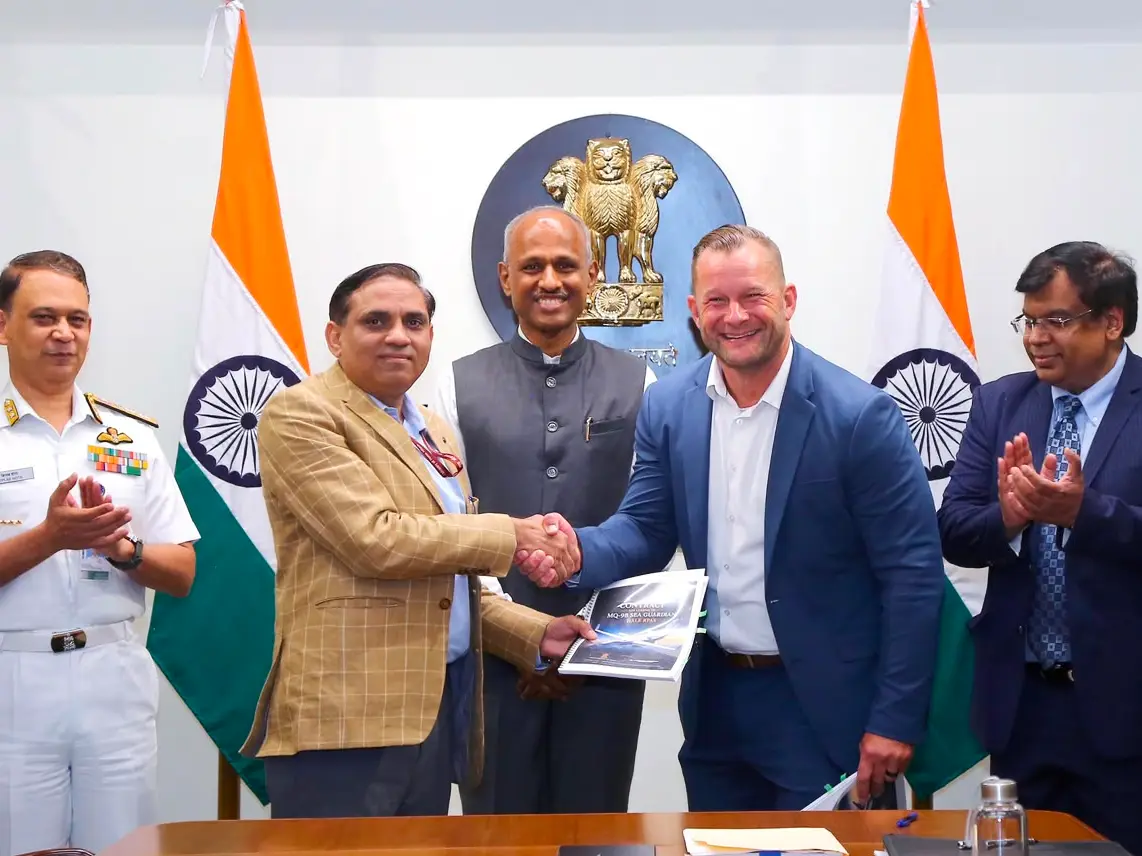
The Indian Ministry of Defence has signed a $203 million (₹1,943 crore) contract with US-based General Atomics to lease two MQ-9B SeaGuardian HALE drones for 30 months to boost Indian Navy surveillance in the Indian Ocean Region.
India has signed a $203 million (₹1,943 crore) deal to lease two MQ-9B SeaGuardian High-Altitude Long-Endurance (HALE) Remotely Piloted Aircraft Systems (RPAS).This move will significantly boost New Delhi’s air defense capabilities**, including** long-range surveillance.The deal has been signed between the Ministry of Defence and US defence company General Atomics for a 30-month period for the Indian Navy.
In a statement, the Ministry of Defence noted, “The MQ-9B SeaGuardian HALE RPAS, equipped with advanced systems, state-of-the-art sensors, and sophisticated payloads, will significantly enhance the Indian Navy’s Maritime Domain Awareness capabilities. The systems will provide persistent Intelligence, Surveillance, and Reconnaissance coverage over vast areas of the maritime domain, strengthening India’s ability to monitor and respond to developments across the Indian Ocean Region.”
)
India signs $203 million lease deal with General Atomics for MQ-9B SeaGuardian drones Photograph: (Credit: General Atomics)
About MQ-9B SeaGuardian
It is a maritime-focused remotely piloted aircraft system (RPAS) designed to deliver persistent maritime domain awareness over the horizon via satellite. Able to fly in all weather conditions for over 30 hours depending on its configuration, it can safely integrate into civil airspace to provide real-time situational awareness to joint forces and civil authorities day or night. It is the first RPAS in its class equipped to conduct real-time search and patrol operations both above and below the ocean's surface.
Versatile sensor integration and mission capabilities
Also read: India-France defence ties beyond Rafale: Next-gen aerospace tech, Future Combat Air System and more
Built with a highly versatile design, the aircraft utilises "bolt-on/bolt-off" sensors to seamlessly integrate advanced maritime intelligence, surveillance, and reconnaissance (ISR) equipment. These features include a centerline wide-area maritime radar, electronic support measures, an automatic identification system, and a self-contained anti-submarine warfare (ASW) mission kit. Through its open architecture system, SeaGuardian can be configured for a vast range of missions, such as search and rescue, law enforcement, humanitarian assistance and disaster relief, long-range strategic ISR, over-the-horizon targeting, airborne mine countermeasures, anti-surface warfare, and anti-submarine warfare.
Trending Stories
)
)
)
)
)
)
)
)
)
)
)
)
)
)
)
)
)
)
)
)
)
)
)
)
)
)
)
)
)
)
)
)
)
)
&im=FitAndFill=(700,400))
)
)
)
)
Advanced anti-submarine warfare and civil airspace compliance
For anti-submarine warfare operations, SeaGuardian can incorporate a sonobuoy management and control system along with a sonobuoy dispenser system (SDS) across four wing stations. This enables operators to deploy, monitor, and control up to 40 'A' size or 80 'G' size sonobuoys from a single aircraft to remotely perform ASW worldwide. Operating at a mission radius of 1,200 nautical miles with significant on-station time for submarine prosecution, it serves as a low-cost, stand-alone capability or as a complement to human-crewed aircraft in manned-unmanned teaming operations. Furthermore, as a world-first type-certifiable RPAS built to meet NATO STANAG 4671 standards, it uses GA-ASI's Detect and Avoid System and Certifiable Ground Control Station to integrate seamlessly into normal air traffic alongside commercial aircraft.

