The marathon commander: How DIG Mohsen Shahedi runs for the nation— On track and off it

&imwidth=600&imheight=450&format=webp&quality=medium "The marathon commander: How DIG Mohsen Shahedi runs for the nation— On track and off it")
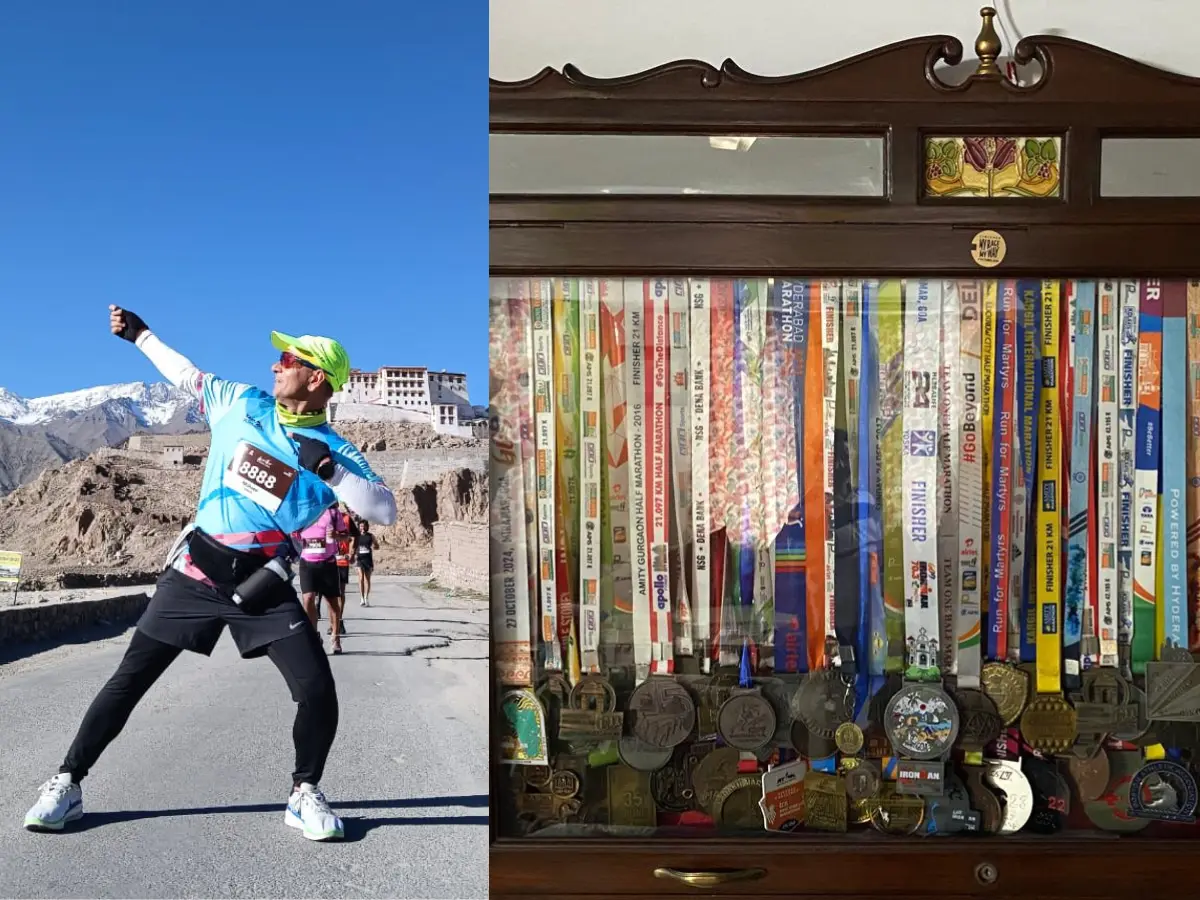
The marathon commander: How DIG Mohsen Shahedi runs for the nation Photograph: (WION)
DIG Mohsen Shahedi has completed 200+ marathons while leading NDRF operations, turning running into a journey of grit, discipline and self-discovery
When the world is asleep on a quiet Sunday morning, Mohsen Shahedi is already awake, pulling on his running gear in the dark. It’s 3 a.m.—his sacred hour. For most, this would seem like an odd ritual. For Shahedi, it’s a way of life. By the time dawn breaks, he’s often kilometres into a marathon, driven by a passion that has lasted more than two decades.
But Shahedi is not your regular long-distance runner. As a Deputy Inspector General in the National Disaster Response Force (NDRF), he oversees operations across India and abroad, leading teams that rush to the frontlines during floods, earthquakes, cyclones and other emergencies. Balancing this high-pressure leadership role with the grueling demands of marathon training is no easy task. Yet, the 55-year-old officer has managed to complete over 200 marathons, including ultra runs of 100 km and 200 km and is now gearing up for the upcoming Vedanta Delhi Half Marathon on Sunday (October 12). “Running is not just physical for me,” he says. “It is a discovery of self and the belief that nothing is impossible.”
A Life-Changing Run in Kosovo
Shahedi’s tryst with marathons began far away from home—in Kosovo in the year 2000. Then a young officer with the CRPF, he was posted as part of the Indian Special Police Unit on a United Nations mission. It was here that he was unexpectedly pushed into what would become a defining moment of his life.
“The Danish battalion had a tradition of organising the 100 km Dancon Death March,” he recalls. “My commander, a Colonel, ordered me to participate and lead the Indian team. I had never run that distance before. It came as a surprise.”
The course wound through the rugged Serbian mountains, far from the flat city tracks he was used to. Rain lashed the runners, washing away parts of the trail. He and his teammate, then-constable Sunil Kumar, had to navigate by map to find their way back onto the route. “I started tentatively,” he remembers, “because there were constant ups and downs. It was tough terrain.”
Trending Stories
)
)
)
)
)
)
)
)
)
)
)
)
)
)
)
)
)
)
)
)
)
)
)
)
)
)
)
)
)
)
)
)
)
)
&im=FitAndFill=(700,400))
)
)
)
)
At the 94 km mark, Shahedi and Sunil made their move, overtaking French personnel to take the lead. Word travelled back to camp, and by the time he reached the final 200 metres, carrying the Indian tricolour, the entire battalion was waiting. “Those last 200 metres seemed unending,” he says with a smile. “But it was the most thrilling moment of my life. Life was never the same again.” He and his teammate finished first among 197 participants from 56 countries. That day, a marathon runner was born.
Running Through Duty
Back home, Shahedi continued his career with the CRPF and later moved to NDRF on deputation. His professional responsibilities only grew heavier. Yet, he never let go of his running. “It’s tough,” he admits. “It comes at a price—not relaxing when you can. But weekends are my time. Friday evening is my happiest moment because I know Saturday and Sunday are for running.”
His weekday routine is packed with administrative meetings, operational planning, and coordinating disaster response across the country. So he fits in short aerobic sessions and yoga midweek to stay limber. Marathons, however, are always on weekends—mostly Sundays. “Initially it felt silly to wake up at 3 a.m. when the world was asleep. But the moment I put on my running gear, I became a different person. Once I start, nobody can stop me,” he says.
This relentless dedication has taken him across India’s major running circuits. He has completed seven to eight Delhi marathons, eight to nine in Mumbai, and runs in Hyderabad, Kolkata, Bengaluru and more. Among his most memorable is the Ladakh Marathon, which he ran recently. “It’s not just about cold or heat—you can adjust to that. But in Ladakh, the challenge is the rarefied atmosphere. Breathing is difficult. That’s what makes it special.” Hyderabad, with its notorious flyovers, is another favourite. “They say it’s the marathon of flyovers—seven of them. As soon as you come down one, another uphill task awaits. That’s why each marathon is a different story.”
Fitness as Leadership
For Shahedi, fitness is not just personal—it’s professional leadership. During the COVID-19 pandemic, when the world was confined indoors, NDRF personnel were out in the field conducting awareness campaigns, evacuations, and relief operations. “In March 2020, I too caught COVID early on,” he recalls. “But after recovering, I knew that as a commander, I had to lead from the front. We didn’t have the option to work from home.” In that challenging year, Shahedi ran 23 half marathons, many within his residential premises on improvised tracks. He also spearheaded fitness initiatives within NDRF—monitoring BMI, organising fitness rescuer competitions, and even leading teams to the Goa Ironman event. “For every rescuer, physical and mental fitness was essential. It’s what keeps us sharp on the ground.”
As a seasoned marathoner, Shahedi follows a disciplined regimen before each big race. Three to four days prior, he focuses on hydration and carbo-loading—fueling his body for the long haul. He eases his routine, does light exercises, and prioritises sleep. “But performance anxiety is always there,” he laughs. “No matter how many races I’ve run, the night before a marathon I can never sleep properly. So I make up for it in the days before.” He remembers one particular night before the Mumbai Marathon when he had a fever of 104°F. “I woke up, took a bath, and decided to run anyway. It turned out to be my best timing. Once you’ve started, everything else fades into the background. That’s the beauty of it.”
Shahedi has witnessed India’s fitness culture change dramatically over the years. “When I started running at Nehru Park, parking was easy,” he says. “Now, on weekends, you struggle to find a spot. It’s wonderful to see so many young people taking to fitness, running, and playing multiple sports. That’s the way forward.” He sees this as a national necessity. “In the 1980 Moscow Olympics, Russia’s performance was seen as proof of their socio-economic model. That’s why initiatives like Fit India are so important. A fit nation is a progressive nation.”
Even after 200 marathons, Shahedi has no plans of stopping. His immediate goal is the Khardungla Challenge in Ladakh, for which he has qualified. He dreams of participating in international events like the Comrades Marathon in South Africa. But above all, he wants to maintain his momentum. “It’s not about how many marathons I do next—it’s about staying the course,” he says.
Perhaps the most poetic part of Shahedi’s journey is the mental state he enters when he runs. After years of practice, he says he has reached a “trance stage”. “This is a stage where I don’t notice people around me. I feel no pain, no agony—only pure joy,” he explains. For someone who started as a reluctant participant in a military run, his journey has been nothing short of extraordinary. His message to the younger generation is clear and powerful: “The virtues you learn in a marathon—fitness, rhythm, perseverance, never-say-die spirit—are the same virtues you need in life. Get the courage to start, do your bit, and keep fit. Only healthy and fit citizens can make a progressive and developed nation. Jai Hind!”

