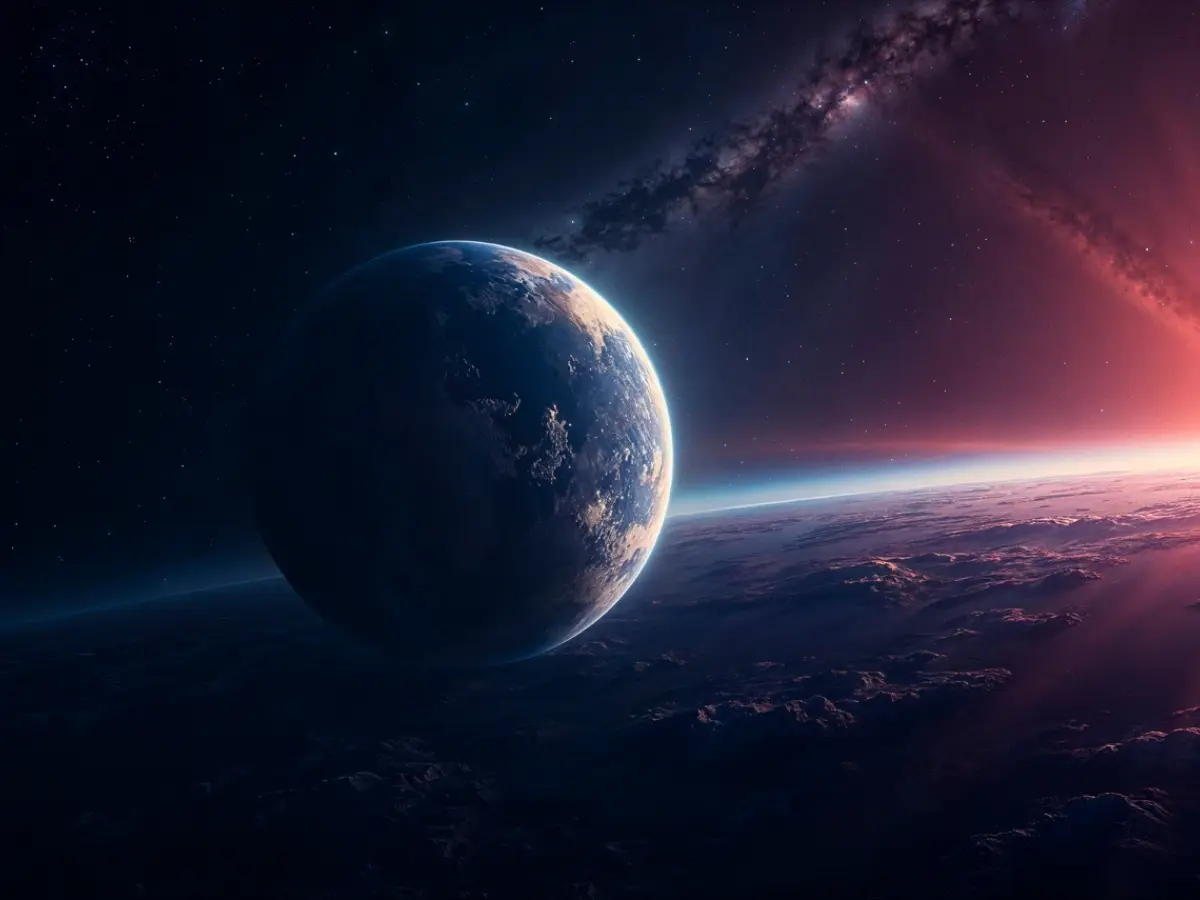
2-billion-light-year-wide cosmic void cocoons Earth and even the Milky Way

&imwidth=600&imheight=450&format=webp&quality=medium "2-billion-light-year-wide cosmic void cocoons Earth and even the Milky Way")
Earth could be in a vast void, and this potentially solves the Hubble tension, Indo-British scientist proposes.
A void in universe? Earth and the Milky Way are lying in a large void in space, a study has stated. Researchers backed it up with the sound of the Big Bang and the smaller number of galaxies near us. The void theory also solves the Hubble tension.
Earth is floating in a vast void in space, according to new findings. Not only our planet, but the entire Milky Way galaxy could be sitting inside a mysterious giant hole in space, astronomers have claimed. The research will be presented at the Royal Astronomical Society’s National Astronomy Meeting (NAM) in Durham, UK. The study, led by Indo-British scientist Indranil Banik, states that this theory could also be a possible explanation for the Hubble tension, EarthSky reported. If it holds true, then the age of our universe could also change. Right now, it is estimated to be 13.8 billion years old. Banik states that the theory of Earth sitting in a void is backed by the sound waves from the early universe, also known as "the sound of the Big Bang." Hubble tension remains a huge problem in astronomy.
What is the Hubble Tension?
Proposed by Edwin Hubble in 1929, the Hubble constant was used to express the rate of expansion of the Universe. This rate has been observed to be increasing. Astronomers observe the distance of celestial objects and how fast they are moving away from us to know how fast the universe is expanding. But, the problem is that when measurements of the distant, early Universe are compared to measurements of the nearby, more recent Universe, the former reveals a slower rate of expansion. This is called the Hubble tension, and some even call it the Hubble crisis. This is where Banik and his team bring in their new theory. Also Read: GREAT WALL of universe: 10 billion light-years long cosmic monster detected in space should not exist
Indo-British scientist says it is highly likely we are in a void
Banik said, "A potential solution to this inconsistency is that our galaxy is close to the centre of a large, local void. It would cause matter to be pulled by gravity toward the higher-density exterior of the void, leading to the void becoming emptier with time. As the void is emptying out, the velocity of objects away from us would be larger than if the void were not there. This, therefore, gives the appearance of a faster local expansion rate." About the Hubble tension, Banik says that it is a "local phenomenon with little evidence that the expansion rate disagrees with expectations in the standard cosmology further back in time. So a local solution like a local void is a promising way to go about solving the problem." Also Read: Scientists use NASA's TESS to discover ‘super-earth’ that could host billions—Is TOI-1846 b humanity's next home?
Sound of the Big Bang
Trending Stories
&imwidth=280&imheight=210&format=webp&quality=medium)
&imwidth=280&imheight=210&format=webp&quality=medium)
&imwidth=280&imheight=210&format=webp&quality=medium)
&imwidth=280&imheight=210&format=webp&quality=medium)
&imwidth=280&imheight=210&format=webp&quality=medium)
&imwidth=280&imheight=210&format=webp&quality=medium)
&imwidth=280&imheight=210&format=webp&quality=medium)
&imwidth=280&imheight=210&format=webp&quality=medium)
&imwidth=280&imheight=210&format=webp&quality=medium)
&imwidth=280&imheight=210&format=webp&quality=medium)
&imwidth=280&imheight=210&format=webp&quality=medium)
&imwidth=280&imheight=210&format=webp&quality=medium)
&imwidth=280&imheight=210&format=webp&quality=medium)
&imwidth=280&imheight=210&format=webp&quality=medium)
&imwidth=280&imheight=210&format=webp&quality=medium)
&imwidth=280&imheight=210&format=webp&quality=medium)
&imwidth=280&imheight=210&format=webp&quality=medium)
&imwidth=280&imheight=210&format=webp&quality=medium)
&imwidth=280&imheight=210&format=webp&quality=medium)
&imwidth=280&imheight=210&format=webp&quality=medium)
&im=FitAndFill=(700,400)&imwidth=280&imheight=210&format=webp&quality=medium)
&imwidth=280&imheight=210&format=webp&quality=medium)
&imwidth=280&imheight=210&format=webp&quality=medium)
&imwidth=280&imheight=210&format=webp&quality=medium)
&imwidth=280&imheight=210&format=webp&quality=medium)
&imwidth=280&imheight=210&format=webp&quality=medium)
&imwidth=280&imheight=210&format=webp&quality=medium)
&imwidth=280&imheight=210&format=webp&quality=medium)
&imwidth=280&imheight=210&format=webp&quality=medium)
&imwidth=280&imheight=210&format=webp&quality=medium)
&imwidth=280&imheight=210&format=webp&quality=medium)
&imwidth=280&imheight=210&format=webp&quality=medium)
&im=FitAndFill=(700,400)&imwidth=280&imheight=210&format=webp&quality=medium)
&imwidth=280&imheight=210&format=webp&quality=medium)
&imwidth=280&imheight=210&format=webp&quality=medium)
&imwidth=280&imheight=210&format=webp&quality=medium)
&imwidth=280&imheight=210&format=webp&quality=medium)
This would mean that Earth and our solar system are near the centre of a two-billion-light-year-wide void. The number of galaxies present in our local universe is lower than in neighbouring regions, which further backs the theory. But it goes against the standard model of cosmology, according to which matter should be more uniformly spread. But there is still something else that supports the idea of a void - the baryon acoustic oscillations (BAOs) – or the “sound of the Big Bang”. Banik said, "These sound waves travelled for only a short while before becoming frozen in place once the universe cooled enough for neutral atoms to form. They act as a standard ruler, whose angular size we can use to chart the cosmic expansion history." Also Read: Interstellar visitor spotted is only the third: One of the other two appeared to be an 'alien vessel'
Banik said that their model and measurements support the idea of Earth lying in a void. His team checked BAOs measurements from over the last 20 years, according to which, it is about 100 million times more likely that a void model exists than a void-free model. Researchers now plan to compare their local void model with other methods to learn more about the history of the universe’s expansion.

