Pangong frozen lake marathon 2026 concludes at Pangong Lake, boosts winter tourism in Ladakh

&imwidth=600&imheight=450&format=webp&quality=medium "Pangong frozen lake marathon 2026 concludes at Pangong Lake, boosts winter tourism in Ladakh")
Pangong Frozen Lake Marathon 2026 Photograph: (WION)
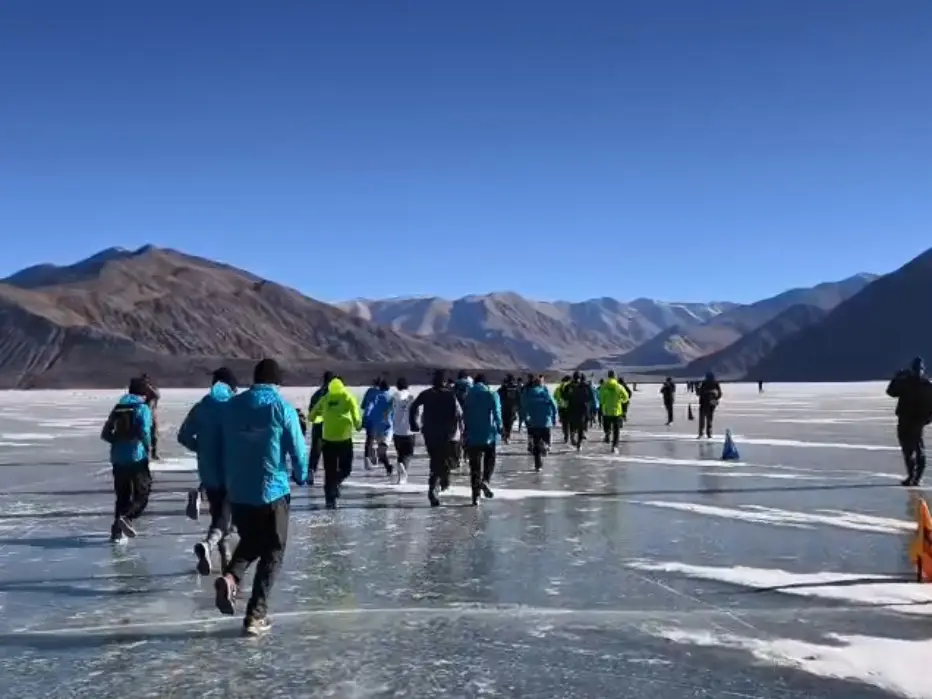
The 4th Pangong Frozen Lake Marathon 2026 concluded at 14,272 ft in Ladakh, drawing 460 runners from across India and abroad. Held in sub-zero temperatures, the event boosted winter tourism and local economy, with strong participation from the Army, ITBP and local communities.
The fourth edition of the Pangong Frozen Lake Marathon 2026 concluded successfully on Thursday at the iconic Pangong Lake, further cementing Ladakh’s growing reputation as a global hub for winter tourism and high-altitude adventure sports.
Held at an altitude of 14,272 feet above sea level, the two-day event (February 24–25) unfolded in extreme temperatures ranging between –15°C and –17°C. Recognized as one of the world’s highest and most challenging frozen lake races, the marathon drew 460 runners from 21 Indian states and international participants from the United Arab Emirates, Nepal, and Australia.
Personnel from the Indian Army and the Indo-Tibetan Border Police (ITBP), along with local residents and children from nearby villages, added a strong community presence to the high-altitude sporting spectacle.
The marathon was organized by Thin Ice Adventures in collaboration with the Union Territory Administration of Ladakh and the Indian Army. The race was flagged off at 8:30 am from Maan village by Durbuk Sub-Divisional Magistrate Mohammad Ismail and Commander Jagdish M.R. of the 114 Brigade.
Trending Stories
)
)
)
)
)
)
)
)
)
)
)
)
)
)
)
)
)
)
)
)
)
)
&im=FitAndFill=(700,400))
)
)
)
)
)
&im=FitAndFill=(700,400))
)
)
)
)
)
On the opening day, 186 runners competed in the 10-km race, while 46 athletes took on the grueling 42-km full marathon across the frozen surface of Pangong Lake. Women athletes made a notable mark, with 16 participants in the 10-km category and six in the full marathon. The second day featured the 21-km half marathon and 5-km races, which saw enthusiastic participation from local youth and visiting runners alike. In the 42-km men’s category, Tsering Nurboo secured first place, followed by Tsering Stobgais in second and Khadim Hussain in third.
The 10-km open women’s race was won by Yeshi Sangdol, who clocked 1:08:34, while Tashi Dolkar and Rinchen Dolkar finished second and third respectively. In the men’s 10-km open category, Mehboob Ali claimed first place with a time of 0:45:01, narrowly ahead of Rinchen Gurmet and Jigmet Stobdan.
The 21-km open female category saw Nima Lhamo finish first, followed by Ishey Dolkar and Tsering Latso. In the men’s half marathon, Tsetan Namgyal led the field, with Tashi Namgail and Sarfaraz Hussain securing second and third positions. In the 5-km open category, Tsewang Dolma topped the women’s race, while Kunchok Dhargyal finished first among men. Dawa Chuzin and Rafket Dolma, along with Sonveer Singh and Rohit, completed the podium positions in their respective categories.
Given the fragile ice conditions and unpredictable weather, organizers prioritized safety. Teams from the National Disaster Response Force (NDRF) and UTDRF carried out detailed inspections, regularly measuring ice thickness before and during the races. Additionally, a scientific assessment based on 15 years of weather data was conducted in collaboration with the Indian Institute of Astrophysics to evaluate environmental patterns and ensure the safe execution of the marathon.
Race Director Chamba Tsetan, an ice hockey player, said the marathon was launched in 2023 to promote winter tourism in Ladakh, a season traditionally marked by minimal tourist activity due to harsh weather conditions. Inspired by the Antarctica Marathon, the event has quickly evolved into a major winter attraction. Organizers noted that the marathon has significantly boosted economic activity in the Changthang region of Eastern Ladakh. Homestay tourism, local employment, youth engagement, and community participation have transformed the typically quiet winter months into a vibrant sporting season.
