AI fighters without airbases, aviation expert Suhas Tejaskanda explains next leap in air power

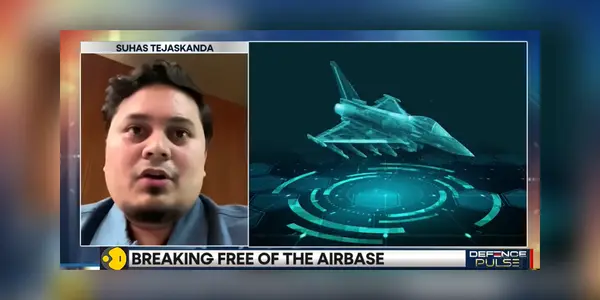
Suhas Tejaskanda, Founder and CEO of Flying Wedge Defence and Aerospace, Photograph: (Credit: WION)
Suhas Tejaskanda, Founder and CEO of Flying Wedge Defence and Aerospace, believes three key factors will determine if this model can scale effectively: basing logistics, cost efficiency, and the level of autonomy AI-piloted aircraft can achieve.
Air power has spent decades moving towards increasingly capable and expensive combat aircraft. But AI and autonomy are opening another possibility, one built around larger numbers of lower-cost aircraft that can operate together and potentially depend less on conventional airbases.
For Suhas Tejaskanda, Founder and CEO of Flying Wedge Defence and Aerospace, three factors will determine whether that model can work at scale. Basing, economics and the autonomy that AI-piloted aircraft can achieve.
Breaking dependence on the runway
Tejaskanda says requirements from the Indian armed forces, particularly for high-altitude environments along India's borders, pushed his team to examine alternatives to conventional runway operations. Flying Wedge is exploring rocket-assisted take-off, or RATO, rather than relying entirely on vertical take-off technology. “You have to have the performance in place and also make something that is runway independent,” Tejaskanda said, explaining why his team chose to explore RATO.
The concept could have significant military implications. Large airbases and runways can become targets during high-intensity conflict. Aircraft capable of operating with less dependence on this infrastructure could potentially be dispersed more widely.
Trending Stories
)
)
)
)
)
)
)
)
)
)
)
)
)
)
)
)
)
)
)
)
)
)
)
)
)
)
)
)
)
)
)
)
)
)
&im=FitAndFill=(700,400))
)
)
)
)
The economics of combat mass
The second challenge is cost. The logic of deploying AI-piloted aircraft in large numbers only works if individual platforms are cheaper than traditional crewed fighters. “These are quite cheaper in nature,” Tejaskanda said, pointing to the emergence of autonomous combat aircraft programmes internationally. He says the company's subscale flight demonstrator is expected to fly in the third quarter of 2026.
From autonomous flight to autonomous combat
The more difficult threshold is autonomy itself. Tejaskanda says his team is currently working at what he describes as Level Four autonomy. He shares that his tactical MALE (Medium Altitude Long Endurance) platform, 'Kaal Bhairava' has completed 100 flight hours, including approximately 20 to 30 hours of autonomous flying.
“We have designed it completely autonomous, take-off and landing without human intervention,” he said. Mission autonomy remains under development. Tejaskanda says the system can currently “identify, track and loiter around the target”, while a human remains in the loop for the final decision.
That distinction could define the next stage of autonomous air power. Flying an aircraft without a pilot is one challenge. Giving it the ability to understand and respond to a changing battlefield is another.

