Iran War drains America's arsenal: Navy forced to revive expired missiles | Gravitas

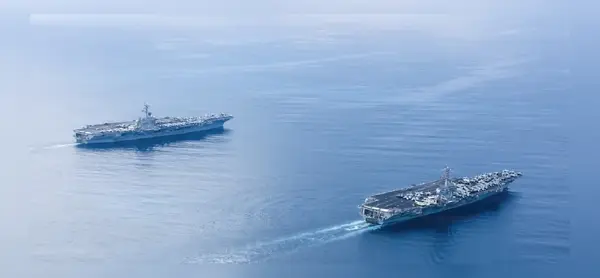
USS Theodore Roosevelt sails with USS George Washington in the Arabian Sea. Photograph: (X)
An estimated two-thirds of Patriots, which cost $5 million each, have been expended against Iranian ballistic missiles. Transfers to Ukraine also diminished the U.S. inventory. Think tank CSIS also pinpointed that around half of the pre-war Thaad inventory has been used in the war.
The protracted Iran War has had a drastic impact on America's munition stockpile.
The crisis is so acute that U.S. Navy has now admitted firing expired munitions during its war with Iran after changing their condition codes.
Acting U.S. Navy Secretary Hung Cao made this disclosure during his Senate confirmation hearing.
Intriguingly, he defended this by highlighting how a poor person survives even on stale bread.
However, Cao did not identify which particular munitions were recoded or how many were fired.
But he did concede that the Iran war has been a strain on the U.S. navy.
Trending Stories


Remember, in September, the Pentagon inspector general's report had also raised serious concerns.
According to this report, munition expenditures during the Iran war resulted in strategic inventory shortfalls and exposed bottlenecks for munition re-supply.
To mitigate these constraints, the report mentioned that U.S. is working to streamline procurement processes and stockpile selected munitions to respond rapidly to a contingency.
According to Reuters, U.S. virtually used up army tactical missile systems as well as precision strike missiles during the Iran war.
These long-range weapons, which cost more than one million U.S. dollars each, allow the U.S. military to conduct accurate strikes from a safe distance.
According to think tank CSIS, U.S. destroyers and submarines are estimated to have fired around one-third of its pre-war Tomahawk inventory.
This long-range cruise missile is launched from ships, submarines and ground launchers, and can strike targets precisely from over 1,600 kilometres away.
Only around eleven hundred Tomahawk missiles are left currently.
Missile defence interceptors are also in short supply.
For instance, an estimated two-thirds of Patriots, which cost five million U.S. dollars each, have been expended against Iranian ballistic missiles.
Transfers to Ukraine have also reportedly diminished the U.S. inventory.
CSIS also pinpointed that around half of the pre-war Thaad inventory has been used in the war.
Seen as an effective defence against ballistic missiles, Thaad complements Patriot by intercepting threats at a higher altitude and over a wider area.
This is not all.
The battlefield cost is also evident from its bases in West Asia, which have suffered damage running into billions of dollars.
Additionally, at least 81 American aircraft, drones and helicopters have been damaged or destroyed.
As of now, 23 U.S. military personnel have been killed in this war, whereas more than 800 others have been injured.
This raises a key question.
Amid such dire state of affairs, will U.S. President Donald Trump change his approach towards negotiations with Iran?