Switzerland expects India trade pact to deliver a significant boost to bilateral commerce, President Guy Parmelin says

&imwidth=600&imheight=450&format=webp&quality=medium "Switzerland expects India trade pact to deliver a significant boost to bilateral commerce, President Guy Parmelin says")
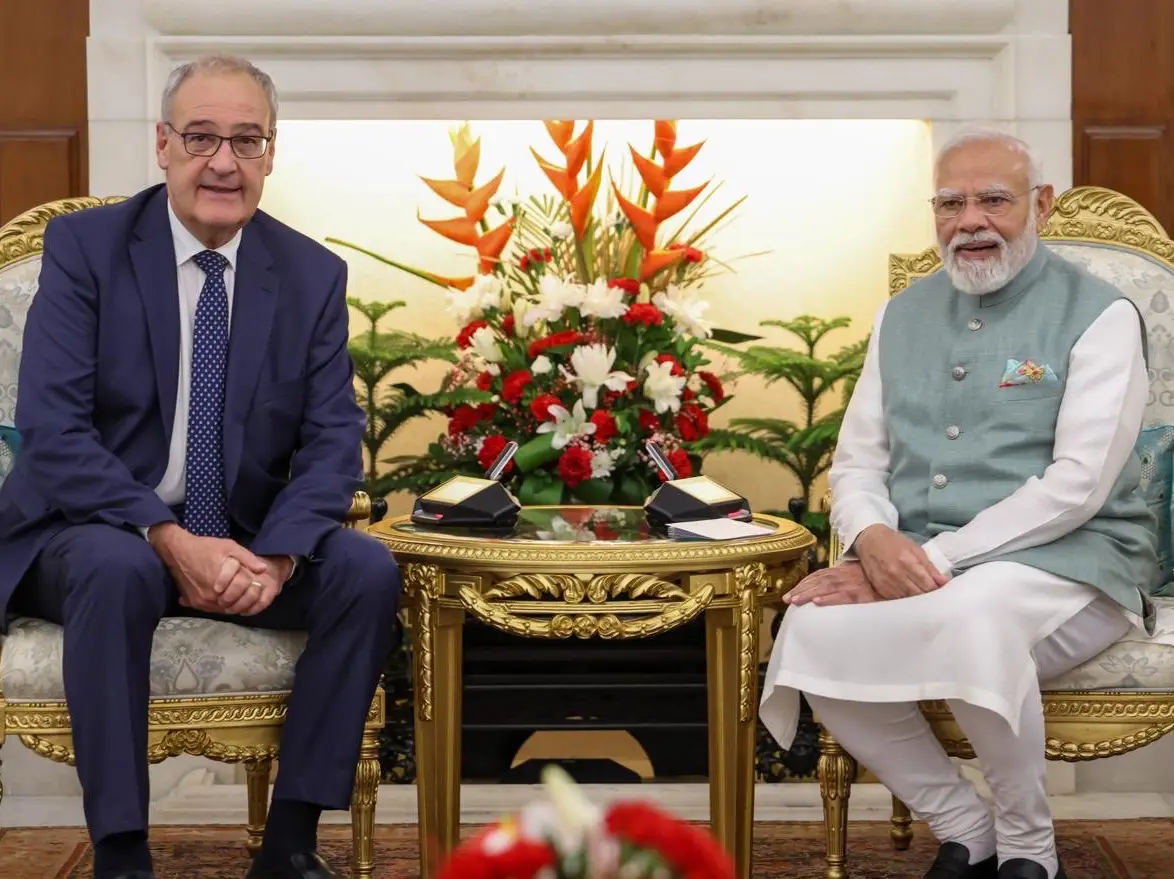
Swiss President Guy Parmelin and Indian Prime Minister Narendra Modi
Swiss President Guy Parmelin says the India-EFTA trade pact will boost bilateral trade, investment and business ties while deepening cooperation on AI and mobility.
Switzerland expects its new trade pact with India to lift investment and commerce, Swiss President Guy Parmelin has said, as the two countries also prepare to cooperate on successive global AI summits and deepen mobility links. The India–EFTA Trade and Economic Partnership Agreement has been in force since October 2025.
Parmelin, speaking to WION's Sidhant Sibal, said that Swiss firms had already made or were planning investments in transport and logistics, financial services, manufacturing, pharmaceuticals and biotechnology, and technology and electronics. “I expect that the TEPA will provide a significant boost to bilateral trade between Switzerland and India in the years to come,” he said.
He described India as a key partner for the global AI summit Switzerland will host in Geneva in 2027, following India’s AI Impact Summit in 2026. Priorities were “closely aligned,” he said after meeting Prime Minister Narendra Modi, and Switzerland wanted continuity between the events.
Full interview
Sidhant Sibal: How has the India–EFTA Trade and Economic Partnership Agreement, in force since October 2025, changed the commercial relationship between Switzerland and India?
Guy Parmelin: The relationship between our two nations is moving from strength to strength. According to information available to us since the entry into force of the TEPA, Swiss companies have made or are planning investments in a wide range of sectors, including transportation and logistics, financial services, manufacturing, pharmaceuticals and biotechnology, and technology and electronics. I expect that the TEPA will provide a significant boost to bilateral trade between Switzerland and India in the years to come.
Trending Stories
)
)
)
)
)
)
)
)
)
)
)
)
)
)
)
)
)
)
)
)
)
)
)
)
)
)
)
)
)
)
)
)
)
)
&im=FitAndFill=(700,400))
)
)
)
)
Sidhant Sibal: Why did Switzerland choose to host the next global AI summit in Geneva in 2027, and how will India be involved?
Guy Parmelin: India’s hosting of the AI Impact Summit 2026 has been of great importance to Switzerland. My meeting with Prime Minister Modi confirmed that our priorities are closely aligned. As we prepare to host the next summit in Geneva in 2027, India is a key partner for us. We are committed to ensuring continuity between the two summits and beyond. India has demonstrated exceptional leadership in amplifying the voices of those who are underrepresented in global technology discussions, particularly those from the Global South. Switzerland will build on this, for example through the International Computation and AI Network (ICAIN), which promotes an equitable distribution of technological benefits and fosters knowledge sharing and AI research across all regions. We are currently refining the thematic focus of the Summit and exploring how cooperation with key partners could be structured. I look forward to India’s participation in Geneva.
Sidhant Sibal: How can Switzerland and India deepen collaboration in science, technology, and innovation?
Guy Parmelin: More than 450 Indian students are currently enrolled at the two federal technological universities (ETH Zurich and EPFL). Furthermore, ETH Zurich currently employs 6 Professors and over 200 research assistants of Indian nationality.
One instrument of international cooperation in research is the Swiss Government Excellence Scholarships. Each year the Swiss Confederation awards Government Excellence Scholarships to promote international exchange and research cooperation between Switzerland and other countries. These very competitive scholarships help build lasting scientific relationships between our countries.
Swiss universities and research institutions maintain a range of partnerships with Indian universities and research organisations. Such collaborations are generally initiated and developed directly by the institutions concerned, in line with their respective priorities and areas of expertise. The Agreement between Switzerland and the Republic of India on Scientific and Technological Cooperation (2003) certainly provides a good framework for this cooperation.
Sidhant Sibal: What role should talent mobility and education linkages play in the next phase of India–Switzerland relations?
Guy Parmelin: I am excited to share that Switzerland and India have just concluded two agreements in the field of migration this month: the Migration and Mobility Partnership and the Young Professionals Agreement. These agreements mark an important milestone in our bilateral cooperation and reflect our shared commitment to a comprehensive and mutually beneficial approach to migration. They facilitate legal migration and mobility while strengthening cooperation on return and readmission. Switzerland has a well-established and nuanced work permit system, and work permits for Indian nationals are regulated separately from the Migration and Mobility Partnership. Nevertheless, the significant number of Indian professionals coming to Switzerland each year – around 1,500 to 1,900 work permits are issued to Indian nationals annually – reflects the strong and growing people-to-people links between our two countries. Today, around 19,000 Indian nationals live in Switzerland, making an important contribution to our societies, economies and bilateral relations.
Sidhant Sibal: Looking ahead from 2026, what would a successful elevation of the India–Switzerland partnership look like in your view?
Guy Parmelin: For me, success would be when people actually feel this partnership in their everyday lives, whether that is in business, in research or in the classroom. The EFTA-India agreement gives us a great framework, and now the real work is using it well. That means more Swiss companies investing in India, more Indian companies finding opportunities in Switzerland, and real jobs created on both sides. But it goes beyond trade. Switzerland and India complement each other in a lot of ways. We bring precision, research strength and a long tradition of vocational training, and India brings scale, talent and a real energy for innovation. So I would love to see our universities, start-ups and research institutions working much more closely together. And finally, I would like us to speak with a shared voice internationally. We both believe in technology that works for everyone. If we can team up on responsible AI, building on the summit in New Delhi and the one we are hosting in Geneva in 2027, then this partnership will be doing something that matters well beyond our two countries.
