Opinion: Let's save Amarnath, not destroy its religious essence

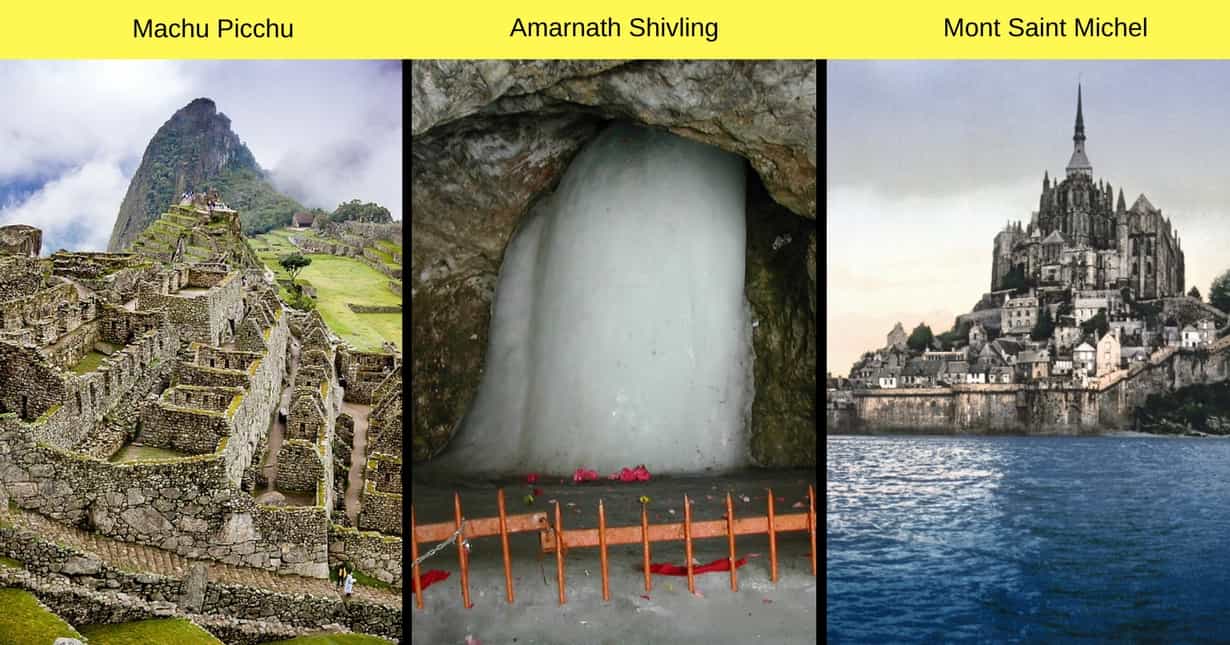
Mont Saint Michel, Amarnath Shivling and Machu Picchu
The devotees and others visit Amarnath out of sheer emotional needs, to satisfy their spiritual quest. The rules should retain the essence of the place and not do away with it.?
I am not religious, but I visited Amarnath.
Visiting Amarnath, standing in front of the Shivalingam gave me goosebumps. I have rarely experienced something like this. And believe me, I have travelled quite a bit around the world. I was crying uncontrollably. The CRPF jawans guarding the cave were staring at me from far, but would not walk up to me and ask me to leave as they were doing to other pilgrims.
I have never cried either before or after that in a public place and that also for no known reason.

Why was I so emotionally moved? Anything of exceptional beauty moves us and brings the tear to our eyes. Amarnath is all about ruggedness, snow-capped peaks. It is beautiful. But not in a soft filmy kind of way.
Gandhiji believed that trains are not good for the human civilisation. One reason he cited was that in ancient days pilgrims had to toil, very hard, to reach the holy places. But with the introduction of the railways, the toil and the effort involved in the process has vanished, making the act of pilgrimage trivial.
If you are planning to climb Amarnath by foot there is no way you can escape the toil involved. It is hard. Very hard indeed, particularly with so little oxygen available at that height. I lost all my toenails. I badly bruised myself. As I mentioned I was crying in front of the Shivalingam, it is because of the extreme hardship I suffered to reach the cave. I was muttering to myself or to God, I am not sure, that if I revisit, then it has to be because of an explicit directive from the Almighty. I will not come by choice. If there is a Supreme Being, it has to pull me in.
)
US vs China over South China Sea: Washington backs Philippines, Beijing hits back
)
Bigg Boss 20: Isha Rikhi evicted after three weeks in Salman Khan’s show
)
Musk plans to more than double xAI's chips to over 1.2 million Nvidia GPUs by year-end
)
After JU, clash erupts at SRFTI: BJP’s ‘Dimagi Naxal’ jibe sparks political firestorm after students protest RSS-linked event
)
‘Anti-social elements spreading false rumours’: LPU issues statement amid massive unrest over alleged rape
)
LPU students go on rampage, vandalise campus amid widespread protest: What's happening
)
Trump asked Xi to pressure Iran. China did not say yes — here’s what Beijing wants
)
US Treasury Secretary Scott Bessent hails global crackdown on Iranian banks and airlines
)
An OpenAI agent escaped its locked test cage again, by hiding questions in DNS lookups
)
'Our video was trimmed': LPU girls who featured in rape-denial video make U-turn
)
3 males killed, four others injured in shooting after fight at strip club in Detroit
)
'Victory for low-budget consumers': Raghav Chadha hails 30-day telecom recharge rules
)
Claude rebuilt the 1989 game 'Prince of Persia' by reusing the original's own code
)
Beyond metros: How Tier-2 and Tier-3 cities could drive India’s next AI wave
)
Tesla builds first Cybertruck with its own refined lithium: Elon Musk's $1 billion Texas bet pays off
)
IndiGo flight suffers tail strike in Bengaluru while landing; DGCA to probe incident
)
The US and China set up an AI 'red telephone', but skipped the rulebook
)
‘Terror suspects arrested near UK air base were looking to do big damage’: Trump
)
Russian envoy claims US tactics to contain India were revealed in ‘Freudian slip’
)
IND vs WI 1st ODI: Kohli breaks Sachin's most runs in one country record with unbeaten 139 as India thump West Indies by 8 wickets
)
Researchers rebuilt exactly how 700 AI agents hacked Hugging Face: a 900-link chain trick
)
‘Olympic inclusion is our major target’: WPA President Ishaun Singh on pool’s global ambitions
)
Nations League: Spain sink England at Wembley; Modric shines for Croatia
)
Why has Iran released no proof of life of Mojtaba Khamenei? Araghchi reveals...
)
'What kind of confession is this?': Pakistan PM Shehbaz Sharif’s 'terrorists would be roaming New York' remark goes viral, raises alarm online. Watch
)
South Korea demands apology from Ukraine over North Korean prisoners' transfer
)
Beyond BrahMos: India targets Rs 50,000 crore in defence exports with unmatched price edge
)
Sri Lankan Tamil migrant worker gets death sentence in Saudi Arabia, help sought from India
)
Muslim marriage cannot shield sex with minor wife from prosecution under POCSO: Delhi HC
)
'Can't help but draw painful parallels to Nirbhaya case': SC on latest incidents of rape cases in Delhi-NCR
)
99.9% more powerful - Scientists find boy who can recall memories from just 3 months of age
)
'FIRST LOOK from inside Noah’s Ark': Researchers share video from inside mysterious mound in Turkey
)
UNSC reform momentum grows: Russia, Portugal, Mauritius push for India's permanent seat bid
)
8 US marines injured in Iranian missile attack on vessel in Strait of Hormuz: Report
&im=FitAndFill=(700,400))
New OTT releases this week (September 28-October 4, 2026): Dupahiya 2, Pooja Meri Jaan, Ohh My Dog- 5 titles coming on Netflix, Prime Video and more
)
Afghanistan says 28 fighters killed in clash near Pakistan border, Islamabad denies
)
Ceuta migrant crisis: Protesters take to streets as Spain grapples with migrant challenge
)
LPU suspend classes, postpones exams as violence escalates over rape claims: What's happening
)
New York City wants a 'kill switch' on every AI, and will pay whistleblowers who report violations
This is the first time, I am sharing such personal feelings about my Amarnath yatra. The reason being I am kind of stirred and divided over the rulings given by the National Green Tribunal (NGT).
The NGT has recently declared few guidelines about the Amarnath Cave that will guide tourists while in the area. The guidelines include, maintaining silence in front of Shivling, one-way queue of pilgrims, there should be no ringing of bells, no mobiles or belongings to be carried beyond the last check post.
The NGT justifies these steps to maintain the sanctity of the cave and to ensure no adverse noise impact on the Shivling.
I am on the same page with anybody asking for the conservation of historically, culturally and naturally unique sites. In its preciousness, Amarnath belongs to an exclusive niche. We have to ensure its longevity, and like other fragile places, such as Macchu Picchu, Petra, and the Mont Saint Michel, we have to ensure strict code of conduct for visitors.
The use of cell phones must be discouraged because it is a distraction. But asking pilgrims to deposit their belongings in a special locker room would create a big hassle and another long line for an exhausted group of people who often include elderly, people with special needs and women. If anyone of you have visited the Mughal Garden in New Delhi will know what I exactly mean. And, the Mughal Garden receives only a fraction of visitors that Amarnath gets every year.
But I am not sure why ringing of bells should stop and why there should be absolute silence in front of the Shivalinga. We are not visiting a moratorium or a sanctuary, we are visiting a religious site. We can promise and endeavour to keep it clean and safe but there is no need for this enforced silence.
Ringing the bell has been part of many religious rituals worldwide. All my life I have seen both my grandmas, my mom and mom-in-law to have rung the handbell, which they called the 'ghonta' in Bengali while doing puja. The bell rings for a brief few seconds. The idea behind the act is to let the deity know that the devotee is there. Over the years, I have found a deeper underlying significance of ringing the bell; it acts as a referee's whistle. Once, the devotee enters the temple, the person rings to tell himself that it is now the time to focus on God alone. The bell marks the process of withdrawing from the material world to focus on the transcendental.
If ringing of bells is turning into a cacophony, the ideal thing will be to restrict the number of pilgrims visiting the Amarnath cave every day.
This is a very common practise among all important sites. Macchu-Picchu imposes a strict rule on the number of people that can visit the site at the top of the hill. Petra does not even allow people to enter the tombs or the stone buildings.
Amarnath needs to implement similar rules but it should not be felt as an imposition. The devotees and others visit the site out of sheer emotional needs, to satisfy their spiritual quest. The rules should retain the essence of the place and not do away with it.
(Disclaimer: The opinions expressed above are the personal views of the author and do not reflect the views of ZMCL)