

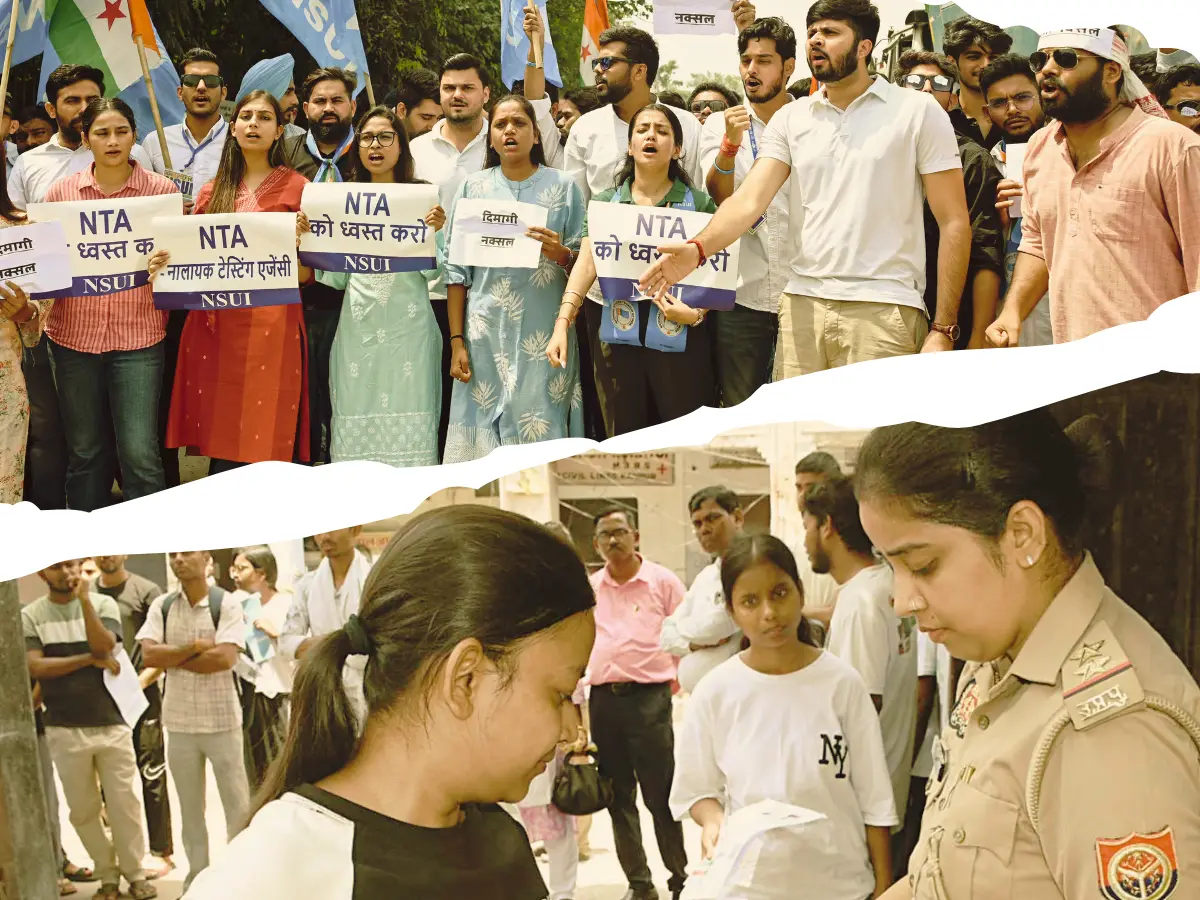
&imwidth=800&imheight=600&format=webp&quality=medium "‘Retest is not accountability...’: What professors told WION about NTA’s decision to re-conduct UGC-NET for 3 papers")
The National Testing Agency (NTA) has ordered a re-examination for the UGC-NET June 2026 for three subjects namely English, Commerce and Sociology. While English and Commerce re-exam will be conducted on September 9, the Sociology exam will be conducted on September 10. This is only the second time since NTA’s inception that the National Eligibility Test (NET) has needed to be redone. The last was in 2024, when the pen-and-paper session was scrapped amid allegations of a leak.
In English, the candidates and coaching teachers alleged that several questions were repeated from earlier UGC-NET cycles, particularly December 2024 and 2025. In Sociology, candidates flagged several spelling errors, including “Ritzer” appearing as “Putzer”, “Ghurye” as “Ghunye”, “Parsons” as “Parsow” and “Nussbaum” as “Nusbaut”, among others. In Commerce, students taking the Commerce exam also alleged that questions were repeated from previous exam cycles.
Also Read: Paper leak, re-NEET and trauma: What's the mental cost of India's medical entrance exam crisis
As students prepare for re-examination, WION spoke to professors from several Indian universities to understand their view on the matter:
What educators said to WION?
Trending Stories
&im=FitAndFill=(700,400)&imwidth=180&imheight=135&format=webp&quality=medium)
What is the real meaning behind Pete Hegseth's tattoos?
&imwidth=180&imheight=135&format=webp&quality=medium)
UK navy hit by espionage scandal: Sailor accused of spying for Russia | Gravitas
&imwidth=180&imheight=135&format=webp&quality=medium)
Katie Zacharia likely to succeed Karoline Leavitt as Trump's White House press secretary
&imwidth=180&imheight=135&format=webp&quality=medium)
‘Never-ending flow of cheap labour’: JD Vance hits back at Indian-origin Congresswoman over US green card curbs for major tech companies
&imwidth=180&imheight=135&format=webp&quality=medium)
Trump's naked 23-karat gold statue unveiled near European Parliament
&imwidth=180&imheight=135&format=webp&quality=medium)
‘Ruh Roh’: Top US official mocks ‘Indian market collapse’ claim after Trump’s IT curbs. But did it? | FACT CHECK
&im=FitAndFill=(700,400)&imwidth=180&imheight=135&format=webp&quality=medium)
Fastest-growing Asian economies in 2026: Who tops the chart? Where does India rank?
&imwidth=180&imheight=135&format=webp&quality=medium)
Houthis continue direct hits on Saudi targets, Türkiye and Pakistan missing in action | Gravitas
&imwidth=180&imheight=135&format=webp&quality=medium)
'Do not stop it altogether': SC asks Centre to review Delhi Metro curbs ahead of Oct 10 protests
&imwidth=180&imheight=135&format=webp&quality=medium)
Prince Harry opens up about loss, depression, and recovery: 'I felt guilty being happy'
&imwidth=180&imheight=135&format=webp&quality=medium)
Jewar airport in Noida to be renamed Narendra Modi International Airport: CM Yogi
&imwidth=180&imheight=135&format=webp&quality=medium)
Russia president Putin promises to 'do everything' to help settle Middle East conflict as US-Iran negotiations stall
&imwidth=180&imheight=135&format=webp&quality=medium)
Powerful 7.7 magnitude earthquake strikes Panama, tsunami warning issued
&imwidth=180&imheight=135&format=webp&quality=medium)
BTS agency HYBE announces first-ever Weverse Con Festival in India
&imwidth=180&imheight=135&format=webp&quality=medium)
Trump has a new 'enemy': Anyone who calls it 'artificial intelligence'. Here's what we wants instead
&im=FitAndFill=(700,400)&imwidth=180&imheight=135&format=webp&quality=medium)
New Friday OTT releases (October 9, 2026): Reporting Live, Animals, Take Charge of My Heart- 6 new titles coming on Netflix, JioHotstar and more
&imwidth=180&imheight=135&format=webp&quality=medium)
BTS' RM urges Peru fans not to gather outside hotel: 'We can't sleep', It's becoming a nuisance'
&imwidth=180&imheight=135&format=webp&quality=medium)
Is Trump playing a double game with Iran?
&imwidth=180&imheight=135&format=webp&quality=medium)
Trump announces Russian diesel deal as Zelensky criticises move
&imwidth=180&imheight=135&format=webp&quality=medium)
Pakistan denies reports of PAF jets being used in attacks against Iran-backed Houthis in Yemen
&imwidth=180&imheight=135&format=webp&quality=medium)
New York ICE shooting sparks protests as Mamdani to call on Trump to halt ICE operations
&imwidth=180&imheight=135&format=webp&quality=medium)
IND vs WI: West Indies set record for highest successful run chase in T20Is against India
&imwidth=180&imheight=135&format=webp&quality=medium)
French students light European bonfire, protests erupt in Belgium, Italy & Greece | Gravitas
&im=FitAndFill=(700,400)&imwidth=180&imheight=135&format=webp&quality=medium)
Food shortages, suicide attempts and more: USS Abraham Lincoln returns to US after 321 day deployment amid Iran war — The whole row explained
&imwidth=180&imheight=135&format=webp&quality=medium)
OpenAI shuts down Russian, Iranian influence operations using ChatGPT to spread propaganda
&imwidth=180&imheight=135&format=webp&quality=medium)
SC questions closure of 57 Delhi Metro stations, asks Centre to resume services in regulated manner
&im=FitAndFill=(700,400)&imwidth=180&imheight=135&format=webp&quality=medium)
435 House seats, 35 Senate races: The numbers behind US midterms 2026
&imwidth=180&imheight=135&format=webp&quality=medium)
Bangladesh named as Pakistan’s replacement for Asian Hockey Champions Trophy
&imwidth=180&imheight=135&format=webp&quality=medium)
‘We will end ICC’: US sanctions International court, threatens to cripple hours after Navi Pillay wins Nobel Peace Prize
&imwidth=180&imheight=135&format=webp&quality=medium)
US midterm elections 2026: What a blue wave or blue tsunami could mean for Trump
&imwidth=180&imheight=135&format=webp&quality=medium)
SC asks Centre to frame mechanism against unethical pharma marketing practices
&imwidth=180&imheight=135&format=webp&quality=medium)
'Warning lights are flashing': Strongest El Nino since 1950 will turn the world red
&imwidth=180&imheight=135&format=webp&quality=medium)
Trump honours Microsoft CEO Satya Nadella with top technology honour amid immigration scrutiny
&imwidth=180&imheight=135&format=webp&quality=medium)
Sri Lankan Tamil worker gets death sentence in Saudi Arabia over blasphemy, calls for pardon intensify
&imwidth=180&imheight=135&format=webp&quality=medium)
‘Real boss of India’: Elon Musk escalates attack over Starlink’s India entry
Speaking to WION, educators said that the UGC-NET re-examination may be necessary to correct flawed question papers, but stressed that the larger issue is the "reliability and accountability" of India’s national examination system. From the toll of the retest on students after months of preparation to its impact on the academic plans and career decisions, educations shed light on several issues, while also advising the students to keep their focus intact.
Dr Yamini, Associate Professor at Delhi University, said that repeated problems with national-level examinations point to systemic shortcomings and the need for an overhaul. She argued that students, who invest considerable time and effort in preparing for such tests, should not be made to pay for avoidable administrative errors. “Most students pin their hopes to these exams and a tremendous amount of preparation goes into them. Such repeated problems with these exams reveal larger systemic issues that further expose the need for an entire rehaul. Students cannot be expected to pay the price for such avoidable errors,” Yamini told WION.
Her concern was echoed by Dr Anurag Shankar Singh, Assistant Professor (PhD UGC-NET-JRF) at Mewar University, Chittorgarh, who said that a re-examination is justified when papers are substantially flawed. “If there were genuine irregularities or issues with the examination, then a re-test is certainly justified. The credibility and fairness of a national-level examination must remain the priority,” he told WION.
The delay in announcement for re-test has been flagged by several students as they prepare for the examination again. Amit Kumar, PGT Chemistry at Patna Doon Public School, explained the irony of the situation by highlighting how the discipline expected to be followed by students is not aligning with the way in which the system is running. “From an educator's perspective, we often tell students that examinations are about discipline, preparation and performance. But there is an equally important principle that the examination system itself must be reliable and accountable. When the system itself becomes uncertain, the psychological cost is much greater than simply appearing for another three-hour paper,” he said.
Archit Dutta, PGT at Birla Bharati, highlighted the ripple effects on PhD admissions, fellowship disbursements and career planning, saying candidates can be left in prolonged professional limbo when examination schedules are disrupted. “For many candidates, UGC-NET is not just another examination. It is closely connected with PhD admissions, JRF opportunities and their future academic careers. When the decision about a re-examination comes late, students are left in a difficult situation. They have to decide whether to focus on the re-test or begin preparing for the next examination cycle.”
‘Retest is not accountability’
When asked about the sanctity of the institutions like NTA, Singh said, “There is also a larger issue of trust. Students spend months preparing for UGC-NET, along with considerable money, time and emotional energy. If they are asked to appear again, they deserve a clear explanation of what went wrong and, more importantly, what steps are being taken to ensure that the same problem does not occur again.” Several educators also stressed that the re-test should not be mistaken for accountability. Dutta opined that students deserve a clear explanation of what went wrong and what steps are being taken to prevent similar failures. "While correcting a fundamentally flawed paper by holding a re-examination is a necessary damage-control measure, viewing it as "accountability" mistakes the symptom for the disease," he said.
Akshay Anand, Guest Faculty in the Department of Environmental Sciences at Anugrah Narayan College, Patna did not mince words and said that “retest alone is not accountability.” “Accountability means explaining how these errors occurred, fixing the quality-control mechanism and ensuring students don't have to repeatedly pay the price for institutional mistakes,” he said.
What educators advised the students?
When asked for advice to students ahead of the retest, Singh noted that candidates have responded differently to the re-examination: while some see it as the fairest solution, others are frustrated by the disruption to their academic plans. He advised students to prepare for the September examination while continuing to pursue PhD admissions, fellowships and other opportunities. “Some students believe that a re-examination is the fairest way forward and are willing to appear again. Others are frustrated because another examination may disturb their academic plans, particularly their PhD admission timelines and preparation for other opportunities. My advice to students would be not to allow the uncertainty to undermine their confidence. If a re-examination is being conducted, they should approach it seriously and treat it as another opportunity to demonstrate their preparation. At the same time, they should continue exploring PhD admissions, fellowships and other academic opportunities rather than putting everything on hold,” he added.
Similarly, Anand urged students not to allow their frustration with the system to undermine their confidence and encouraged them to keep their broader academic plans moving. “I would not advise students to see September as a 'wasted session.' They have already prepared once; they should consolidate rather than restart—focus on weak areas, PYQs and mock tests. Don't prepare psychologically for December before September is over,” he said. He also encouraged students to keep demanding answers from the system. “My message to students would be: You have every right to be disappointed with the system, but don't let that disappointment make you doubt your own preparation and ability. Prepare for the re-test, demand accountability, and keep your academic plans moving forward.”

