Allegations of police excess at CJP protests warrant independent probe, says SC

&imwidth=600&imheight=450&format=webp&quality=medium "Allegations of police excess at CJP protests warrant independent probe, says SC")
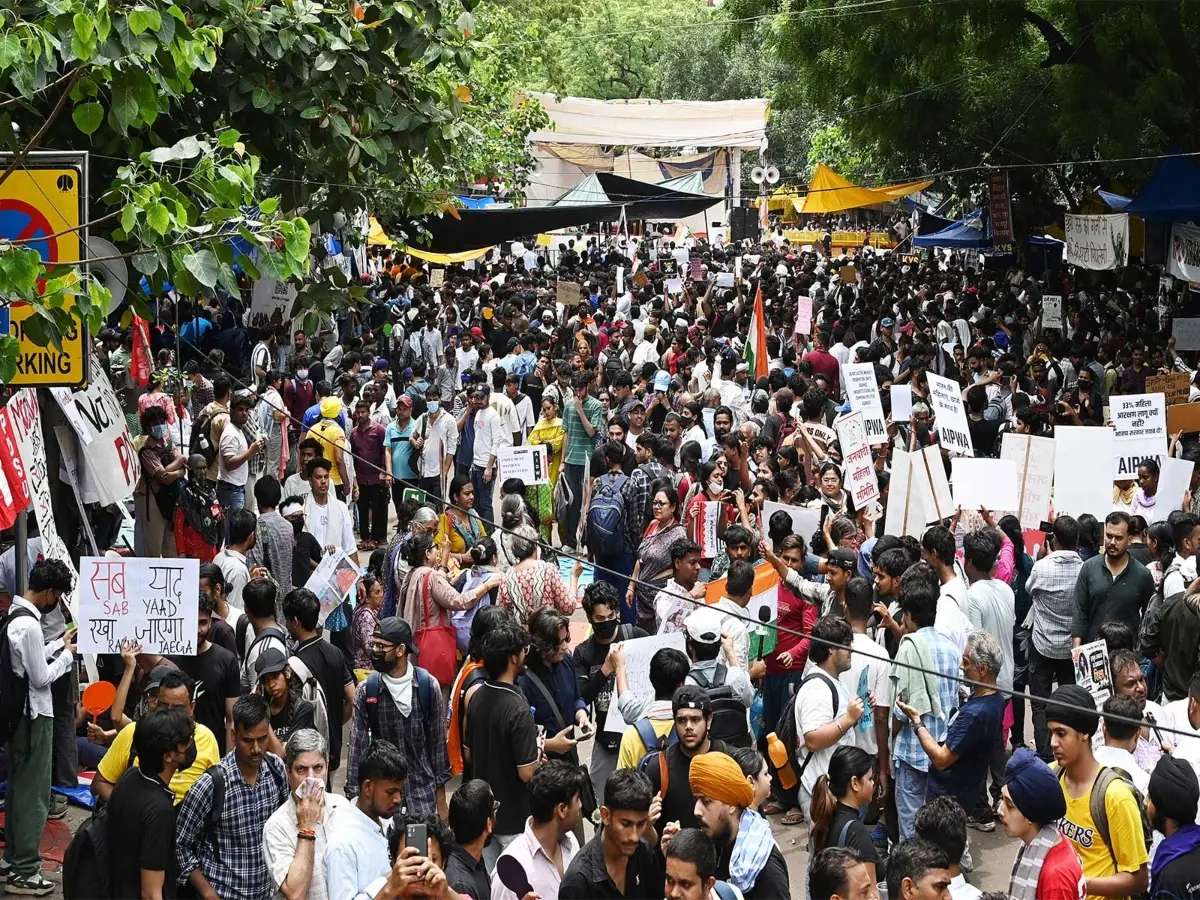
Cockroach Janata Party protest at Jantar Mantar Photograph: (ANI)
In several of the petitions it has been alleged that the police used pellet guns, electric batons and lathi charged students to disperse them from wherever they gathered to protest.
The Supreme Court of India on Tuesday barred any coercive action against students who participated in the recent protests over the NEET paper leak. The Court held that the allegations of police brutality across several states disclosed a prima facie case for an independent inquiry that is "scientific" and "evidence" based.
While passing the order Bench of Chief Justice Surya Kant and Justices Joymalya Bagchi and V Mohana said that a fresh constitutional framework is required to for evolving methods of crowd control.
"Whoever has committed excess ... atrocities on innocent people, the law will take care of them. For that, there needs to be a completely independent and fair investigation," Kant said, according to legal website Live Law.
Allegations of excessive force
The court was hearing a bunch of petitions regarding allegations of excessive force used against students protesting across the country regarding examination irregularities, including the NEET paper leak.
Trending Stories
)
)
)
)
)
)
)
)
)
)
)
)
)
)
)
)
)
)
)
&im=FitAndFill=(700,400))
)
)
)
)
)
)
)
)
)
)
)
)
)
)
)
&im=FitAndFill=(700,400))
)
)
)
)
)
In several of the petitions it has been alleged that the police used pellet guns, electric batons and lathi charged students to disperse them from wherever they gathered to protest.
One of the petitions alleged that the use of pellet guns caused a 19-year-old boy to lose his eyesight. Another petition claimed that electric batons had caused life threatening injuries to a young protester.
While some petitions were filed by the family members of the police officers too who alleged they were assaulted during the demonstrations.
"Police had failed to follow the graded protocol"
Appearing for one of the petitioners, Senior Advocate Gopal Sankaranarayanan argued that police had failed to follow the graded protocol which required announcements through loudspeakers, the use of water cannons before force and carefully regulated deployment of tear gas away from the crowds and lathis. He also contended that several officers operated without identification badges.
“We want responsibility to be placed up the ladder. Unless this Court does that, the police think they can get away.” said Sankaranarayanan suggesting that a Special Investigation Team (SIT) be constituted headed by a former CJI.
