Bangladesh election 2026: List of all prime ministers since independence

&imwidth=600&imheight=450&format=webp&quality=medium "Bangladesh election 2026: List of all prime ministers since independence")
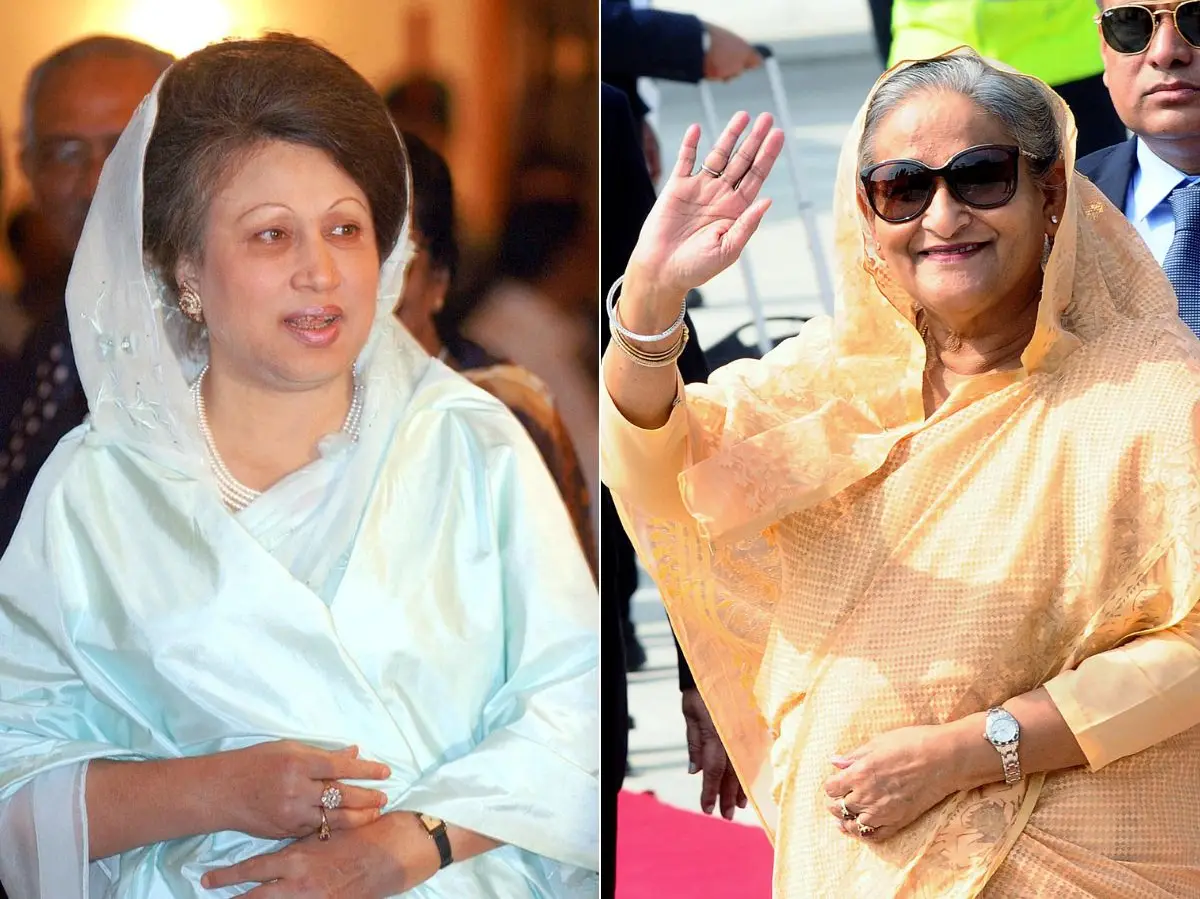
Khaleda Zia and Sheikh Hasina Photograph: (AFP)
Bangladesh has had six prime ministerial tenures since 1971, led mainly by Sheikh Mujibur Rahman, Khaleda Zia and Sheikh Hasina, reflecting decades of political rivalry and shifting governance.
As Bangladesh cast its vote in the first election on Thursday (Feb 12) after the deadly 2024 uprising, BNP’s Tarique Rahman and Jamaat‑e‑Islami leader Shafiqur Rahman compete in a two-way contest. The election is one of its most consequential in decades and comes about 18 months after the resignation of long-time prime minister Sheikh Hasina, which ended the Awami League’s rule.
Bangladesh’s political journey
Since gaining independence in 1971, Bangladesh’s political journey has been closely tied to the office of the Prime Minister, with periods of both parliamentary and presidential rule shaping the country’s governance. The nation’s first Prime Minister was Tajuddin Ahmad, who led the provisional government during the Liberation War in 1971. Operating from exile, he played a crucial role in coordinating the struggle for independence against Pakistan and laying the foundations of the new state.
After independence, Sheikh Mujibur Rahman, the founding father of Bangladesh, assumed office as Prime Minister in 1972. His tenure marked the early years of nation-building. However, in 1975, he introduced a presidential system, effectively abolishing the parliamentary structure. Later that year, he was assassinated, plunging the country into political turmoil and years of military and presidential rule.
Parliamentary democracy was restored in 1991, ushering in a new political era. Khaleda Zia, leader of the Bangladesh Nationalist Party (BNP), became Prime Minister from 1991 to 1996, becoming the country’s first woman to hold the post. In 1996, Sheikh Hasina, daughter of Sheikh Mujibur Rahman and leader of the Awami League, took office for her first term, serving until 2001. Khaleda Zia returned to power from 2001 to 2006, leading a coalition government.
Sheikh Hasina again assumed office in 2009 and went on to serve multiple consecutive terms, becoming the longest-serving Prime Minister in Bangladesh’s history. Her tenure continued until 2024, marking one of the most dominant political periods in the country’s post-independence era.
Trending Stories
)
)
)
)
)
)
)
&im=FitAndFill=(700,400))
)
)
)
)
)
)
)
)
)
)
)
)
)
)
)
)
)
)
)
)
)
)
)
&im=FitAndFill=(700,400))
)
)
&im=FitAndFill=(700,400))
)
)
)
)
)
)
)
List of prime ministers of Bangladesh
Here’s a list of all prime ministers of Bangladesh from its independence till present:
| 1 | Sheikh Mujibur Rahman | 12 Jan 1972 – 25 Jan 1975 | Awami League |
| — | Muhammad Mansur Ali | 25 Jan 1975 – 15 Aug 1975 | Awami League |
| 2 | Mashiur Rahman (acting) | 15 Aug 1975 – 6 Nov 1975 | Independent |
| 3 | Muhammad Habibullah Bahar | 6 Nov 1975 – 20 Nov 1975 | — |
| 4 | Khandaker Mushtaq Ahmed | 29 Nov 1975 – 7 Nov 1976 | — |
| 5 | M. A. Hannan (acting) | 7 Nov 1976 – 29 Jun 1978 | BNP precursor |
| 6 | Mohammad Martuza | 29 Jun 1978 – 12 Jun 1981 | — |
| 7 | Shah Azizur Rahman | 12 Jun 1981 – 24 Mar 1982 | BNP |
| — | Position vacant (military rule) | 1982–1986 | — |
| 8 | Mizanur Rahman Chowdhury | 27 Dec 1986 – 6 Dec 1990 | Jatiya Party |
| 9 | Kazi Zafar Ahmed | 6 Dec 1990 – 20 Oct 1991 | — |
| 10 | Khaleda Zia | 20 Oct 1991 – 15 Oct 1996 5 Jul 2001 – 21 Oct 2006 | BNP |
| 11 | Muhammad Habibur Rahman (acting) | 30 Oct 1996 – 23 Jun 1996 | Independent |
| 12 | Sheikh Hasina | 23 Jun 1996 – 15 Jul 2001 6 Jan 2009 – 5 Aug 2024 | Awami League |
| 13 | Latifur Rahman (chief adviser, acting equiv.) | 15 Jul 2001 – 10 Oct 2001 | Caretaker |
| 14 | Iajuddin Ahmed (chief adviser, acting equiv.) | 29 Oct 2006 – 12 Jan 2007 | Caretaker |
| 15 | Fakhruddin Ahmed (chief adviser, acting equiv.) | 12 Jan 2007 – 6 Jan 2009 | Caretaker |
| 16 | Muhammad Yunus (chief adviser, post-2024 interim) | 8 Aug 2024 – Present (as of 2025) | Independent |