China's 11th century 'guest star' revealed as spectacular Crab Nebula

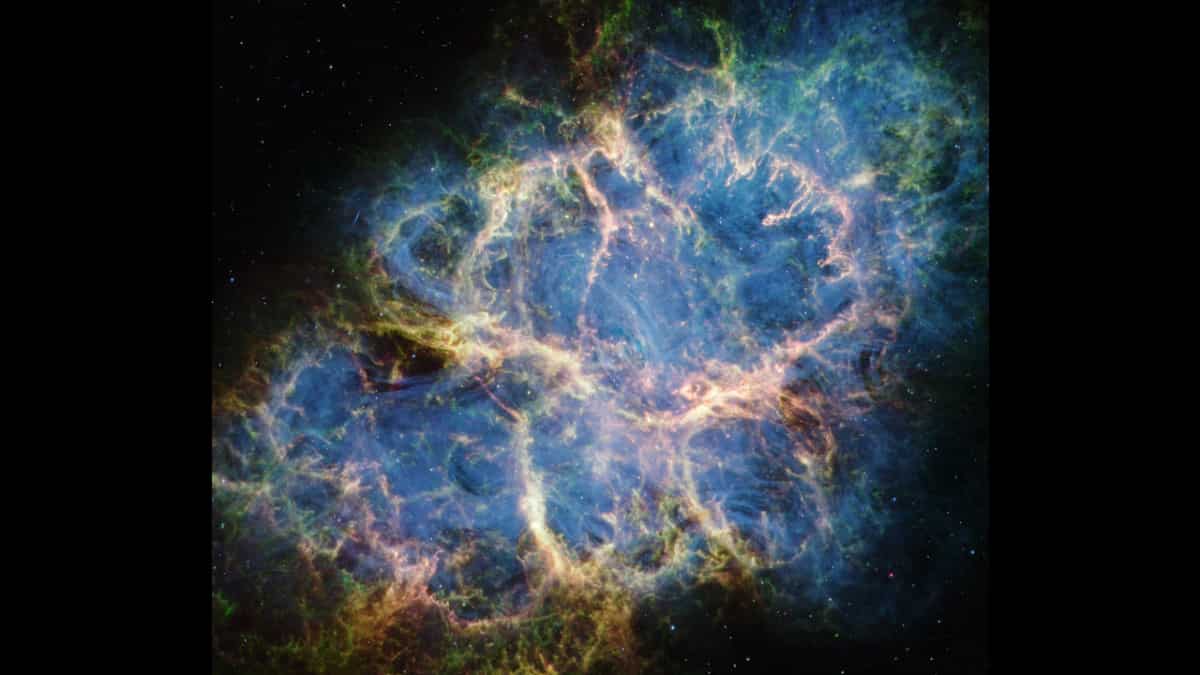
NASA's James Webb Space Telescope dissected the Crab Nebula’s structure | NASA/Princeton University
Over a millennium ago, in July 1054, when Chinese astronomers documented a remarkable "guest star" that shone as brightly as Jupiter for nearly a month, it sparked curiosity and speculations in equal proportions. But the two quickly went into oblivion as the guest star faded from sight. This celestial phenomenon was later identified as a cloud of debris from a dying star, located approximately 6,500 light-years away in the constellation Taurus.
Named the Crab Nebula in the 19th century by Irish astronomer Lord Rosse, it was so called due to its appearance of "streams running out like claws in every direction."

Now in the twenty first century, the James Webb Space Telescope has provided an unprecedented mosaic of the Crab Nebula. For the first time, astronomers can observe the cage-like formations created by countless dust grains, prominently displayed as fluffy magenta material in the upper right and lower left regions of the image.
Unlike other supernova remnants, where dust is concentrated in the central regions, the Crab Nebula’s dust is largely contained within the filaments of its outer shell.
Also watch |NASA James Webb Telescope captures stunning pictures of the universe | Science News | WION
"The Crab Nebula lives up to a tradition in astronomy: The nearest, brightest, and best-studied objects tend to be bizarre," Nathan Smith, co-author of the study from the Steward Observatory at the University of Arizona, said in a statement.
These observations have been detailed in a paper accepted for publication in The Astrophysical Journal Letters.
What makes this 'guest star' mysterious?
Since its explosion as a supernova, the star's shell has been expanding at a staggering rate of approximately 900 miles (1,500 kilometres) per second and now spans about 11 light-years across. Despite its well-documented history and proximity, many details of the explosion have remained a mystery.
The star at the centreof the Crab Nebula likely initiated its demise by producing iron, a process that consumes more energy than it releases, causing the star to collapse under its own gravity.
At the heart of the nebula now lies a rapidly spinning pulsar, visible in Webb's image as a bright white dot at the centre.
(With inputs from agencies)