India to launch NEED initiative on Labour's Day: Key takeaways and all we know

&imwidth=600&imheight=450&format=webp&quality=medium "India to launch NEED initiative on Labour's Day: Key takeaways and all we know")
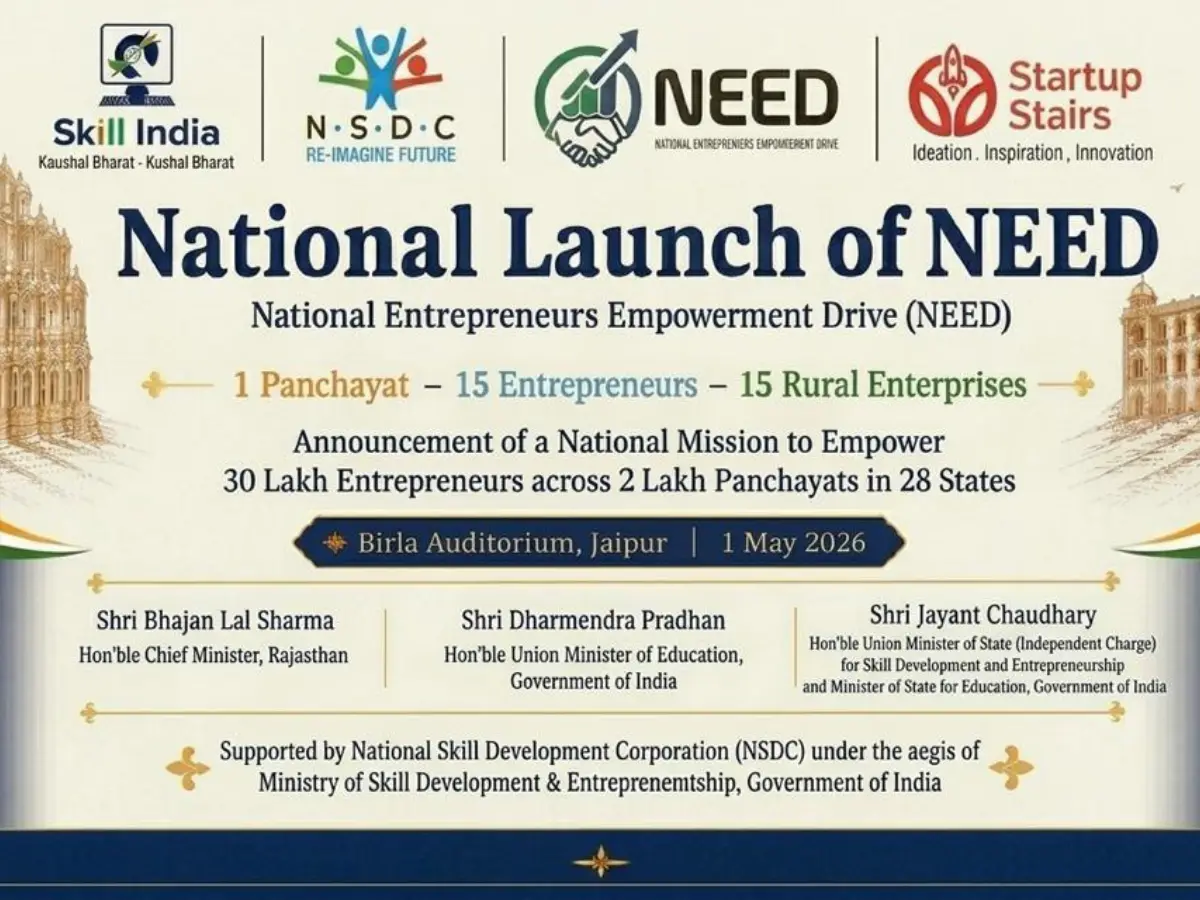
Launch of the National Entrepreneurs Empowerment Drive (NEED)
India is launching the NEED initiative to boost rural entrepreneurship by supporting 30 lakh micro-entrepreneurs across Panchayats. Backed by NSDC and partners, it blends AI tools with local support to create sustainable livelihoods and shift focus from welfare to wealth creation.
In a major push to de-centralise entrepreneurship and unlock rural economic potential, the Government of India on Thursday announced at Birla Auditorium in Jaipur, one of its most ambitious grassroots entrepreneurship initiatives — the National Entrepreneurs Empowerment Drive (NEED). The launch is being held on May 1. Timed with International Workers’ Day, or Labour's Day, the initiative aims to transform grassroots workers into structured, income-generating entrepreneurs across the country. The programme is being driven by the National Skill Development Corporation under the Ministry of Skill Development and Entrepreneurship, in collaboration with state governments, financial institutions, and industry partners.
15 anchor partners sign MoUs
A key highlight of the launch is the signing of Memorandums of Understanding (MoUs) between NSDC and 15 anchor partners spanning education, skilling, technology, and employment sectors. These partners will deploy scalable enterprise models at the Panchayat level. Among them is Vidysea Education Pvt. Ltd., which will lead efforts in career guidance and livelihood facilitation through its Career Development Officer (CDO) network. Vidysea’s model combines artificial intelligence with a human-led delivery system at the village level. Its proprietary PathLynks platform enables personalised career guidance, while its Talent Sync network deploys trained Career Development Officers within each Panchayat.
Speaking at the event, Vidysea Founder and CEO Karunn Kandoi said:
“The biggest gap in rural India has never been talent — it has been access and guidance. For years, opportunities have existed, but they have not reached the last mile. NEED, combined with our Career Development Officer model, ensures that every village has a trusted human interface who can translate opportunity into action. This is not just about jobs or education — it is about building a structured pathway for aspiration to turn into income.”
What NEED aims to achieve
Trending Stories
)
)
)
&im=FitAndFill=(700,400))
&im=FitAndFill=(700,400))
)
&im=FitAndFill=(700,400))
)
&im=FitAndFill=(700,400))
)
&im=FitAndFill=(700,400))
)
&im=FitAndFill=(700,400))
)
&im=FitAndFill=(700,400))
)
&im=FitAndFill=(700,400))
)
&im=FitAndFill=(700,400))
)
)
&im=FitAndFill=(700,400))
)
&im=FitAndFill=(700,400))
)
)
&im=FitAndFill=(700,400))
&im=FitAndFill=(700,400))
&im=FitAndFill=(700,400))
)
)
)
)
&im=FitAndFill=(700,400))
)
NEED is designed as a Panchayat-level entrepreneurship ecosystem rather than a conventional scheme. Under its framework, each Gram Panchayat will identify and support 15 micro-entrepreneurs, linking them to training, certification, credit, and market access. With its Panchayat-level design and emphasis on structured enterprise creation, NEED signals a shift in India’s rural development strategy—from welfare delivery to wealth creation. If executed at scale, it could redefine how entrepreneurship is nurtured at the grassroots and bridge long-standing gaps between talent and opportunity in rural India.
- Scale: 30 lakh micro-entrepreneurs across 2 lakh Panchayats in 28 states
- Model: 1 Panchayat · 15 Entrepreneurs · 15 Rural Enterprises
- Year 1 rollout: 15,000 Panchayats across Uttar Pradesh, Rajasthan, Haryana, Gujarat, Karnataka, and Andhra Pradesh
- Immediate reach: Around 2.25 lakh micro-entrepreneurs
Rajasthan has further strengthened the initiative by offering interest-free loans up to ₹10 lakh under the Mukhyamantri Yuva Swarojgar Yojana, providing direct financial backing to youth entrepreneurs.
Startup Stairs: Architect of the programme
The initiative has been conceptualised and operationalised by Startup Stairs, which has brought together government backing, industry expertise, and financial linkages into a unified framework. The organisation is led by Managing Director Preet Sandhu, whose vision centres on democratising entrepreneurship in Tier 2, Tier 3, and rural India.
Key takeaways
- Shift from schemes to systems: NEED is positioned as a structured entrepreneurship ecosystem rather than a subsidy-driven programme.
- Massive scale ambition: Targets 30 lakh entrepreneurs, making it one of India’s largest grassroots economic initiatives.
- Public-private collaboration: Combines government support with industry-led execution models.
- Localised impact: Each Panchayat becomes a hub of 15 income-generating enterprises.
- Sustainable livelihoods: Focus on long-term income generation, not short-term assistance.
- Human + tech model: Emphasis on combining AI tools with locally embedded human support systems.