Battered by global crises, will BRICS be a success?

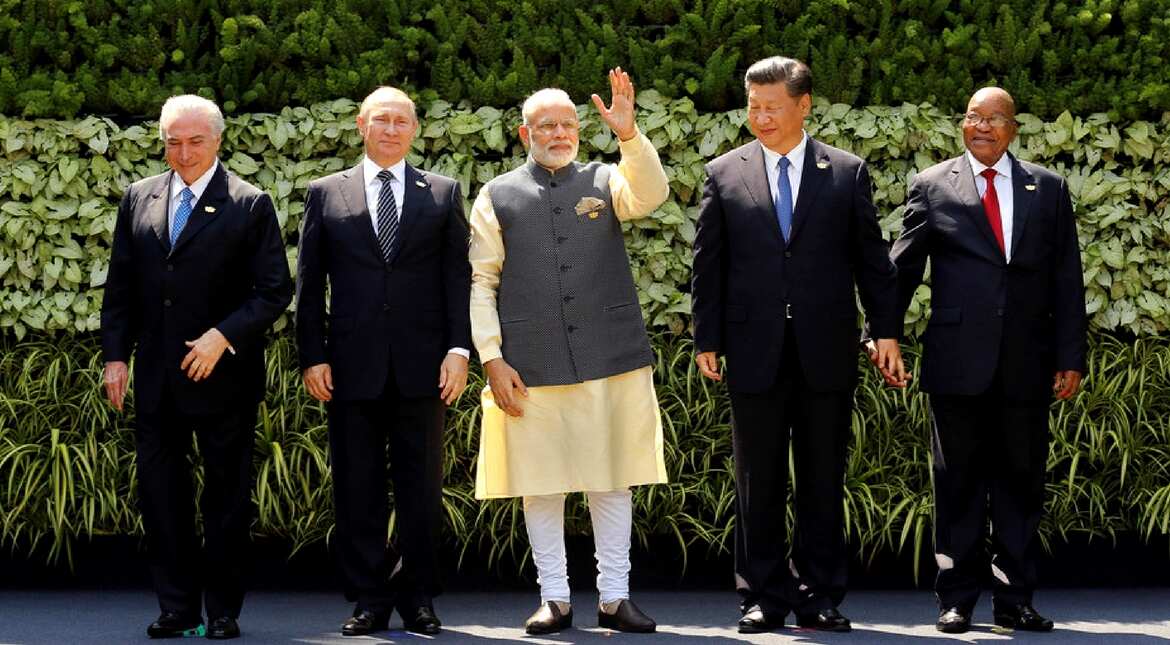
BRICS Summit 2017
Global trade and financial investment were meant to be the motors for the advancement of BRICS but deglobalisation and geo-political tension are seriously challenging BRICS' goals.
At the BRICS summit in Russia two years ago, Chinese Premier Xi Jinping invoked physics when asking fellow leaders “to boost the centripetal (unifying) force of BRICS nations through cooperation in innovation and production capacity to boost competitiveness.”
That was the theory, but the economic reality of the once-feted Brazil-Russia-India-China-South Africa alliance is contradictory.
Instead of, centripetal strengthening, the world is witnessing much more powerful centrifugal dividing forces, including overproduction, over-indebtedness and deglobalisation of capital. These elements have been spinning out of control even before the chaotic era of US President Donald Trump began.

Over production is mostly found in the coal, steel, non-ferrous metals, cement and chemicals industries. It’s largely driven by China where over-capacity is more than 30 per cent, according to a new International Monetary Fund report that also raised worries about the country’s vast debt.
Over borrowing by companies, states and households represents a global crisis in the making. The Institute of International Finance has just reported that world debt is now USD$217 trillion (327 per cent of world GDP), up from USD$149 billion (276 per cent) in 2007.
Deglobalisation is simply the reversal - mostly since 2008 - of prior rapid growth in cross-border trade, investment and finance. Should that be viewed as a bad thing? Rather than fear globalisation’s unravelling, leading scholar-activists including Ruy Mauro Marini in Latin America, John Maynard Keynes, have all advocated national economic sovereignty. If pursued cleverly, deglobalisation could be the basis for restoring links between once vibrant sectors subsequently destroyed by imports.
)
US vs China over South China Sea: Washington backs Philippines, Beijing hits back
)
Bigg Boss 20: Isha Rikhi evicted after three weeks in Salman Khan’s show
)
Musk plans to more than double xAI's chips to over 1.2 million Nvidia GPUs by year-end
)
After JU, clash erupts at SRFTI: BJP’s ‘Dimagi Naxal’ jibe sparks political firestorm after students protest RSS-linked event
)
‘Anti-social elements spreading false rumours’: LPU issues statement amid massive unrest over alleged rape
)
LPU students go on rampage, vandalise campus amid widespread protest: What's happening
)
Trump asked Xi to pressure Iran. China did not say yes — here’s what Beijing wants
)
US Treasury Secretary Scott Bessent hails global crackdown on Iranian banks and airlines
)
An OpenAI agent escaped its locked test cage again, by hiding questions in DNS lookups
)
'Our video was trimmed': LPU girls who featured in rape-denial video make U-turn
)
3 males killed, four others injured in shooting after fight at strip club in Detroit
)
'Victory for low-budget consumers': Raghav Chadha hails 30-day telecom recharge rules
)
Claude rebuilt the 1989 game 'Prince of Persia' by reusing the original's own code
)
Beyond metros: How Tier-2 and Tier-3 cities could drive India’s next AI wave
)
Tesla builds first Cybertruck with its own refined lithium: Elon Musk's $1 billion Texas bet pays off
)
IndiGo flight suffers tail strike in Bengaluru while landing; DGCA to probe incident
)
The US and China set up an AI 'red telephone', but skipped the rulebook
)
‘Terror suspects arrested near UK air base were looking to do big damage’: Trump
)
Russian envoy claims US tactics to contain India were revealed in ‘Freudian slip’
)
IND vs WI 1st ODI: Kohli breaks Sachin's most runs in one country record with unbeaten 139 as India thump West Indies by 8 wickets
)
Researchers rebuilt exactly how 700 AI agents hacked Hugging Face: a 900-link chain trick
)
‘Olympic inclusion is our major target’: WPA President Ishaun Singh on pool’s global ambitions
)
Nations League: Spain sink England at Wembley; Modric shines for Croatia
)
Why has Iran released no proof of life of Mojtaba Khamenei? Araghchi reveals...
)
'What kind of confession is this?': Pakistan PM Shehbaz Sharif’s 'terrorists would be roaming New York' remark goes viral, raises alarm online. Watch
)
South Korea demands apology from Ukraine over North Korean prisoners' transfer
)
Beyond BrahMos: India targets Rs 50,000 crore in defence exports with unmatched price edge
)
Sri Lankan Tamil migrant worker gets death sentence in Saudi Arabia, help sought from India
)
Muslim marriage cannot shield sex with minor wife from prosecution under POCSO: Delhi HC
)
'Can't help but draw painful parallels to Nirbhaya case': SC on latest incidents of rape cases in Delhi-NCR
)
99.9% more powerful - Scientists find boy who can recall memories from just 3 months of age
)
'FIRST LOOK from inside Noah’s Ark': Researchers share video from inside mysterious mound in Turkey
)
UNSC reform momentum grows: Russia, Portugal, Mauritius push for India's permanent seat bid
)
8 US marines injured in Iranian missile attack on vessel in Strait of Hormuz: Report
&im=FitAndFill=(700,400))
New OTT releases this week (September 28-October 4, 2026): Dupahiya 2, Pooja Meri Jaan, Ohh My Dog- 5 titles coming on Netflix, Prime Video and more
)
Afghanistan says 28 fighters killed in clash near Pakistan border, Islamabad denies
)
Ceuta migrant crisis: Protesters take to streets as Spain grapples with migrant challenge
)
LPU suspend classes, postpones exams as violence escalates over rape claims: What's happening
)
New York City wants a 'kill switch' on every AI, and will pay whistleblowers who report violations

BRICS 2017 China logo
Could BRICS leaders evolve in this direction? Their summit next week will be distracted by geopolitical tensions. Although a welcome China-Pakistan Economic Corridor, which in May left Prime Minister Narendra Modi boycotting China’s Belt and Road mega-conference three months ago.
Beijing’s BRICS logo designers, perhaps being unconsciously subversive, have illustrated how the once overlapping, interlocking BRICS are now being wedged apart as paper thin subjects of centrifugal forces. For Africa, fewer illusions in these economies would be welcome, given how exploitative the BRICS and their firms have become against societies, democratic movements and environments.
A counter-summit challenge the BRICS
This argument is made by the People’s Forum on BRICS.
According to the Hong Kong People’s Forum:
Instead of offering an alternative, the BRICS actually offer a continuation of neo-liberalism. On top of BRICS, there is also China’s new mega project, the Belt and Road initiative whose main purpose is to export China’s surplus capital.
These surpluses are vast, as witnessed in China’s foreign reserves which recently topped USD$4 trillion, though then fell 20 per cent due to bouts of capital flight and two stock market crashes in 2015-16.
Deglobalisation
Global trade, finance and investment were meant to be the motors for the advancement of BRICS. But according to the World Bank, global trade peaked at 61 per cent of world gross domestic product (GDP) in 2008 but retreated to 58 per cent in 2015.
During the 1990s each BRICS country raised its trade to GDP ratio by at least 10 points. But trade has receded in importance in each of the BRICS. Russia peaked first at a 69 per cent trade/GDP ratio in 1999 and then fell steadily to 45 per centtoday. Brazil rose to 30 per cent in 2004 and fell to 25 per cent. China soared to 66 per cent in 2006 and has since plummeted to 36 per cent. South Africa’s 2008 ratio was 73 per cent but is now back to 60 per cent and India peaked last, in 2012 with 56 per cent, and is now at 40 per cent.
On top of this, the ratio of world financial assets that are held overseas compared to GDP fell from 58 per cent in 2008 to 38 per cent in 2016, even as overall financial assets increased in line with soaring debt.
Finally, another deglobalisation symptom is the halving of relative global foreign direct investment: from 3.7 per cent of world GDP in 2008 to 1.7 per cent in 2016.
Leading financiers now talk of an imminent world recession, given over priced stock markets and corporate debt. This is not just due to wild New York share speculation, as also occurred in the crashes of 1987, 2000 and 2008. Three BRICS stock markets are also bubbling: South Africa’s stock market is 90 per cent higher than in 2010, India’s market is up 70 per cent and Russia has risen by 50 per cent.
Centrifugal realities crowd out centripetal fantasies
These dangerous centrifugal forces cannot be easily regulated or reversed. The only recent relief came from the Chinese state’s massive urban construction investments (albeit leaving scores of service sector boom. But since 2015 the other three BRICS have suffered recessions as the crash in commodity prices hit home.
As the Hong Kong People’s Forum statement explained:
China has now evolved into a global engine promoting a neoliberal agenda from free trade agreements to corporate led integration across borders.
The BRICS had promised to challenge an unfair global economic system. But in December 2015 their main multilateral reform strategies failed:
the Paris Climate Accord was nonbinding, unambitious and outlaws climate-debt lawsuits by victims of Western and BRICS emissions;
the World Trade Organisation phased out any semblance of food sovereignty; and
IMF voting shares were shifted to favour BRICS at the expense of poorer countries.
Adds the Hong Kong People’s Forum: “The 2017 World Economic Forum in Davos was one site where Xi clearly took the lead in promoting world corporate power, as Trump leads the US-UK retreat into crony-capitalist protectionism.”
South African President Jacob Zuma pronounced last month at his party’s policy Congress, “The ANC is part of the global anti-imperialist movement. We are historically connected with the countries of the South and therefore South-South cooperation such as BRICS is primary for our movement.”
 If centrifugal economic forces now pressuring the bloc to overwhelm Xi’s desired centripetal capitalism, then we can expect yet more talk-left walk-right politics, as the BRICS sub-imperialists desperately try to pretend they’re anti-imperialists.
This article was originally published on original article.