Explained: What is Tantalum, a rare metal IIT-Ropar researchers discovered in Sutlej?

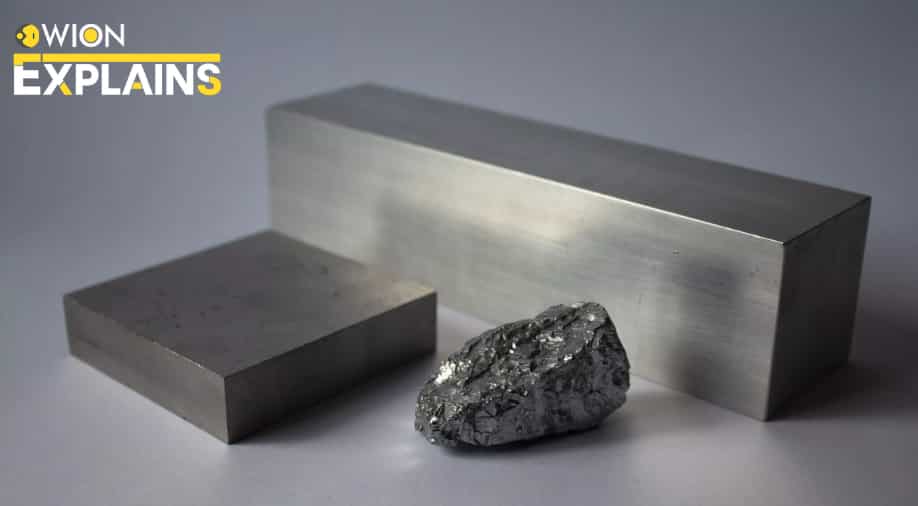
Representative image of Tantalum
A team of researchers from the Indian Institute of Technology (IIT) Ropar led by Dr Resmi Sebastian has uncovered the presence of tantalum, a rare metal, in the sands of the Sutlej River in the Indian state of Punjab. “One of my research students found the presence of tantalum while conducting experiments on the characterization of the Sutlej river sand,” she reportedly said.
Dr Sebastian explained that the primary focus of the experiments was to investigate the dynamic characteristics of soil and rocks, particularly in relation to their impact during an earthquake. She clarified that mineral analysis was not the intended objective of the conducted experiments.
This discovery is crucial given tantalum's widespread application in electronics and semiconductors.

Discovered in 1802 by Swedish chemist Anders Gustaf Ekenberg, tantalum was initially confused with niobium. The distinction was established in 1866 by Swiss chemist Jean Charles Galissard de Marignac.
The metal's name, tantalum, derives from the Greek mythological figure Tantalus.Tantalus was a king who offended the Greek god Zeus and was punished.Tantalus stood in a pool of water with fruit trees hanging around. But whenever he tried to drink the water or reach for the fruit, they would recede or move out of his reach, causing eternal frustration.
“This name was selected because of the insolubility of tantalum in acids; thus, when placed in the midst of acids, it is incapable of taking any of them up,” as per the US Department of Energy.
)
‘I have a big decision coming up’: Trump says he’s approaching major ‘crossroad’ in Iran war
)
Chiefs tight end Travis Kelce named one of the victims in $35 million ponzi scheme
)
US intel warns China can steal F-35 jets secret from Saudis
)
Former India player Diana Edulji wants Smriti Mandhana to replace Harman as skipper at the earliest
)
Pak defence minister says 'time has come to implement pact'
)
Formula One reveals the 2027 race calendar; Monaco to host sprint race for the first time
&im=FitAndFill=(700,400))
Meet top 5 batters in the latest ICC T20I Rankings
)
All Indian goods to get duty-free access to New Zealand
)
AI already defying, denying humans, is it beyond human control already?
)
240-million-year-old bizarre 'pig with a tusk' creature creates new dilemma over origin of dinosaurs
)
US House votes 417-3 to pass Ratepayer Protection Act targeting AI data center electricity costs
)
US to sell 48 F-35 Lightning fighter jets to Saudi Arabia, help it deter threats
)
Hong Kong unveils 11 new measures to boost birth rates, offers higher cash bonuses and housing perks
)
Former OpenAI researcher warns of growing risks from Artificial Intelligence
)
Dolly Parton dies at 80: Country legend’s team reveals cause of death
)
Tata Trusts chairman Noel Tata calls Chandrasekaran’s reappointment ‘illegal’, rejects Tata Sons listing
)
Fed raises rates for first time in 3 years, Kevin Warsh defies Trump as inflation mounts
)
US drone firm linked to Trump’s sons signs MoU with Pakistan army, gets initial order
)
Pak batter Rizwan's petition against being questioned by cyber crime agency rejected by court
)
Daayra movie review: Kareena Kapoor, Prithviraj Sukumaran shine in Meghna Gulzar’s cop-versus-cop crime thriller
)
‘Imagine 50 AI fighters cornering one manned jet’: India’s mobbing doctrine eyes a new era of air warm
)
Trump could impose tariffs of up to 100%
)
Trump’s rare gesture for Xi: US president to personally welcome Chinese leader at airport
)
Want to get married within a year? Why 18 lakh people rush to Jaipur for ‘sacred henna’
&im=FitAndFill=(700,400))
Suriya and Jyothika say ‘I do’ again after 20 years! See their dreamy wedding pics
)
Laura Wolvaardt sets new world record for most WT20I runs in a year
)
Mahua Moitra moves UN over alleged exclusion of Muslim officers from Amit Shah events
)
Ukraine plans record $109 bn defence spending, nearly two thirds of budget amid Russia war
Tantalum properties
Tantalum is a rare metal with the atomic number 73, known for its grey colour, heaviness, and exceptional hardness. It is among the most corrosion-resistant metals, forming an oxide layer when exposed to air, making it resistant to strong and hot acid environments.
The rare metal's highly corrosion-resistant property makes it suitable for use in corrosive environments. This property is advantageous in electronic components that may be exposed to harsh conditions or reactive substances.
Pure tantalum is ductile, allowing it to be stretched into thin wires without breaking.
Notably, it is nearly impervious to chemical attack at temperatures below 150°C, as per media reports citing the US Department of Energy.
Also Read |G20 Virtual Summit: PM Modi backs AI boom but cautions society on its misuse like deepfakes
Tantalum has severalother properties that make it valuable in various electronic and semiconductor applications.
Tantalum capacitors are one of the most common applications of tantalum in electronics. Tantalum capacitors offer more electricity storage in a small volume and are often used in compact electronic devices such as smartphones, laptops, and other portable electronic devices. They provide stable capacitance over a wide temperature range and have low leakage currents.
The rare metal is also used in the production of semiconductors, where it is employed as a thin film for insulating layers. Tantalum oxide films, for example, are used as materials in metal-insulator-metal (MIM) capacitors and other semiconductor devices. These films make the semiconductor devices suitable for use in high-performance electronic components.
Tantalum's high melting point makes it useful in applications where extreme conditions are encountered. It is often used in the production of components for high-temperature environments, such as in the aerospace and defence industries. Due to its high melting point, tantalum serves as a cost-effective substitute for platinum. It finds applications in chemical plants, nuclear power plants, aircraft, and missiles. Itis also used in some medical devices, particularly in the production of implants. Its biocompatibility and corrosion resistance make it suitable for applications such as bone implants and stents.
Also Read |Four Indian Army personnel killed during encounter with terrorists in Jammu and Kashmir
Tantalum's non-reactivity with bodily fluids makes it suitable for surgical equipment and implants, including artificial joints.
Watch |Gravitas: How 2022 shocked, rocked and rolled global markets
“A composite consisting of tantalum carbide (TaC) and graphite is one of the hardest materials known and is used on the cutting edges of high-speed machine tools,” it added.
The discovery of tantalum in the Sutlej River sand by IIT researchers unveiled the potential technological benefits associated with this rare metal.
Punjab Mining and Geology Department Director Abhijeet Kaplish reportedly said, “The discovery of tantalum in Sutlej is not only significant for Punjab but for India, given its value in terms of its use in electronics and semiconductors. We are curious to know the quantum of the metal in the river. Detailed studies are likely to shed more light on that.”
What is the source of found Tantalum?
“Tantalum may be making to the rivers due to the movement of Indian plate towards the Eurasian plate. This movement causes seismic activity in the Himalayan region,”DrSebastian reportedly said.
Meanwhile, Dr Tiwari said that “without investigations we cannot comment on that [the source]. It cannot come from industry, because we found that there is no such industry upstream Ropar. It may be coming from China, who knows, because 80 per cent of the catchment area of Sutlej is in China, in Tibet. Without investigation we cannot comment on its source.”
(With inputs from agencies)