Countdown starts for ISRO's launch tomorrow

&imwidth=600&imheight=450&format=webp&quality=medium "Countdown starts for ISRO's launch tomorrow")
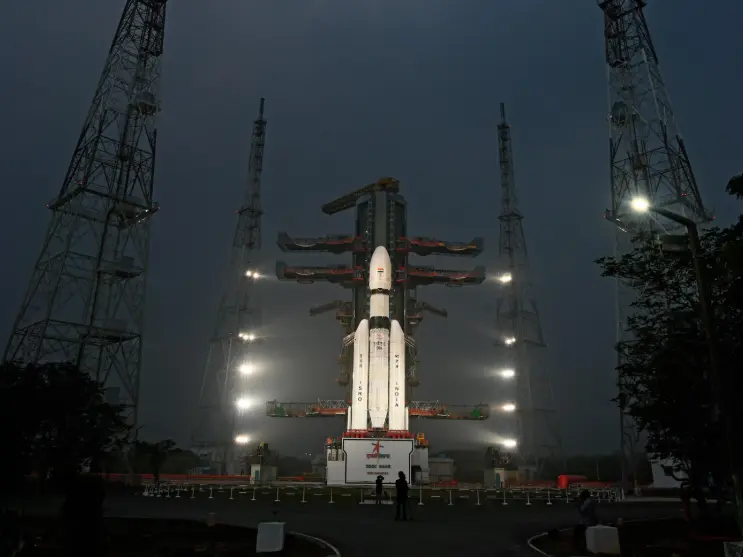
ISRO commences 24-hr countdown to US firm's Bluebird-6 satellite launch Photograph: (ISRO)
ISRO has begun the countdown for launching AST SpaceMobile’s 6,100 kg BlueBird-6 satellite aboard its LVM3 rocket on Dec 24 from Sriharikota. This marks LVM3’s heaviest payload and first commercial mission for a US customer.
Indian space agency ISRO has commenced the 24-hour countdown to the Wednesday, (24th Dec) launch of US firm AST SpaceMobile's BlueBird-6 satellite aboard the LVM3 rocket. The three-stage LVM3 rocket, India's most capable spacefaring vehicle is to liftoff from the second launchpad of the Satish Dhawan Space Centre in Sriharikota, Andhra Pradesh at 8:54am Indian Time, Wednesday. The satellite would be injected into orbit 520kms above the Earth, barely 16 minutes after launch.
The countdown to a rocket launch involves sequential tasks like fueling, system checks, and approvals, synchronizing hundreds of people and automated systems. It's a crucial operational checklist during which all processes are validated.
The 6,100kg BlueBird 6 satellite is the heaviest payload to be lifted by the LVM3 vehicle in its operational history. Therefore, this satellite would be the heaviest payload to be carried by an Indian rocket. LVM3 has a track record of having delivered success in all its eight missions to date.
This mission is being executed as part of a commercial deal between ISRO's business arm NewSpace India Limited(NSIL) and the Texas-based AST SpaceMobile. As a launch services provider(rocket builder and operator), ISRO launches foreign-origin satellites to space on a commercial basis. Facilitated by NSIL, these commercial space missions are like a taxi ferrying a passenger. In this case, the passenger is the US firm, which pays the Indian Government for the launch service.
This is the third commercial mission of LVM3, and the first time that the Indian LVM3 rocket is executing the mission for an American customer. Earlier, it had executed two launches for a European customer OneWeb(now Eutelsat OneWeb).
About AST SpaceMobile and their internet-beaming satellites
AST SpaceMobile is a Texas-based telecom company that aims to build and launch a fleet of satellites that can directly provide internet connectivity to mobile phones. Typically, only purpose-built satellite phones can facilitate satellite communication. These traditional satellite phone handsets are bulky and require visible antennas, they offer voice connectivity, and low-bandwidth texting and data services. Such services are offered by firms such as Iridium, Thuraya, among others. They are widely used in the defence and maritime sectors for providing connectivity where no communication infrastructure exists.
Trending Stories
)
)
)
)
)
)
)
)
)
)
)
)
)
)
)
)
)
)
)
)
)
)
)
)
)
)
)
)
)
)
)
)
)
)
&im=FitAndFill=(700,400))
)
)
)
)
Firms like AST and Starlink are attempting to change this by ensuring direct connectivity between smartphones and satellites. They intend to ensure that Android and Apple devices available in the market can communicate directly with satellites, without any modifications or special hardware. Thanks to the global coverage planned using a fleet of satellites, such services would eventually enable cell phone connectivity almost anywhere on Earth. In simple terms, one need not worry about being "not reachable" or "out of coverage area".
As per reports, AST presently has a fleet of five first-generation (Block-1) satellites in orbit. The firm plans to launch a fleet of 45-60 second-generation (Block-2)satellites to offer services in major global regions, it is said.
The firm has announced that they have a series of satellites that will be launching in the coming months. BlueBird 7 has shipped to the Cape Canaveral, Florida launch site this month, BlueBirds 8-16 are in various stages of production, with launches planned every 1-2 months on average during 2025 and 2026, the firm announced.
They expect to have 45-60 satellites in orbit by year-end 2026. It is touted that these BlueBird satellites(by size) will be the largest commercial satellites ever deployed in Low Earth orbit (about 600kms above earth). Each of these satellites would carry a 2,400sq feet phased array antenna with true direct-to-cell broadband, with a claimed capability of up to 10,000 MHz of processing bandwidth and claimed peak speeds of 120 Mbps per cell.
The firm says they have partnered with 50+ mobile network operators serving nearly 3 billion subscribers, "supported by a flexible spectrum strategy blending our own licensed spectrum with partner spectrum".
While the launch of Bluebird-6 is being carried out from India, it must be noted that such direct-to-mobile satellite internet services have not been approved by the Indian Government. Firms like Starlink and Eutelsat OneWeb that are also into providing LEO satellite-based high-speed internet connectivity are in the process of seeking approvals from various departments of the Indian government.
