
&imwidth=800&imheight=600&format=webp&quality=medium "America's B-52 vs Russia's Tu-95: Two Cold War bombers, still flying, still pointing at each other")
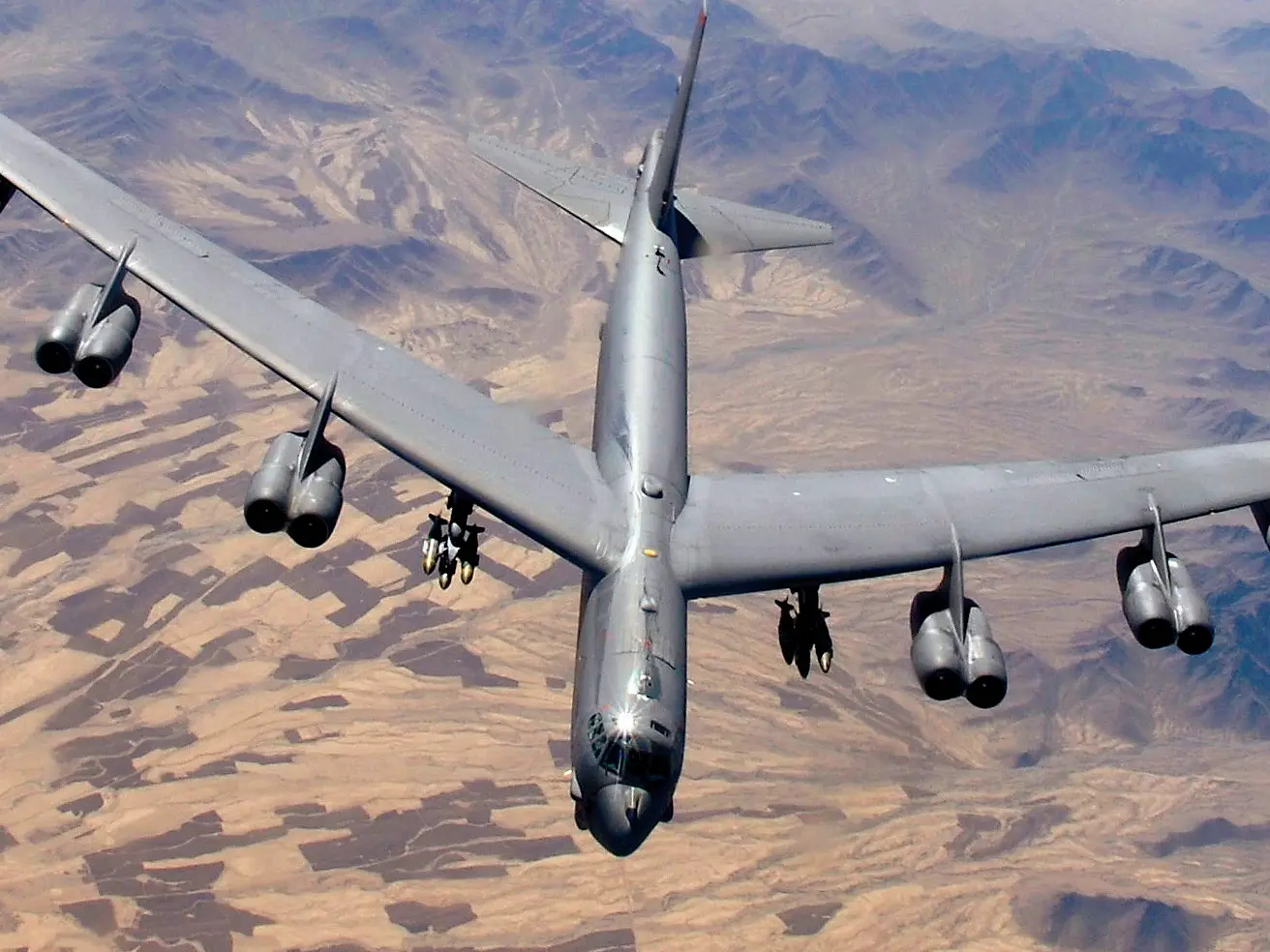
In 1955, the United States Air Force took delivery of its first Boeing B-52 Stratofortress. One year later, in 1956, the Soviet Air Force received its first Tupolev Tu-95 Bear. Both aircraft were designed with the same purpose: to fly enormous distances, carry nuclear weapons, and deter the other side from starting a war. Nearly 70 years later, both aircraft are still doing exactly that — and the pilots of each nation's air force still intercept each other on patrol missions over the Pacific, Atlantic, and Arctic.
Two Different Engineering Philosophies
The B-52 and the Tu-95 represent opposite answers to the same question of how to build a long-range nuclear bomber. The B-52 is powered by eight jet turbofan engines, now being upgraded to Rolls-Royce F130 powerplants. It has a maximum speed of around 1,000 km/h and a range of over 14,000 km unrefuelled. The Tu-95 took a different path: it uses four massive Kuznetsov turboprop engines, each driving a pair of contra-rotating propellers — making it one of the fastest propeller-driven aircraft ever built, capable of around 920 km/h, with a slightly longer unrefuelled range of approximately 15,000 km. The propellers also make the Tu-95 extraordinarily loud — NATO intercept pilots have reported hearing the aircraft before they could see it on their radar.

Performance By The Numbers
On raw performance, the B-52 edges the Tu-95 on speed by roughly 80 km/h. The Tu-95 marginally outranges the B-52 without refuelling. Both aircraft can carry nuclear-armed cruise missiles as their primary standoff weapon — the B-52 carries the AGM-86 Air-Launched Cruise Missile, while the Tu-95 carries the Kh-101 and Kh-55 series. Both are large, non-stealthy aircraft with significant radar signatures, operating on the premise that deterrence works through visibility and credible threat rather than concealment.
Still Buzzing Each Other's Borders
Trending Stories
)
No Pandya as Auqib Nabi earns maiden ODI call-up; Mayank returns for WI T20Is| check full squads
)
Chiefs tight end Travis Kelce named one of the victims in $35 million ponzi scheme
)
Trump praises India’s Opium crackdown, hails anti-drug efforts
)
Sydney Sweeney defends provocative ad choice, the internet is still not impressed
)
Former India player Diana Edulji wants Smriti Mandhana to replace Harman as skipper at the earliest
)
Trump calls Canada-EU associate membership plan ‘laughable’ and threatens 'very serious tariffs'
)
Protests erupt over migrant housing plan in Piddington
)
Shahzad Bhatti Network declared terrorist organisation under UAPA: Govt order
)
Europe wants a common playbook for security threats, seeks security beyond NATO
)
Formula One reveals the 2027 race calendar; Monaco to host sprint race for the first time
)
All Indian goods to get duty-free access to New Zealand
)
Bigg Boss 20: Mahhi Vij reveals she lost Yuva role to Kareena Kapoor; 'didn’t work out in my favour'
)
Lionel Messi for 2026 Ballon d’Or over Mbappe and Yamal, says Diego Simeone
)
US House votes 417-3 to pass Ratepayer Protection Act targeting AI data center electricity costs
)
Hong Kong unveils 11 new measures to boost birth rates, offers higher cash bonuses and housing perks
)
Former OpenAI researcher warns of growing risks from Artificial Intelligence
)
Veteran actor Anant Nag honoured with Indian cinema’s highest award
)
AUS vs SA: Steve Smith still gets 'little flashbacks' from sandpaper gate
)
Pakistan naval vessel returns to harbour with 'severe damage' after collision with Indian warship in Arabian Sea
)
Fed raises rates for first time in 3 years, Kevin Warsh defies Trump as inflation mounts
)
Katrina Kaif’s postpartum weight is not the problem; your gaze is
)
Taiwan seeks deeper India ties as direct flights restart soon and chip projects advance
)
Daayra movie review: Kareena Kapoor, Prithviraj Sukumaran shine in Meghna Gulzar’s cop-versus-cop crime thriller
)
Saudi Vs Houthis: Yemeni military rebels clash with Houthis
)
Pak batter Rizwan's petition against being questioned by cyber crime agency rejected by court
)
US trade tariff: 100% tariff targets Russian buyers amid trade tensions
)
Pakistan: Imran Khan's sons Kasim & Sulaiman claim their father is 'tortured' in jail
&im=FitAndFill=(700,400))
New OTT releases this week (September 14-20, 2026): Lust Stories 3, Waiting Hai, Irumudi- 5 new titles coming on Netflix, Prime Video and more
)
Trump gets new power to hit India, China with up to 100% tariffs as US Senate clears Russia sanctions bill
)
Prime Minister Narendra Modi's birthday: Italian PM Meloni sends birthday wishes
)
‘Imagine 50 AI fighters cornering one manned jet’: India’s mobbing doctrine eyes a new era of air warm
)
Saudi vs Houthis: Riyadh claims to have shot Houthi drone targeting Mecca
)
US Treasury rallies global financial institutions for Op Economic Outcast to isolate Iran
)
India breaks silence on US Russia sanctions bill, 100% tariff threat: ‘Committed to energy security’ for 1.4 billion
)
Pakistan boycotts chess match against Israel at Olympiad
)
Want to get married within a year? Why 18 lakh people rush to Jaipur for ‘sacred henna’
&im=FitAndFill=(700,400))
Suriya and Jyothika say ‘I do’ again after 20 years! See their dreamy wedding pics
)
Abhishek Sharma rises to No. 2 in T20Is; ENG’s Robinson 3rd after record Pakistan Tests
)
The Early Spring season 2 is happening, but fans have one request - 'don't change the actors'
In 2026, Tu-95s are still being intercepted by NATO aircraft off the coast of the United Kingdom, near Alaska, in the Pacific west of California, and near Japanese airspace. American B-52s conduct regular bomber task force missions over the Korean peninsula, the South China Sea, and Eastern Europe. The intercepts are routine enough to have their own procedures, and both sides understand the rules — but the patrols themselves have never stopped, through the end of the Cold War, through the collapse of the Soviet Union, and into the present.
Which One Will Outlast The Other?
The US Air Force has committed to flying the B-52 — upgraded to the B-52J designation — until at least 2050, and possibly beyond. Russia's Tu-95 fleet is projected to remain in service until around 2040, with some Russian sources suggesting extensions are possible. If those timelines hold, the B-52 will outlast its Cold War rival — the aircraft that has been its mirror image and primary counterpart for nearly seven decades. The two bombers that were built to threaten each other across the Iron Curtain have now spent more of their operational lives in a post-Cold War world than in the conflict that created them. Yet they are still flying. Still patrolling. And still being pointed, however indirectly, at each other.
