249 radio signals slam Earth in minutes: Deep-space eruption puzzles scientists

&imwidth=600&imheight=450&format=webp&quality=medium "249 radio signals slam Earth in minutes: Deep-space eruption puzzles scientists")
Multiple radio signals slammed Earth, and the mystery continues.
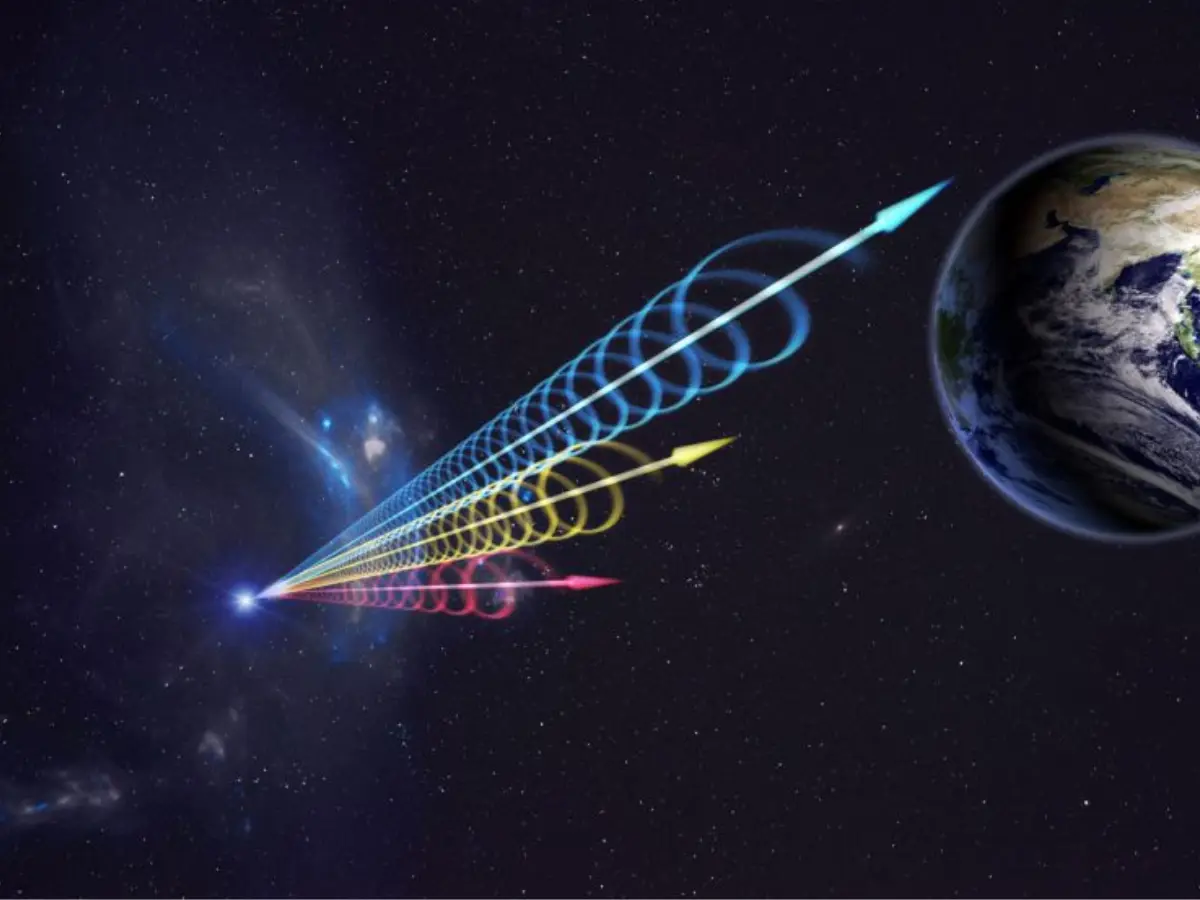
Earth was slammed by a blitz of hundreds of radio signals within minutes in 2024. Scientists studied the source of the bursts using the MeerKAT in South Africa and identified that they were coming from an intense cosmic event releasing hundreds of bursts.
Scientists have discovered the source of repeating short, sharp radio pulses that were first detected in June last year. The MeerKAT in South Africa tracked the signals to a cosmic event that generated an intense outburst, producing hundreds of such bursts across multiple frequency bands. Known as fast radio bursts (FRB), researchers say that these signals came from a far-off place in deep space. The burst seen on June 19, 2024, is known as FRB 20240619D. The source emitted hundreds of tiny but powerful pulses within minutes. Lead author Jun Tian of the Jodrell Bank Centre for Astrophysics at The University of Manchester (JBCA) wrote in the paper that initially, they recorded "three bursts being detected within two minutes in the MeerKAT L-band." To understand what was happening, the researchers checked for the bursts on ultra-high frequency, L band, and S band. They recorded a total of 249 bursts. Also Read: WOW! Signal was faster and stronger: Scientists know where the mysterious wave came from...well, almost
What do repeating signals suggest?
The study was published in the Monthly Notices of the Royal Astronomical Society. The speed and frequency showed that the source was one of the most active repeaters ever recorded. The data also stated the signals preferred one clear frequency, as most of them were centred in the L band rather than at lower or higher radio frequencies. This meant that the bursts are strongest around the L-band and showed a downward drift towards the end. In most repeaters, there are compact emission zones. But the new observations reveal that sometimes multi-component bursts change their frequency drift. Also Read: 44 minutes apart, 2 minutes every time: Something from deep space is sending signals to Earth
Where do most FRBs come from?
The universe emits repeating and non-repeating FRBs, and scientists don't know whether they come from the same kind of source. Some simulations suggest that they come from highly magnetised neutron stars undergoing starquakes, while others come from compact object interactions in binary systems. The FRB 20240619D will enable scientists to work on these two hypotheses to determine which of the two is occurring here. Scientists have seen similar FRBs in the past, with hundreds of outbursts in an hour.
To know whether there were simultaneous optical flashes when the burst occurred, the team coordinated the optical observations with the MeerLICHT telescope. “We find no optical counterpart of FRB 20240619D in the MeerLICHT optical observations,” Tian wrote in the paper. Notably, other independent projects are now searching for FRB signals in optical light with extremely fast timing—down to millisecond speeds. This is helping set even stronger limits on how much optical light accompanies these bursts compared to their radio energy.
)
)
)
)
)
)
)
)
)
)
)
)
)
)
)
)
)
)
)
)
)
)
)
)
)
)
)
)
)
)
)
)
)
)
&im=FitAndFill=(700,400))
)
)
)
)

