Bangladesh’s fault lines: The cost of deepening defence reliance on China

Bangladesh’s escalating military reliance on China presents critical fault lines that jeopardise its national sovereignty, economic resilience, and regional relationships. Opinions & Blogs
Bangladesh’s escalating military reliance on China presents critical fault lines that jeopardise its national sovereignty, economic resilience, and regional relationships. Beijing has strategically cultivated defence ties with Dhaka, positioning Bangladesh as a cornerstone of its ambition to exert influence in the Indian Ocean Region (IOR). While this alignment appears beneficial for Bangladesh’s immediate defence modernisation ambitions, recent developments highlight significant geopolitical risks.
Historically, Bangladesh-China relations have witnessed profound transformations. Despite China’s initial opposition to Bangladesh’s independence in 1971, bilateral ties improved significantly post-1975. The 2002 Defence Cooperation Agreement intensified military exchanges, arms transfers, and strategic consultations. Consequently, Bangladesh has progressively increased its reliance on Chinese military technology to unprecedented levels.

Currently, China supplies around 80 per cent of Bangladesh’s military equipment. Notable acquisitions include naval vessels such as frigates, corvettes, maritime patrol ships, and sophisticated missile systems, notably the C-802A anti-ship missiles. The procurement of two Ming-class submarines in 2016 marked a critical escalation, substantially improving Bangladesh’s naval capabilities but simultaneously binding Dhaka further into Beijing’s strategic orbit.
A particularly significant recent development is Bangladesh’s ongoing negotiation with China to procure 16 advanced J-10C multirole fighter jets, designed to replace its ageing MiG-29 and F-7 aircraft. This procurement signifies not only a significant step toward modernising Bangladesh’s air force but also represents a deeper strategic pivot towards Beijing amidst increasingly strained relations with India and cautious relations with the United States.
Moreover, China’s role in enabling Bangladesh’s domestic defence production capabilities further entrenches Dhaka’s dependency. Recent Chinese technology transfers to Bangladesh involve local manufacturing capacities for rifles, rocket launchers, and light utility vehicles. While these transfers align with Bangladesh’s “Force Goal 2030” campaign for military modernisation, they simultaneously deepen the structural dependence on Chinese technology and assistance, eroding Bangladesh’s autonomy in defence production.
)
Emmys 2026: Matthew Rhys wins Best Actor twice, sets historic 78-year record
)
3 Italians fly from Delhi to Munich without immigration clearance; Air India gets notice on major security lapse
)
Did India risk its US trade deal despite softer stance at BRICS?
)
Pakistan puts Pak Rs 70 lakh bounty on UN terrorist Masood Azhar; move draws skepticism in Delhi
)
‘US ensuring global energy supplies’: Trump demands reimbursement for securing Strait of Hormuz
)
'She married her brother': Ilhan Omar faces criminal probe over immigration fraud claims
)
'Huge destructive power': North Korea calls its latest missile launches 'live-fire drill' even as US dismisses 'immediate threat'
)
Ukraine strikes Syzran Oil Refinery deep inside Russia, fires erupt
)
‘Let’s go’: Newly declassified videos show dramatic rescue of US Air Force officers downed in Iran
)
Emmy Awards 2026: Widow's Bay and The Pitt win in lead categories- check out the complete list of winners
&im=FitAndFill=(700,400))
Why European Meteor missiles use ramjet engines compared to standard US solid rockets
)
Emmys 2026 In Memoriam: Catherine O’Hara honoured by on-screen children Macaulay Culkin, Annie Murphy, Dan Levy; Dolly Parton, Rob Reiner remembered
)
Iran, India agree to deepen humanitarian and political ties, President Pezeshkian says
)
‘Want to reset ties with India, have engagement based on mutual interests,’ says Bangladesh minister
&im=FitAndFill=(700,400))
Emmys 2026 Red Carpet: Zendaya, Nicole Kidman and Julia Garner lead the glamour peak
)
Turkish Airlines plane flies through a storm three times, triggering severe turbulence
&im=FitAndFill=(700,400))
Why Chinese PL-15 air-to-air missiles use dual-pulse motors compared to European interceptors
)
What is Hyrox, in news for athlete who soiled herself, but kept running and using common equipment?
)
Russia proposes to build 360 kmph Ivolga FG trains in India: What happened on sidelines of BRICS
)
800 million years old - Scientists discover 'fingerprints' of supercontinent Gondwana in ancient rocks
)
China discovers vast gold and silver 'mine' in the Pacific with unheard-of deposits
)
Plane carrying prominent figure crashes at Libya’s Misrata airport: Report
)
UPI payments up to Rs 2,000 to stays free, but bigger transactions may soon cost you: Govt
&im=FitAndFill=(700,400))
New OTT releases this week (September 14-20, 2026): Lust Stories 3, Waiting Hai, Irumudi- 5 new titles coming on Netflix, Prime Video and more
)
Sent home midway from UK tour, Pakistan's Salman Agha hits 300* in domestic return
)
Who is Kalyan Bainsla, accused in the Gurugram hit-and-run case involving woman biker?
)
Nigerian Navy seizes 10,000 litres of suspected illegal fuel in Rivers State crackdown
)
Saudi Arabia discovers 110 million tonnes of Uranium-rich ore in Madinah region
)
Dodgers beat Reds for playoff berth in bid for third consecutive World Series
)
Ecstasy tablets are rage in 'drug haven' Libya | Gravitas
)
'Now Trump is copying us': Shivakumar links US $5,000 plan to Congress guarantees
)
Video of Pakistani lawmaker struggling to read English tribute to Jinnah goes viral - WATCH
)
Trump downplays China's alleged 'help' to Iran in strike on Jordan base | Gravitas
)
Baba Vanga's first prophecy for 2027 is out, and straight out of science fiction
)
Trump loses Supreme Court battle over mail ballots ahead of US midterms: What happened?
)
BCCI VP Rajeev Shukla says Mohsin Naqvi 'did not object' India refusing trophy from ACC chief
)
Photographs, LeT labels vanish from two 2008 Mumbai attack entries in Pakistan’s most wanted list
)
Delhi govt to roll out ₹13,820 crore development projects under Seva Sankalp Abhiyan: CM Rekha Gupta
)
UK man admits drugging, raping wife for 20 years in shocking abuse case
)
Extreme warming in Indian Ocean added 695 billion tons of ice to Antarctica ice sheet
)
China thinned Himalayan troop presence in 2025, India defence report says; terms border situation 'stable'
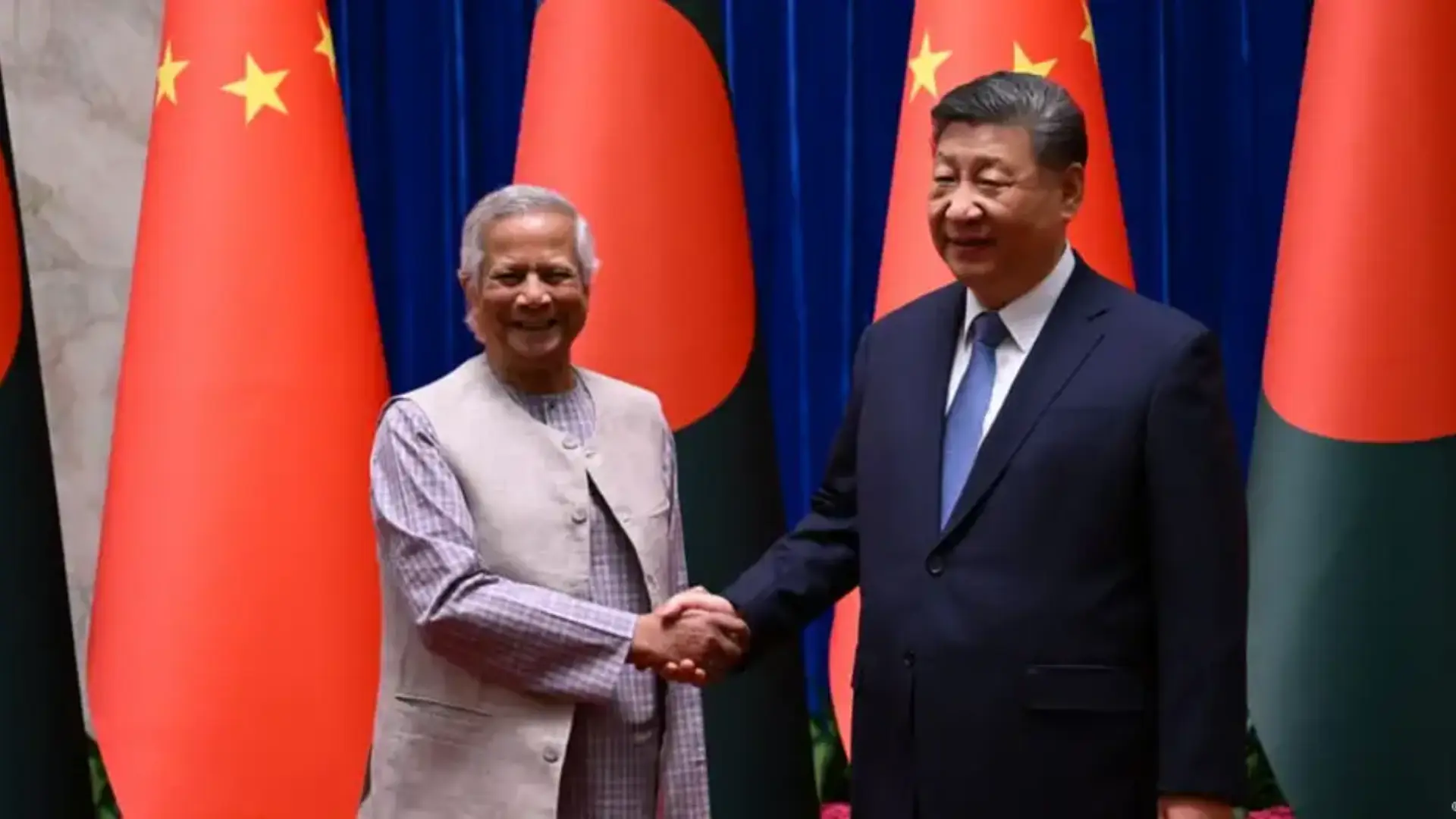
Bangladesh’s interim Chief Adviser, Dr Muhammad Yunus, visited Beijing in March 2025, significantly boosting bilateral ties. Yunus signed eight Memorandums of Understanding (MoUs) and one agreement encompassing infrastructure, economic cooperation, and expanded defence collaboration. Crucially, Yunus secured $2.1 billion in new Chinese investments, loans, and grants, along with discussions focused on expanding military cooperation. Such diplomatic outreach underscores Bangladesh’s deepening political tilt toward China, intensifying concerns among regional and global stakeholders.
Strategic infrastructure projects financed and executed by China through the Belt and Road Initiative (BRI) are additional pressure points. These include the modernisation of Mongla Port and the sensitive Teesta River management project. While these initiatives promise economic advancement, they risk locking Bangladesh into a debt-driven dependency, potentially replicating debt-trap scenarios already seen elsewhere along the BRI corridors.
The BNS Sheikh Hasina Submarine Base at Pekua, Cox’s Bazar, financed by approximately $1.21 billion in Chinese loans, represents another critical strategic entanglement. While it significantly boosts Bangladesh’s maritime defence capabilities, the facility potentially enables Chinese deployment of advanced surveillance and anti-submarine warfare systems. The base embodies a profound strategic vulnerability, potentially rendering Bangladesh a proxy within China’s broader Indo-Pacific ambitions.
These developments understandably alarm India, South Asia’s predominant maritime power. China’s intensified engagement, especially involving sensitive projects like the Teesta River initiative and dual-use military facilities, aggravates Indian apprehensions about strategic encirclement. Washington, similarly concerned, continues to caution Dhaka against unchecked alignment with Beijing under its broader Indo-Pacific Strategy aimed explicitly at counterbalancing Chinese dominance.
Economically, Bangladesh’s persistent trade deficit with China remains substantial despite attempts at negotiating favourable terms. Although Beijing pledged duty-free access for 99 percent of Bangladeshi goods until 2028, continued heavy reliance on high-interest Chinese loans exacerbates fears of unsustainable debt accumulation and long-term economic vulnerabilities.
Given these unfolding complexities, Bangladesh stands at a pivotal geopolitical crossroads. While deepening ties with Beijing offers immediate defence enhancements and economic support, these short-term benefits come with potentially irreversible strategic vulnerabilities. Bangladesh risks compromising its ability to independently navigate regional and global strategic currents, limiting autonomy in its foreign policy choices and jeopardising balanced relationships with key international actors, notably India, the US, and Japan.
Bangladesh must urgently reconsider its strategic orientation for regional stability. Diversifying military procurement and infrastructure development through partnerships with various global actors could mitigate the risks inherent in overreliance on China. Enhanced diplomatic outreach and economic cooperation with regional neighbours and established democracies can serve as effective counterbalances against potential exploitation.
India, for its part, must recalibrate its strategy by expanding diplomatic engagement, enhancing economic partnerships, and reinforcing military readiness. Regional allies, like Japan, should also proactively support Bangladesh in building resilient, diversified, and balanced strategic relationships.
Ultimately, Bangladesh’s geopolitical future depends critically on its ability to navigate these fault lines prudently. Pursuing strategic autonomy and balanced diplomacy will help secure long-term national sovereignty, economic resilience, and regional stability. Failure to address these pressing issues risks irreversible consequences—an outcome neither Bangladesh nor its regional neighbours can afford.