What does the G20 do ?

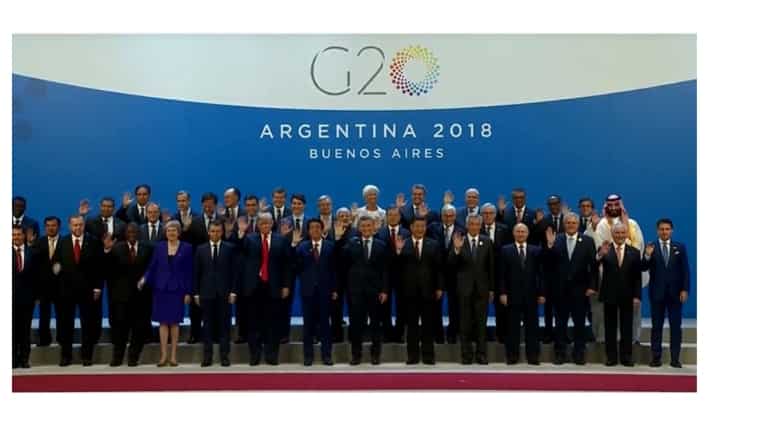
G20 Leaders
The G20 (or Group of Twenty) is an international forum for the governments and central bank governors from Argentina, Australia, Brazil, Canada, China, the European Union, France, Germany, India, Indonesia, Italy, Japan, Mexico, Russia, Saudi Arabia, South Africa, South Korea, Turkey, the United Kingdom, and the United States. The G20 is a self-appointed group whose composition is determined by the major countries and powers.
G20 consists of 19 individual countries plus the European Union (EU).
Collectively, the G20 economies account for around 90% of the gross world product (GWP), 80% of world trade (or, if excluding EU intra-trade, 75%), two-thirds of the world population,and approximately half of the world land area. It seeks to address issues that go beyond the responsibilities of any one organization, but still, the G20's membership policies have been criticized by numerous intellectuals. G20 is an initiative aiming at international coordination of economic policy. Summit themes varies from year to year.

HISTORY
Canadian finance minister Paul Martin was chosen as the first chairman and German finance minister Hans Eichel hosted the inaugural meeting in 1999 in Berlin. The group was founded primarily at the initiative of Eichel, the concurrent chair of the G7, as per 2004 report by Colin I. Bradford and Johannes F. Linn of the Brookings Institution.
However, Bradford later described Paul Martin as "the crucial architect of the formation of the G-20 at finance minister level," and as the one who later "proposed that the G-20 countries move to leaders level summits."
)
US vs China over South China Sea: Washington backs Philippines, Beijing hits back
)
Bigg Boss 20: Isha Rikhi evicted after three weeks in Salman Khan’s show
)
Musk plans to more than double xAI's chips to over 1.2 million Nvidia GPUs by year-end
)
After JU, clash erupts at SRFTI: BJP’s ‘Dimagi Naxal’ jibe sparks political firestorm after students protest RSS-linked event
)
‘Anti-social elements spreading false rumours’: LPU issues statement amid massive unrest over alleged rape
)
LPU students go on rampage, vandalise campus amid widespread protest: What's happening
)
Trump asked Xi to pressure Iran. China did not say yes — here’s what Beijing wants
)
US Treasury Secretary Scott Bessent hails global crackdown on Iranian banks and airlines
)
An OpenAI agent escaped its locked test cage again, by hiding questions in DNS lookups
)
'Our video was trimmed': LPU girls who featured in rape-denial video make U-turn
)
3 males killed, four others injured in shooting after fight at strip club in Detroit
)
'Victory for low-budget consumers': Raghav Chadha hails 30-day telecom recharge rules
)
Claude rebuilt the 1989 game 'Prince of Persia' by reusing the original's own code
)
Beyond metros: How Tier-2 and Tier-3 cities could drive India’s next AI wave
)
Tesla builds first Cybertruck with its own refined lithium: Elon Musk's $1 billion Texas bet pays off
)
IndiGo flight suffers tail strike in Bengaluru while landing; DGCA to probe incident
)
The US and China set up an AI 'red telephone', but skipped the rulebook
)
‘Terror suspects arrested near UK air base were looking to do big damage’: Trump
)
Russian envoy claims US tactics to contain India were revealed in ‘Freudian slip’
)
IND vs WI 1st ODI: Kohli breaks Sachin's most runs in one country record with unbeaten 139 as India thump West Indies by 8 wickets
)
Researchers rebuilt exactly how 700 AI agents hacked Hugging Face: a 900-link chain trick
)
‘Olympic inclusion is our major target’: WPA President Ishaun Singh on pool’s global ambitions
)
Nations League: Spain sink England at Wembley; Modric shines for Croatia
)
Why has Iran released no proof of life of Mojtaba Khamenei? Araghchi reveals...
)
'What kind of confession is this?': Pakistan PM Shehbaz Sharif’s 'terrorists would be roaming New York' remark goes viral, raises alarm online. Watch
)
South Korea demands apology from Ukraine over North Korean prisoners' transfer
)
Beyond BrahMos: India targets Rs 50,000 crore in defence exports with unmatched price edge
)
Sri Lankan Tamil migrant worker gets death sentence in Saudi Arabia, help sought from India
)
Muslim marriage cannot shield sex with minor wife from prosecution under POCSO: Delhi HC
)
'Can't help but draw painful parallels to Nirbhaya case': SC on latest incidents of rape cases in Delhi-NCR
)
99.9% more powerful - Scientists find boy who can recall memories from just 3 months of age
)
'FIRST LOOK from inside Noah’s Ark': Researchers share video from inside mysterious mound in Turkey
)
UNSC reform momentum grows: Russia, Portugal, Mauritius push for India's permanent seat bid
)
8 US marines injured in Iranian missile attack on vessel in Strait of Hormuz: Report
&im=FitAndFill=(700,400))
New OTT releases this week (September 28-October 4, 2026): Dupahiya 2, Pooja Meri Jaan, Ohh My Dog- 5 titles coming on Netflix, Prime Video and more
)
Afghanistan says 28 fighters killed in clash near Pakistan border, Islamabad denies
)
Ceuta migrant crisis: Protesters take to streets as Spain grapples with migrant challenge
)
LPU suspend classes, postpones exams as violence escalates over rape claims: What's happening
)
New York City wants a 'kill switch' on every AI, and will pay whistleblowers who report violations
Canadian academic and journalistic sources have also identified the G20 a project initiated by Martin and then-US Treasury Secretary Larry Summers. But Germany and the United States played a key role in bringing their vision into reality.
The G20's primary focus has been governance of the global economy.
MEMBERS
As of 2017, there are 20 members of the group. These include leaders of 19 countries, and of European Union and, at the ministerial-level meetings, the finance ministers and central bank governors of 19 countries and of the European Union.
In addition each year, the G20's guests include Spain; the Chair of ASEAN; two African countries and a country (sometimes more than one) invited by the presidency, usually from its own region, and office holders of United Nation, World Bank Group and World Trade Organisation.
G20 AGENDA
Initially, G20 was set up for global economic coordination but over the years it has widened up its agenda. After the adoption of the UN Sustainable Development Goals and the Paris Climate Agreement in 2015, more "issues of global significance" were added to the G20 agenda: migration, digitisation, employment, healthcare, the economic empowerment of women and development aid.
CRITICISM
Although G20 group has a high degree of legitimacy and influence over the management of the global economy and financial system due to broad membership and economic weight. G20 group's legitimacy has been challenged.
In a 2010 interview with Der Spiegel, the Norwegian foreign minister Jonas Gahr Støre called the G20 "one of the greatest setbacks since World War II."
The G20's transparency and accountability have been questioned by critics.
The cost and extent of summit-related security is often a contentious issue in the hosting country, and G20 summits have attracted protesters from a variety of backgrounds, including information activists, opponents of fractional-reserve banking and anti-capitalists. In 2010, the Toronto G20 summit sparked mass protests and rioting, leading to the largest mass arrest in Canada's history. Critics also point out at the disproportionate representation of African countries
ACHIEVEMENTS
G20 provides a platform to discuss all issues that affect the world. Its major achievement includes quick deployment of emergency funding during the 2008 global financial crisis.
2018 G20 BUENOS AIRES SUMMIT
The thirteenth meeting of Group Of Twenty was held from 30 November till 1 December 2018 in the city of Buenos Aires, Argentina. It was the first G20 summit to be hosted in South America.
G20 Argentina had put forth three agenda priorities for the G20 dialogue in 2018: the future of work, infrastructure for development and a sustainable food future.
A number of attending countries also focused on the regulation of crypto-currencies at this meeting. International trade was also one of the priorities of the thirteenth G20 Summit.
The 13 G20 Summit ended with a number of big outcomes such as India being as the host for G20 in 2022 and Trump-Xi truce in the ongoing trade war.
On Global outcomes, US president and Chinese President met for almost two-and-a-half hours on a working dinner.
Trump & Xi have also agreed to "immediately" begin negotiations on "structural changes" with respect to forced technology transfer, intellectual property protection, non-tariff barriers, cyber intrusions and cyber theft, services and agriculture. Both agreed that this will be completed within the next 90 days.
G20 nations also agreed on reforming WTO
On the sidelines of G20, PM Modi also met a number of world leaders including Chinese President Xi for the fourth time since he assumed office and invited South African President Cyril Ramaphosa for the Republic day celebrations.