&imwidth=800&imheight=600&format=webp&quality=medium "US restricts access of Anthropic’s Mythos and Fable to Americans only. Is globalisation dead in the age of AI?")
The AI firm Anthropic has barred all foreign nationals from accessing its latest AI models, Fable 5 and Mythos 5, as per an order of the United States government citing national security reasons. The company, known for its Claude chatbot, said government agencies had instructed it to prevent all foreign nationals from accessing Fable 5 and Mythos 5.
The Mythos AI model is particularly adept at detecting software vulnerabilities, some of which have remained undiscovered for decades. This capability has been used by US authorities and select companies to plug security gaps. The Fable 5 model, released this week, is also based on Mythos technology, but its cybersecurity and biotechnology capabilities are blocked.
The US government believes that such AI could become a dangerous cyberweapon in the wrong hands, and rightly so.

Also Read: MoU will ensure end of war on all fronts, including Lebanon: Iran’s Foreign Minister Abbas Araghchi
US government’s order to Anthropic sparks debate
However, the US government’s order has sparked a debate about who controls the future of artificial intelligence and whether globalisation is dead.
Trending Stories
)
Why asking questions could be more important than memorising answers
)
BRICS Summit 2026 full schedule: Day-wise agenda, timings and key issues - All you need to know
)
BRICS Summit 2026: Iran's Pezeshkian praises PM Modi at BRICS
)
Why dehydration is the hidden cause of travel fatigue on long flights
)
Top 5 places to visit in Goa beyond its famous beaches
)
BRICS Summit: All about Xi Jinping's armoured limousine Hongqi that will ferry him in New Delhi
)
BRICS Summit 2026: Modi-Xi meeting to test India-China reset after border tensions
)
BRICS Summit 2026: 30+ countries seek BRICS membership
)
Frustrated man demolishes his kitchen after thousands flock to see Mother Mary his wife spotted on the wall
)
Trump says Canada eager to reach a deal, it could come ‘fairly soon’ if Ottawa treats US farmers better
)
From drones to KAAN fighters: Turkey outlines 229% surge in defence spending amid regional shifts
)
‘Partners, not rivals’: Xi outlines four point plan for stronger India-China ties
)
Could staying indoors all day affect your health?
)
Bigg Boss 20: Uditi Singh reacts to ex Karan Wahi’s possible wildcard entry
)
Why going digital does not always mean becoming more efficient
)
800 million years old - Scientists discover 'fingerprints' of supercontinent Gondwana in ancient rocks
)
ENG vs PAK: Joe Root breaks Sachin Tendulkar’s record for most Test fifties
)
Israel spent nearly $470,000 on PM's hair, makeup since 2019, data shows
)
From severe mobility problems to recovery: Madhuri the elephant’s journey of wildlife care
)
BRICS Summit day 1: New Delhi declaration adopted with full consensus, big diplomatic win for India
)
From India, Putin warns Europe against sending troops to Ukraine, Zelensky expresses willingness to meet him at G20 Summit
)
9/11 attack anniversary: The day that changed America forever
)
9-year-old Chennai prodigy clears Cambridge IGCSE grade 10 exams
)
BRICS Summit 2026: PM Modi says India and Iran should pursue win-win strategy
)
Why does your body need time to adjust after a long journey?
)
Baba Vanga's first prophecy for 2027 is out, and straight out of science fiction
)
BRICS declaration calls for stronger people ties, women-led growth and greater youth cooperation
)
Why does your skin need protection from UV rays?
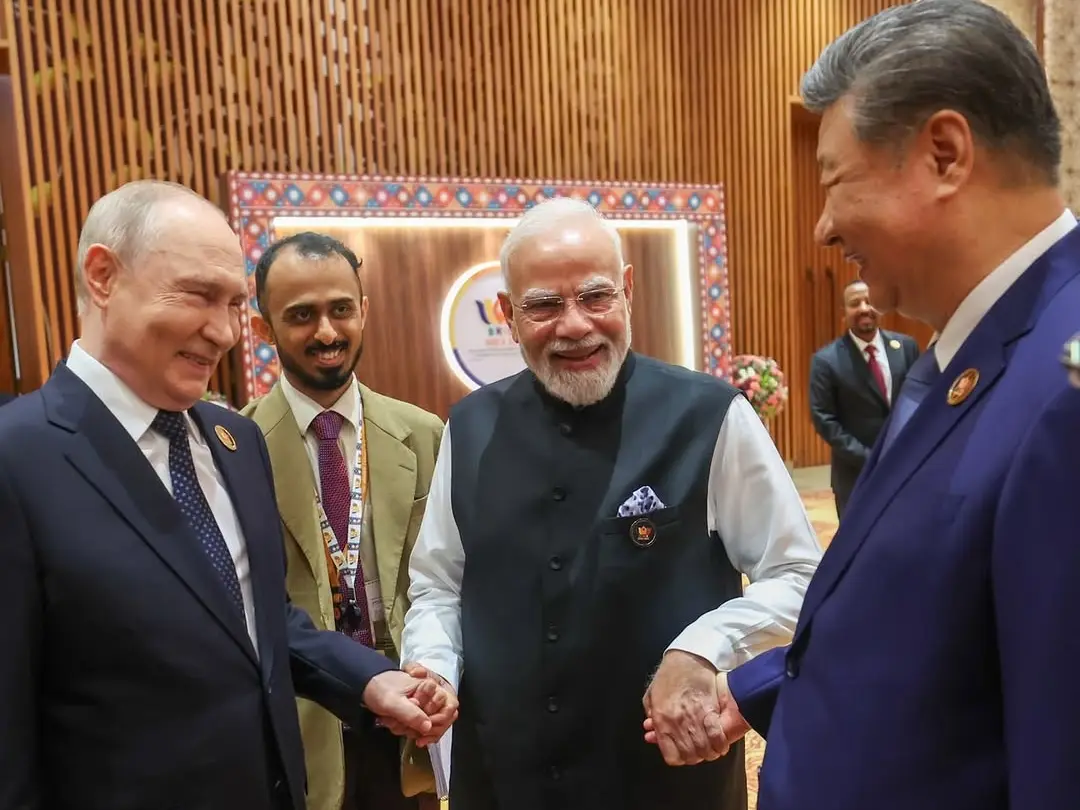)
Modi, Putin, Xi ‘bromance’ goes viral as leaders captured holding hands at BRICS Summit
)
How does the loss of forests affect the way wildlife lives and moves?
)
IND vs AFG, 1st T20I: When and where to watch live streaming in India?
)
Anthropic is giving Claude to schools free, and the reason is not philanthropy
)
BRICS Summit: China resumes Guangzhou-New Delhi flight, issues 'good-neighbourliness' remark ahead of Xi-Modi meet
)
Why do wild animals need quiet places to survive?
)
Humans may lose control of AI: Anthropic CEO calls for slowdown, Altman, Musk back him
The access curb marks a major shift in how governments regulate artificial intelligence. Until now, restrictions largely focused on chips and hardware used to build and run AI systems.
Now questions are being asked about technology sovereignty and whether countries can even rely on AI systems developed elsewhere.
Globalisation has been one of the hallmarks of the modern world, as it enabled the free flow of goods, services, capital, technology, and ideas across national boundaries. The internet accelerated it by creating a global digital marketplace where innovation could spread rapidly and benefit people worldwide. The access curbs on advanced AI models show that AI is no longer viewed merely as a commercial product but as a strategic asset.
Also Read: US govt funded foreign biolabs, many of them worked on dangerous pathogens, reveals Tulsi Gabbard
Powerful AI models can affect military capabilities, cybersecurity
Governments recognise that powerful AI models can influence military capabilities, cybersecurity, scientific research, and economic productivity and are trying to protect technological advancements that can be misused.
The globalisation concept was built on the principles of openness, international cooperation, and the belief that innovation should spread across borders.
Globalisation also has its own challenges, the primary ones being income inequality, job displacement, and environmental concerns.
Moreover, it would be premature to say that globalisation is dying or is dead. In fact, globalisation may be evolving and taking a new form. Global economic interdependence still remains strong even as some strategic technologies may be becoming more restricted.
Also Read: ‘US will use Iran’s frozen funds to pay for damages inflicted on Gulf allies’: Scott Bessent
AI development depends on global supply chains, talent pools, and collaboration
AI development itself depends on international supply chains, global talent pools, and cross-border collaboration. Researchers and engineers from different countries are contributing to the advancements in computing infrastructure and data science. Complete technological isolation is very difficult to achieve in a highly interconnected world.
Both competition and cooperation are evident in the AI industry as nations compete for leadership in the field, but they also collaborate on research, standards, and governance frameworks.
Various governments, academic institutions, and private companies from across the globe are heavily involved in international discussions on AI ethics, safety, and regulation. All these happenings suggest that globalisation is not disappearing but adapting to new situations, realities and perceptible threats.