&imwidth=800&imheight=600&format=webp&quality=medium "This is f***ing insane!: AI’s dystopian future is K-shaped, and could decimate the middle classes from India to the US")
Let me give you both the most pessimistic and optimistic views of where the middle classes of countries like the US and India will end up if AI adoption does not go beyond merely asking ChatGPT for answers, or Grok for funny images and videos. Companies at the forefront of artificial intelligence are warning about how jobs across industries could be wiped out by AI. This could potentially lead to a middle-class collapse in these countries if action does not match the situation. How bad can it get? And what is the way out?
A disturbing discussion led by AI leaders on the impending fall of jobs
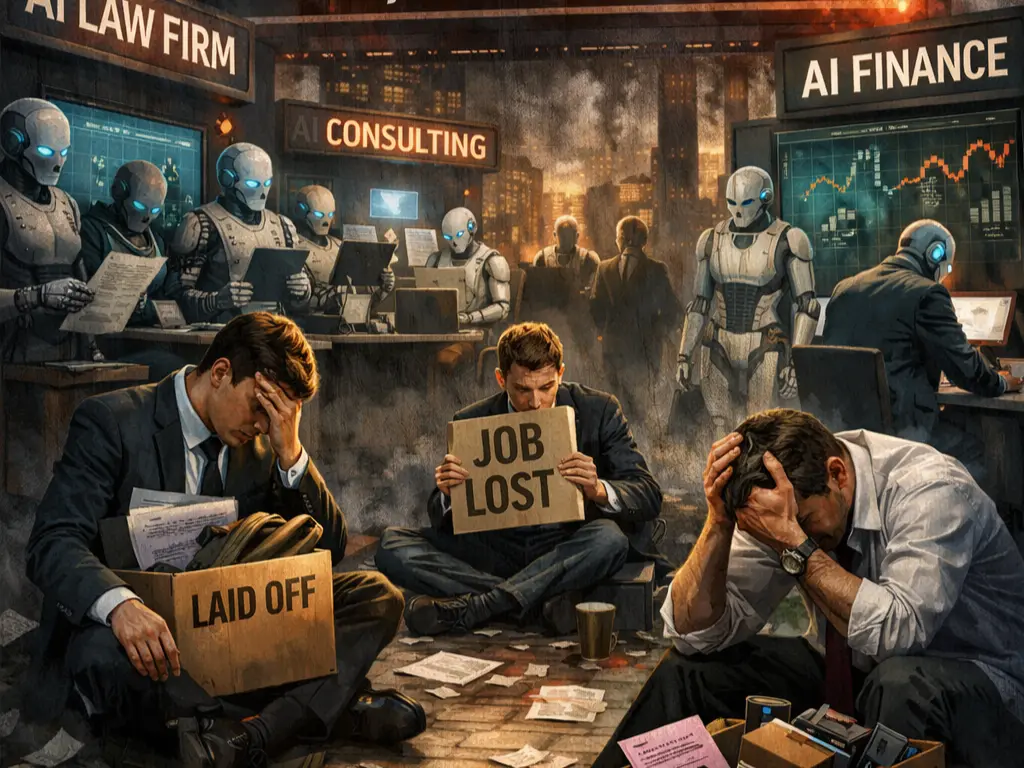
The starting point for this article is a disturbing series of discussions on a future fall in jobs, ironically led by AI leaders themselves. Anthropic CEO Dario Amodei is ‘leading the charge’ in bluntly saying how traditional jobs, including ‘secure’ jobs in the legacy IT sector, are going to be wiped out. In recent interviews and public remarks, Amodei indicated that up to 50 per cent of entry-level work in fields such as law, consulting, and finance could be disrupted or replaced by AI systems within the next one to five years.

Reacting to this, Damian Player, CEO of the AI consulting firm Agent Integrator, recently posted on X: “This is f***ing insane! The CEO of Anthropic said what most C-suites only say behind closed doors… this is the head of one of the biggest AI companies alive telling ordinary people to wake up.”
A dystopian scenario if India does not adapt to AI beyond current levels
The situation being described below is only a simulation of the future, taking cues from the ongoing K-shaped growth in the US, underway since the Covid pandemic. K-shaped growth is when certain sections of society and the economy show exponential growth, while other sections race to the bottom, making the resultant image resemble the letter K. In a future scenario where AI eats up jobs, large sections of Indians could be pushed towards poverty. This could happen as early as the next five years in the absence of even foundational-level skills in AI.
Trending Stories
)
Nigeria: Protesters take to the streets, police fire shots
)
US-Iran war: Tehran draws red lines — seven demands before any peace talks
)
Russia-Europe tensions: Polish PM warns Russian attacks could test NATO's unity
&im=FitAndFill=(700,400))
‘Not the US or China’: These are the countries leading the world in arable land
)
EXCLUSIVE | Singer Hanita Bhambri on her Toxic debut, working with Vishal Mishra and more
)
Sikh bus driver assaulted, bus stolen and rammed into cars in England; video surfaces
)
Mark Carney mimics Trump in hilarious moment over C$70 billion clean-energy investment; room erupts in laughter
&im=FitAndFill=(700,400))
Before Extraordinary Minami Minami, these popular K-dramas got Japanese versions
)
'Were you here to sell chickpeas?': Wasim Akram criticises Babar Azam's captaincy
)
Aravana prasadam shortage at Sabarimala temple in Kerala triggers protests, TDB questioned
)
‘End of my career...’: NSA Doval recalls tense Sikkim mission when China captured Indian intelligence team
)
Report: Iran rebuilding Taleghan 2, nuclear site tied to past weapons research, hit twice by Israel
)
Trump defends AI amid growing alarm, announces new 'AI force' and promises an 'AI czar'
)
Iran sets 7 conditions to end war with US: What are Tehran’s demands?
)
Trump announces ‘AI Force’ as debate grows over AI risks and regulation
)
China may have gained access to US's classified F-35 jets; parts meant for repairs diverted to Hong Kong, sparking Pentagon inquiry
)
Man breaks open wall hiding hundreds of books since 15 years
)
Gaza under attack: Health chief's son killed in IDF strikes
)
S Jaishankar, former Army chief among high-profile names issued Delhi SIR notices
)
Arvind Kejriwal, family members, Delhi CM Rekha Gupta get SIR notices
)
AI actress Tilly Norwood glitches mid-interview, switches from English to Chinese | Watch
)
Saudi vs Houthis: Houthis claim missiles & drones used in attack on key Saudi sites
)
Ed Sheeran addresses Macklemore's removal, Gaza conflict during Philadelphia concert: 'I cannot hide how I feel'
)
‘Will go to any extent’: Pakistan vows to defend Saudi Arabia amid Houthi attacks
66 years of the Indus Waters Treaty: How India and Pakistan settled a bitter river dispute
)
The Verdict | When precision fails: US commits war crime in Minab school strike, UN finds
)
9 women found dead near Johannesburg: South Africans rally, demand 'enough' to femicide
)
Kampala-Ankara rift deepens: Uganda suspends military ties, seeks Fred Lumbuye's extradition
)
Several petrol pumps, other businesses to refuse UPI payments above Rs 2,000 from Oct 16: Is it legal?
)
US-Iran war: Tehran sets seven conditions to re-engage in talks with US
)
Reacher star Alan Ritchson opens up about alleged blackmail, suicide attempt during difficult period
)
Africa is splitting, and a lot sooner than estimated, giving way to a new ocean
)
West Indies Squad for India Series: Hetmyer included for T20Is, Holder rested
)
Trump bans CNN, MS NOW and Politico from White House over ‘FAKE NEWS’
&im=FitAndFill=(700,400))
How many F-35s does Britain, Japan and Israel have?
)
Harry Brook targets long reign at top of T20I rankings after Sri Lanka sweep
)
Russia's deadly Ukraine strikes kill 2 in Sumy, hit Dnipro mall
)
Russia holds first parliamentary elections since the beginning of the Ukraine war
&im=FitAndFill=(700,400))
Meet top 5 Indian batters with fastest T20I centuries
)
Raphinha hat-trick powers Barcelona to 3-1 win over Sevilla in La Liga
)
What is the level of AI adoption in India? Identifying the problem
It is quite possible that a large majority of Indians have never actively used AI tools in a meaningful way. Even among the digitally savvy population, many have little knowledge of AI apart from using the free version of ChatGPT and the like. Contrast this with the current world, where agentic and ‘copilot’ systems such as Anthropic’s Claude integrations and automated workflow tools are slowly entering enterprise environments.
Only a small fraction of users subscribe to paid AI platforms that typically cost around ₹2,000 per month or more. An even smaller proportion use coding interfaces, APIs, or automated workflows to interact with AI systems.
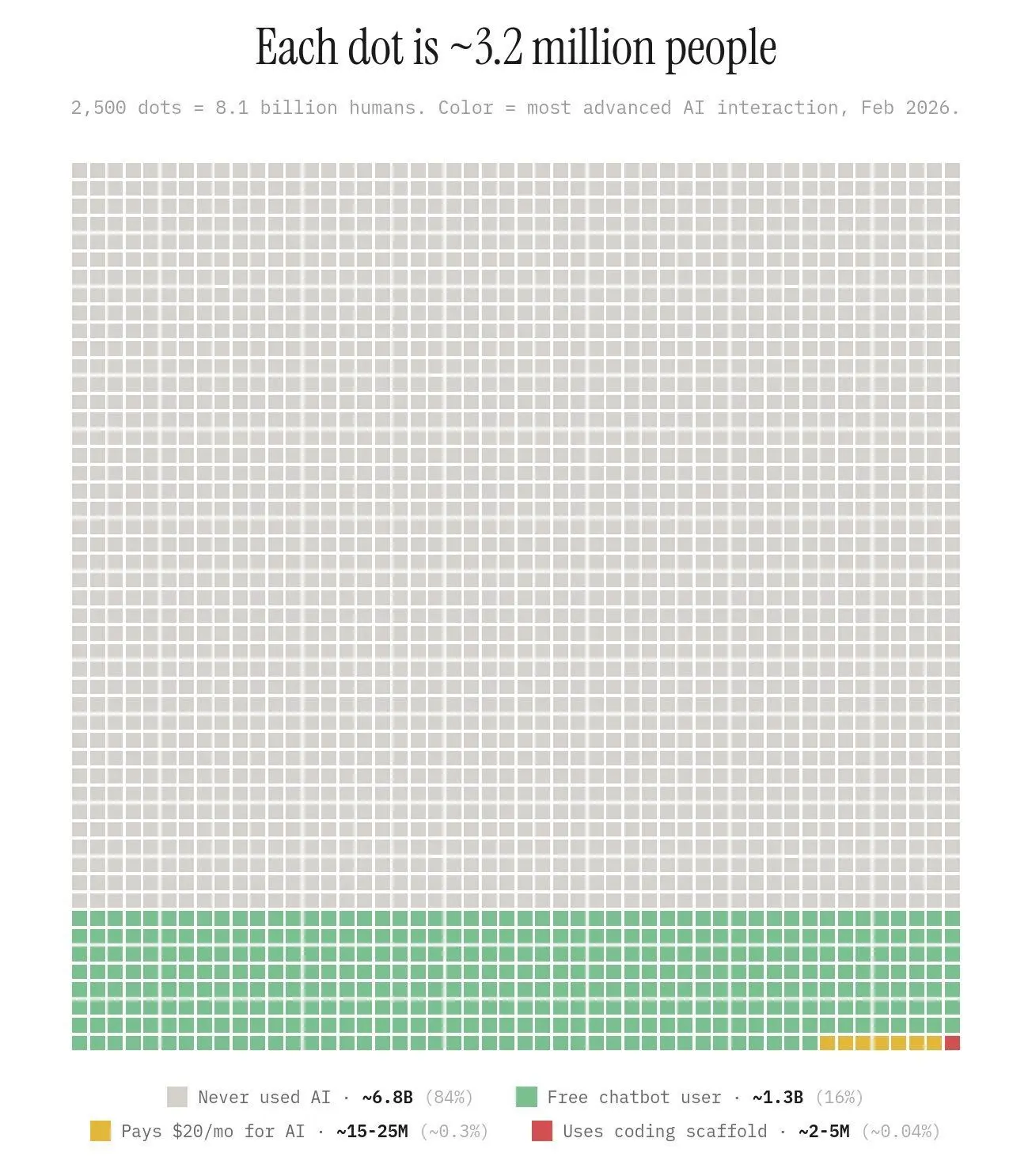
An infographic showing the level of AI adoption in the world (Image Courtesy: LinkedIn/ Benjamin T, co-Founder at Aiso)
Why K-shaped growth in the US should be a wake-up call to India
The K-shaped growth pattern is already visible in the US economy. In the current scenario, this is partly a function of AI adoption too. Many Americans are forcing themselves to learn AI use cases in order to remain competitive in the workplace. In terms of AI adoption, analysts often describe four levels of participation, known as AI maturity models: Elite, Augmented, Middle, and Struggling. It is projected that around 30 per cent of American citizens could remain in the Elite and Augmented categories, while 50 per cent could fall into the Middle group, and about 20 per cent may Struggle to keep up.
Indians are ‘consumers’ of AI, and that is prelude to potential digital colonisation
There is a clear danger in Indians becoming consumers of international AI companies, essentially paying for subscription packages ranging anywhere from ₹2,000 or upwards to use their AI models. This is because India has yet to build globally competitive AI tools at scale, in spite of several initiatives at the government (India AI mission) and corporate (Infosys, TCS and others incoporating AI in workflows) levels. Even ‘localisation efforts’ are largely being driven by global technology companies such as Google, Microsoft, and OpenAI.
In several ways, this echoes patterns seen during colonial economic structures, when the British Raj turned large sections of the Indian population into consumers of value-added goods produced elsewhere.
If this trajectory continues, India could risk a form of neo-digital colonisation, where countries ahead of the AI curve — particularly the US and China — dominate the virtual and technological landscape.
Indians would, in effect, end up paying US or Chinese companies for AI services, revenue that could ultimately support these countries' domestic technology ecosystems and economic programmes.
Also read: India AI Impact Summit: $300 billion worth of AI investments committed in India, say reports
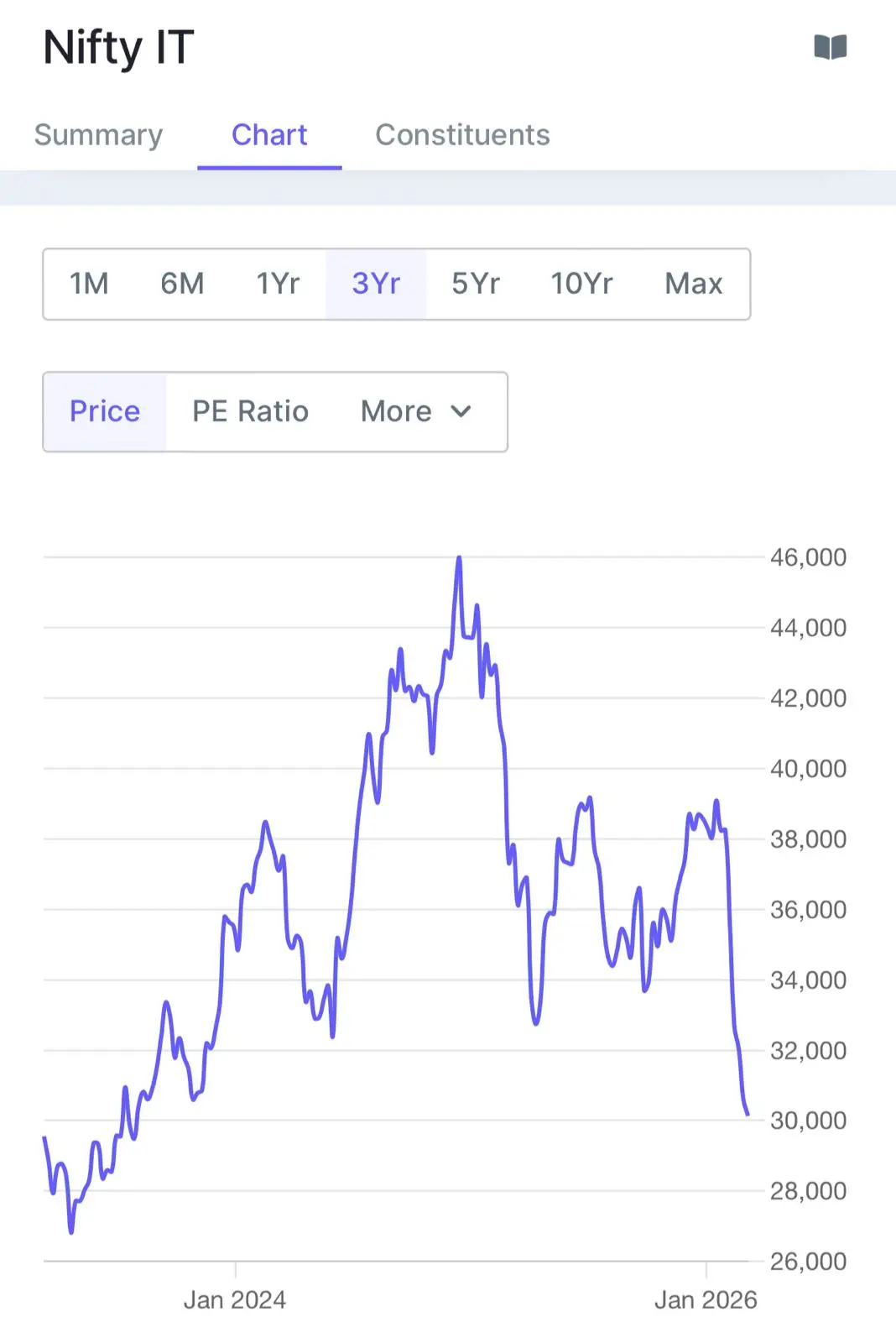
A three-year price drop of Nifty IT stocks
Indian IT stocks crash, HNIs trickle out: A fever indicating worse possible outcomes in the near future
Not too far away in the future, full-stack AI companies could enter India aggressively, resulting in a dramatic rise in layoffs and a stock market correction led by the decline of traditional IT service firms. And in some ways, the warning signs are already visible when it comes to IT stocks.
The Nifty IT index has already shown significant volatility when viewed across recent multi-year patterns. At one point, it fell around 30–34 per cent from its peak within a span of several months (see image above).
For some observers, this evokes memories of the early stages of the 2007 downturn that eventually led to the global financial crisis triggered by the US mortgage market collapse.
A prolonged slowdown could potentially spill over into banking and other industries.
Layoffs, which have already been seen periodically in the global technology sector, could hit traditional IT jobs in India particularly hard.
A major downturn could also affect the Indian rupee, which has gradually weakened against the US dollar over the past decade.
Another indicator often cited in this context is the growing number of high-net-worth individuals (HNIs) exploring migration. According to various global wealth reports, several thousand millionaires are estimated to leave India annually, often relocating to countries such as the UK, United Arab Emirates, Singapore, Australia, and Canada.
So what is the way out? Adopt AI or die
Damian Player’s post that I mentioned earlier, also offers a possible cure for the problem. To paraphrase him, the good news is that the playbook has not changed.
There is still a pathway for AI adoption for those who are currently ‘AI-illiterate’. As Player said, pick an industry, learn the workflows. Become the ‘AI person’ these companies need.
As Player puts it, you do not need a degree. “You sure as hell don’t need to be a McKinsey consultant. You need Claude, a vertical, and the hunger to learn a business better than anyone else. God speed! I’ll be rooting for ya,” Player wrote.
Godspeed is all I can say to those standing at the edge of the AI cliff — and staring downwards.