&imwidth=800&imheight=600&format=webp&quality=medium "Palestinian statehood recognition is UK’s moral responsibility. The British colonial legacy behind creation of Israel, displacement of Palestinians")
There is increasing pressure on the UK to recognise the statehood of Palestine, with reports even suggesting that Prime Minister Keir Starmer is likely to do so. If it happens, it would be an act of natural justice, because Britain’s colonial-era actions directly contributed to the creation of Israel, leading to the displacement of Palestinian populations from their land.
The Legacy of Empire: Britain's direct role in Palestine and the creation of Israel
Between 1920 and 1948, Britain governed Palestine under a League of Nations Mandate following the collapse of the Ottoman Empire. The Mandate system was formally intended to prepare the territory for self-governance. However, Britain embedded within it the Balfour Declaration of 1917 — a statement issued by Foreign Secretary Arthur Balfour promising to support the establishment of a "national home for the Jewish people" in Palestine. The declaration also vaguely stated that “nothing shall be done which may prejudice the civil and religious rights of existing non-Jewish communities,” who at that time formed the overwhelming majority of the population.

Palestine and Israel: A demographic re-engineering by Britain for economic reasons
Palestinian Arabs comprised over 85 per cent of the population in the early 1920s. Yet, their national aspirations were sidelined as Britain facilitated and legitimised waves of Jewish immigration and land acquisition under the terms of the Mandate. These policies were informed by a range of motives, including post-war diplomacy, geopolitical strategy, and the desire to maintain influence over critical trade routes such as the Suez Canal and emerging oil infrastructure in the Middle East. By 1947, Jewish ownership of land had increased to about 6.6 per cent — up from less than 3 per cent in 1918. Jews became roughly one-third of the total population, mostly concentrated in urban and coastal areas such as Tel Aviv, Haifa, and parts of Jerusalem.
Trending Stories
)
Xi Jinping's new AI bloc: China launches 'World AI Body' with Pakistan and Russia in, India out
)
3.5-million-year-old mystery creature found in Japan is a 'giant' never seen before
&im=FitAndFill=(700,400))
Why the S-400 uses solid rocket fuel instead of liquid fuel
)
Explained: Why Rodri won the FIFA World Cup Golden Ball over Lionel Messi
)
Japan is selling a refrigerator to cool the human body for Rs 9 lakh. It is already a hit in Tokyo
)
Lip reader reveals what Donald Trump told every Spain and Argentina player after FIFA World Cup final during medal ceremony
)
US-Iran conflicts: Houthis announce maritime blockade on Saudi Arabia, Iran attacks MQ-9 drone hangar | Gravitas
)
‘Iran can survive sanctions, but can’t truly live’: Dy FM warns of economic cost of war
)
Sonam Wangchuk's connection with George Soros and Ford Foundation explained!
)
'There is no need for...': PM Modi takes a veiled dig at Rahul Gandhi, sends big message amid Parliament March
)
‘Netanyahu will not be arrested in any way, shape, or form in US’: Trump’s counter to Mamdani
)
FACT CHECK: Was Abhijit Dipke detained during CJP's Parliament march? Here's what police say
)
UP BTech gold medalist dies by suicide after failing in nearly 50 govt job attempts, leaves note for father
)
Jail over Khamenei post: J&K youth returns home after 3 months in Saudi custody
)
'Now come to us': CJP resumes protest after Parliament march violence, calls meeting with Nadda 'waste of time'
)
Salman Khan breaks silence on health concerns after viral Mumbai appearance
)
'George Soros playbook': Understanding the foreign funding network around Sonam Wangchuk
)
Indus treaty can no longer function in its current form, says India; plans 5,500 mw of new J&K hydro projects
)
Maha CM Wife Amruta Fadnavis' Yoga Day appearance sparks social media debate over attire | Watch
&im=FitAndFill=(700,400))
2026 FIFA World Cup awards: Full list of Golden Boot, Golden Ball, Golden Glove and every major winner
)
US-Iran war: Report suggests US lost 42 aircraft, including fighter jets, reaper drones
&im=FitAndFill=(700,400))
Spain World Cup victory parade in Madrid: Champions celebrate second FIFA World Cup title with over million fans
&im=FitAndFill=(700,400))
FIFA World Cup 2026 team of the tournament: The best XI that ruled football’s biggest stage
)
Heavy sanctions loom over Argentine players after ugly brawl following final whistle in World Cup final
)
Truck loaded with stones, metro stations closed: What's happening at Jantar Mantar now
&im=FitAndFill=(700,400))
Why US fighter jets use seamless bubble canopies compared to Russian jets
&im=FitAndFill=(700,400))
Why the F-22’s cockpit glass is thicker than a standard fighter jet
)
Student union leaders call off hunger strike at Jantar Mantar after civil society appeal, but protest continues
)
Tulsi Gabbard's brother Batarti accused of luring children to hotel room in Hawaii
)
'What is wrong...': Anna Hazare breaks silence on Sonam Wangchuk's protest, makes an appeal to Centre
Partition, War, and the ‘Nakba’ exodus: How Israel came into being
The 1936–1939 Arab Revolt fiercely challenged British rule and protested the acceleration of Jewish immigration and land dispossession. The British response was brutal and involved the deployment of tens of thousands of troops, mass arrests, and executions. The revolt was eventually crushed. It left the Palestinian national movement weakened. After the Second World War, Britain, now exhausted and facing increasing violence from both Arab and Jewish armed groups, referred the issue of Palestine to the newly formed United Nations.
In 1947, the UN General Assembly proposed a Partition Plan (Resolution 181), which sought to divide Palestine into two states: a Jewish state covering approximately 56 per cent of the territory, and an Arab state covering about 43 per cent, with Jerusalem placed under international administration. This plan marked the first official two-state framework, though it was deeply contested. At the time, Jews constituted about one-third of the population and owned a small fraction of the land, yet were allocated the larger portion.
Britain, torn by internal disagreements and wary of taking sides, abstained from the UN vote on the partition.
By May 1948, Britain fully withdrew its forces, leaving behind a power vacuum and worsening instability.
Israel declares independence, wins war, and controls most of Palestinian territory
On 14 May 1948, Israel declared independence. The next day, 15 May, neighbouring Arab armies — including Egypt, Jordan (then Transjordan), Syria, Lebanon, and Iraq — launched a military intervention, leading to the first Arab-Israeli war.
Despite being newly established, Israel was far from defenceless. It inherited a well-organised paramilitary structure, chiefly the Haganah, which was transformed into the Israeli Defence Forces (IDF). Israel also received significant arms shipments from erstwhile Czechoslovakia, and benefited from international fundraising and the support of thousands of Jewish volunteers from abroad, known as Mahal.
Britain did not support Israel militarily during the war, and maintained an arms embargo on both sides. However, its earlier policies under the Mandate had laid much of the institutional and demographic groundwork that made Israel’s military success possible.
How Israel managed to control most of Palestine
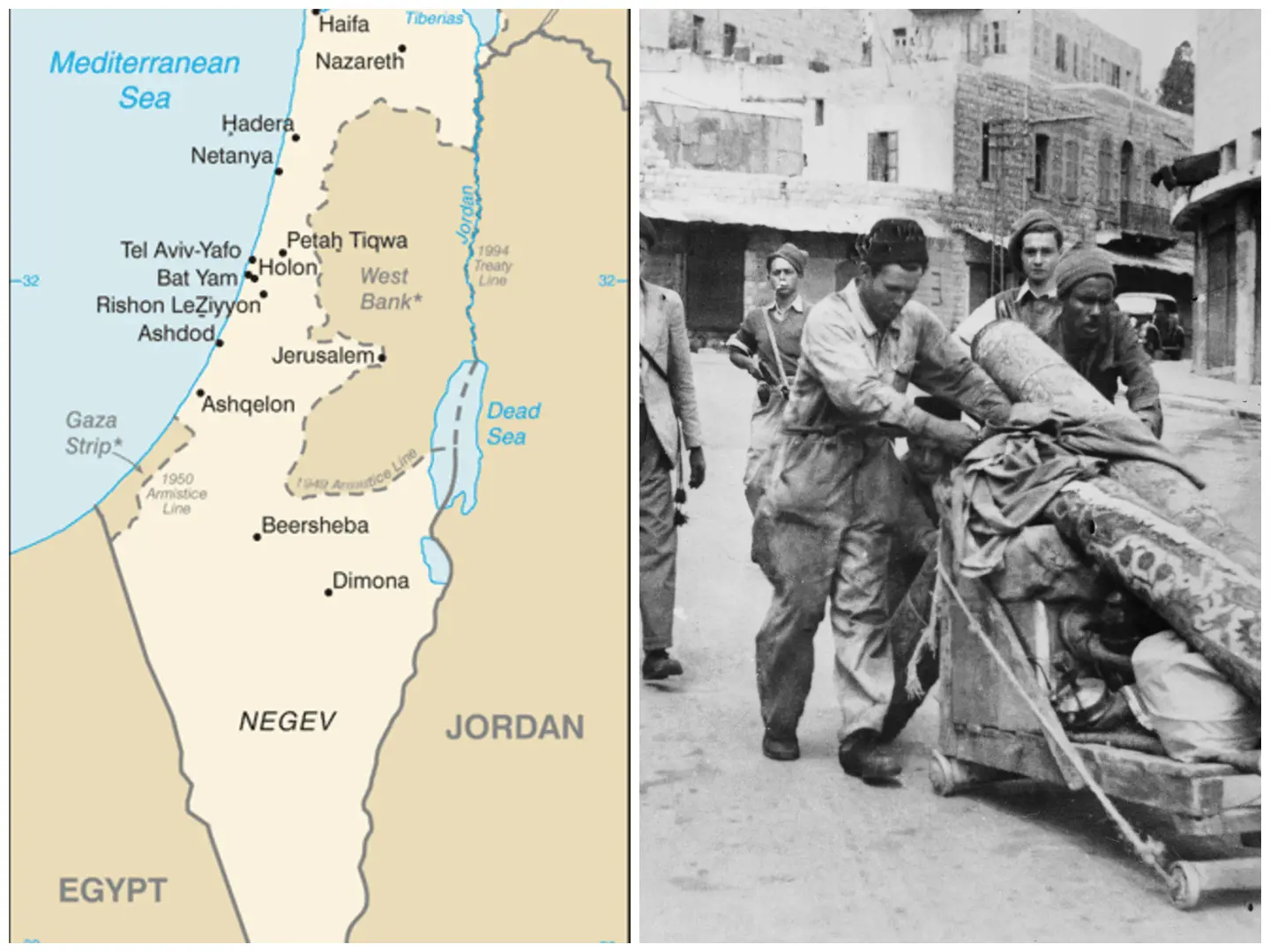
By the end of the war, Israel controlled 78 per cent of historic Palestine, far beyond what had been allocated under the UN plan. This included key cities like Jaffa, Haifa, and Acre.
More than 750,000 Palestinians were expelled or fled their homes during this period, a mass displacement known as the Nakba — Arabic for “catastrophe”.
Over 400 Palestinian villages were depopulated and many were deliberately destroyed. During and after the Nakba, large numbers of Palestinian refugees were forced into camps in the West Bank and Gaza Strip, which today constitute the core Palestinian territories.
These two territories, now governed individually and fragmented by decades of conflict, are separated by around 70 kilometres of Israeli land, as you can see from the map in the picture.
Britain built the imperial geography of Palestine with maps drawn abroad
Even today, the effects of Britain’s colonial architecture remain etched into the physical and political geography of the Palestinian question — from the configuration of settlements and roads to the demarcation of borders and land registries.
Many of the railways, road networks, and administrative boundaries still trace their origins back to maps drawn in London or Geneva.
These imperial-era lines continue to define the contours of division, dispossession, and control.
The Nakba was not merely an unintended side effect of conflict. It was the result of a decades-long process of settler colonialism — a political project supported, at various points, both tacitly and overtly by British imperial policy.
Britain had committed to facilitating the establishment of a Jewish national home while promising to protect the rights of the Arab majority.
But in practice, this dual obligation produced systemic inequity. Palestinians were excluded from meaningful sovereignty by a system designed to serve imperial and settler interests.
British recognition of Palestine would be a form of restorative justice
As outlined here, Britain bears direct historical responsibility for a colonial process that denied Palestinians the very statehood it now hesitates to acknowledge. This responsibility is not merely rhetorical — it is deeply embedded in decades of policy choices that shaped the dispossession, disempowerment, and displacement of an entire people.
No amount of warfare is going to solve this problem. Can talks succeed where violence has failed? One side would argue — and international law supports this — that Palestinians have a right to sovereignty, dignity, and territorial integrity. But others argue that recognising Palestinian statehood would be incompatible with Israel’s right to exist and secure its borders — a view that has underpinned decades of political stalemate.
Yet Britain, the state most historically responsible for the roots of the conflict remains on the sidelines.
Meanwhile, European allies such as Spain, Ireland, and Norway have already extended formal recognition of Palestine. France, Belgium, Slovenia, and Malta have expressed strong support and are reportedly considering similar steps.
Britain’s recognition of Palestine would be the closing of the colonial loop. But will it solve the problem?
If it happens, Britain’s recognition of Palestine would be a "full circle" moment in the tumultuous history of the region. It would require the difficult but necessary admission that Britain helped enable one people’s independence while obstructing another’s. Britain cannot undo the past, but recognition would symbolically confront that legacy.
It would represent a form of justice long delayed — an attempt to restore some measure of balance in a region still shaped by the consequences of imperial borders and colonial betrayals.
For Britain, recognising Palestine is not merely a symbolic act — it is a moral reckoning long overdue.
It would not by itself resolve the conflict, but it would affirm the principle that historical injustice cannot be left unaddressed forever: justice, after all, begins with acknowledgement.
And for Palestinians, that acknowledgement is now more than a century overdue.
Whether it will lead to peace, or provoke yet another war, is a question no one can answer.
But without justice, peace will remain a distant dream