
&imwidth=800&imheight=600&format=webp&quality=medium "Lake Lucerne Summit: First US-Iran talks in Switzerland end with cautious optimism. What was agreed and what comes next? | WION Decodes")
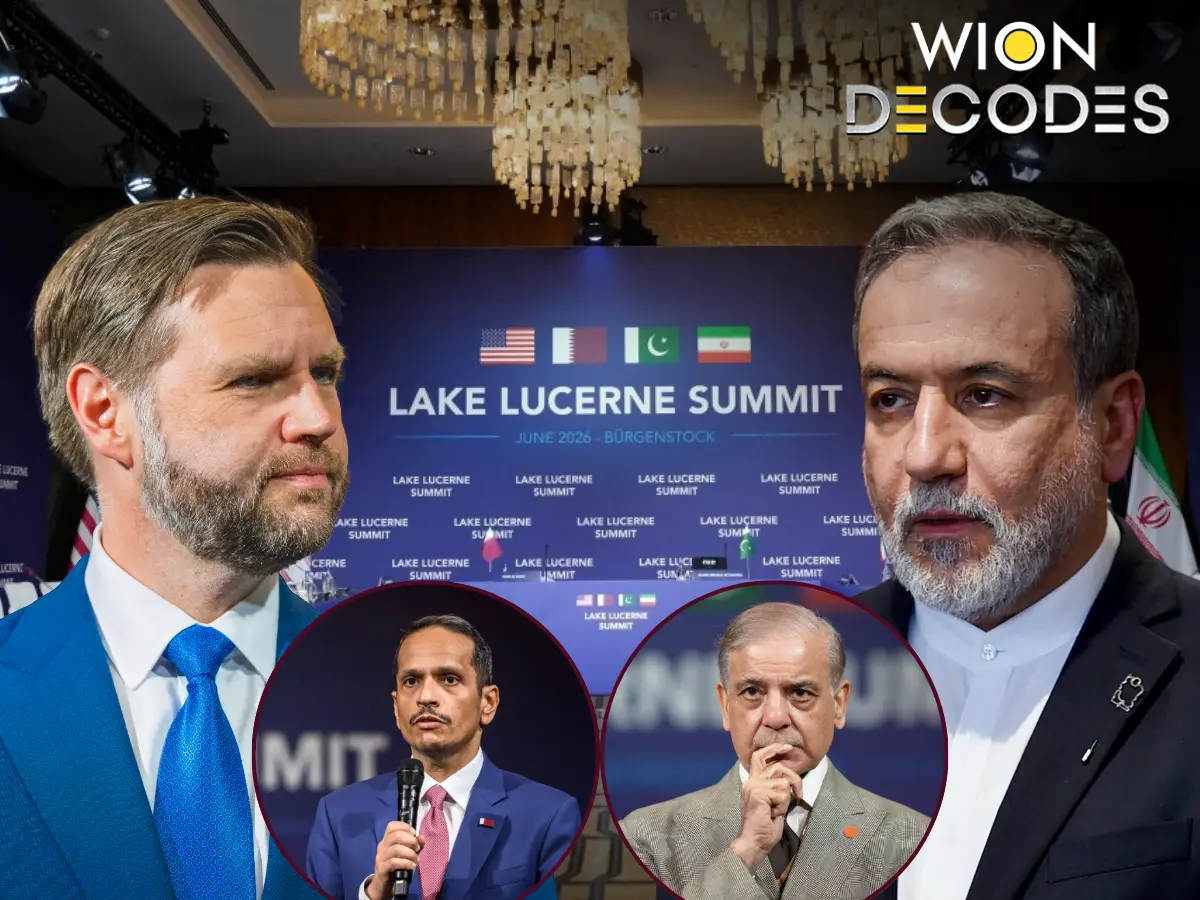
The first round of high-level talks between the United States and Iran aimed at ending the wider Middle East conflict has concluded in Switzerland, with mediators Pakistan and Qatar describing the discussions as "positive and constructive". After a marathon 8-hour session, negotiators shared a joint statement on what happened at the talks.
While they stopped short of announcing a final breakthrough, negotiators suggested that the talks produced the clearest roadmap yet for a potential agreement. These vital talks between Washington and Tehran come after months of war, regional instability and economic disruption. WION Decodes what happened at the first round of negotiations and what will happen going forward.
What happened?

The negotiations took place at the Lake Lucerne Summit in Burgenstock, Switzerland, under the framework of the Islamabad Memorandum of Understanding (MoU), the agreement reached earlier to halt hostilities and create a pathway toward a broader settlement.
According to a joint statement issued by Pakistan and Qatar, both sides agreed to continue discussions and established several new mechanisms designed to keep negotiations moving forward.
The biggest outcome was the creation of a High-Level Committee that will oversee the mediation process and provide political guidance to negotiators.
Also read | Iran's Araghchi says Switzerland talks delivered 'major progress' on sanctions, oil exports
Who was involved in the talks?
The talks brought together delegations from the United States and Iran, with Pakistan and Qatar acting as mediators.
Here's a look at the delegates who were present for the negotiations:
Iranian Delegation
Trending Stories
)
US vs China over South China Sea: Washington backs Philippines, Beijing hits back
)
Bigg Boss 20: Isha Rikhi evicted after three weeks in Salman Khan’s show
)
Musk plans to more than double xAI's chips to over 1.2 million Nvidia GPUs by year-end
)
After JU, clash erupts at SRFTI: BJP’s ‘Dimagi Naxal’ jibe sparks political firestorm after students protest RSS-linked event
)
‘Anti-social elements spreading false rumours’: LPU issues statement amid massive unrest over alleged rape
)
LPU students go on rampage, vandalise campus amid widespread protest: What's happening
)
Trump asked Xi to pressure Iran. China did not say yes — here’s what Beijing wants
)
US Treasury Secretary Scott Bessent hails global crackdown on Iranian banks and airlines
)
An OpenAI agent escaped its locked test cage again, by hiding questions in DNS lookups
)
'Our video was trimmed': LPU girls who featured in rape-denial video make U-turn
)
3 males killed, four others injured in shooting after fight at strip club in Detroit
)
'Victory for low-budget consumers': Raghav Chadha hails 30-day telecom recharge rules
)
Claude rebuilt the 1989 game 'Prince of Persia' by reusing the original's own code
)
Beyond metros: How Tier-2 and Tier-3 cities could drive India’s next AI wave
)
Tesla builds first Cybertruck with its own refined lithium: Elon Musk's $1 billion Texas bet pays off
)
IndiGo flight suffers tail strike in Bengaluru while landing; DGCA to probe incident
)
The US and China set up an AI 'red telephone', but skipped the rulebook
)
‘Terror suspects arrested near UK air base were looking to do big damage’: Trump
)
Russian envoy claims US tactics to contain India were revealed in ‘Freudian slip’
)
IND vs WI 1st ODI: Kohli breaks Sachin's most runs in one country record with unbeaten 139 as India thump West Indies by 8 wickets
)
Researchers rebuilt exactly how 700 AI agents hacked Hugging Face: a 900-link chain trick
)
‘Olympic inclusion is our major target’: WPA President Ishaun Singh on pool’s global ambitions
)
Nations League: Spain sink England at Wembley; Modric shines for Croatia
)
Why has Iran released no proof of life of Mojtaba Khamenei? Araghchi reveals...
)
'What kind of confession is this?': Pakistan PM Shehbaz Sharif’s 'terrorists would be roaming New York' remark goes viral, raises alarm online. Watch
)
South Korea demands apology from Ukraine over North Korean prisoners' transfer
)
Beyond BrahMos: India targets Rs 50,000 crore in defence exports with unmatched price edge
)
Sri Lankan Tamil migrant worker gets death sentence in Saudi Arabia, help sought from India
)
Muslim marriage cannot shield sex with minor wife from prosecution under POCSO: Delhi HC
)
'Can't help but draw painful parallels to Nirbhaya case': SC on latest incidents of rape cases in Delhi-NCR
)
99.9% more powerful - Scientists find boy who can recall memories from just 3 months of age
)
'FIRST LOOK from inside Noah’s Ark': Researchers share video from inside mysterious mound in Turkey
)
UNSC reform momentum grows: Russia, Portugal, Mauritius push for India's permanent seat bid
)
8 US marines injured in Iranian missile attack on vessel in Strait of Hormuz: Report
&im=FitAndFill=(700,400))
New OTT releases this week (September 28-October 4, 2026): Dupahiya 2, Pooja Meri Jaan, Ohh My Dog- 5 titles coming on Netflix, Prime Video and more
)
Afghanistan says 28 fighters killed in clash near Pakistan border, Islamabad denies
)
Ceuta migrant crisis: Protesters take to streets as Spain grapples with migrant challenge
)
LPU suspend classes, postpones exams as violence escalates over rape claims: What's happening
)
New York City wants a 'kill switch' on every AI, and will pay whistleblowers who report violations
- Mohammad Bagher Ghalibaf - Speaker of the Iranian Parliament, Head of Delegation
- Abbas Araghchi - Foreign Minister, Chief Diplomatic Negotiator
- Esmaeil Baghaei - Foreign Ministry Spokesperson
- Ali Bagheri Kani - Deputy Secretary of the Supreme National Security Council
- Abdolnasser Hemmati - Head of Economic and Banking Committee
- Hamid Bord - Head of Energy and Oil Committee
United States Delegation
- JD Vance - Vice President of the United States, Head of Delegation
- Steve Witkoff - White House Special Envoy
- Jared Kushner - Senior Adviser and Special Envoy
Also read | 'Children of Minab are watching us': Iran's Ghalibaf arrives in Switzerland for talks with US
Pakistan (mediator)
- Shehbaz Sharif - Prime Minister of Pakistan
- Syed Asim Munir - Field Marshal and Chief of Defence Forces
Qatar (mediator)
- Mohammed bin Abdulrahman Al Thani - Prime Minister and Foreign Minister of Qatar
- Senior Qatari diplomatic officials
Switzerland (host nation)
- Ignazio Cassis - Swiss Foreign Minister
Swiss diplomatic facilitation team
International/Technical Presence
- Rafael Grossi - IAEA Director General (attending sidelines and technical consultations)
Total known participants: Around 15-20 senior political, diplomatic, security, economic and technical officials across the delegations and mediation teams.
Where do the negotiations go from here?
The newly formed High-Level Committee has agreed on a roadmap aimed at reaching a final agreement within 60 days. Several working groups will now begin technical discussions on key issues, including:
- Iran's nuclear programme
- Sanctions relief
- Monitoring and dispute resolution mechanisms
- Regional security arrangements
Technical talks are expected to continue throughout the week in Switzerland.
Also read | US-Iran peace deal: Inside the 14-point MoU that ended over 108 days of war | WION Decodes
Why are these talks important?
The negotiations come after months of conflict involving Iran, Israel and the United States. The crisis had rattled global energy markets and disrupted shipping through the Strait of Hormuz, driving oil and crude prices to alarming highs.
One of the most significant developments announced was the creation of a direct communication line between Washington and Tehran to "avoid incidents and miscommunication" with the aim of safe passage for commercial vessels through the Strait of Hormuz.
A separate de-confliction cell involving Iran, the US and Lebanon has also been established to monitor the cessation of military operations in Lebanon.
How is Iran describing the outcome?
Iranian Foreign Minister Abbas Araghchi struck an optimistic tone following the talks.
In a post on X, he claimed that Pakistani and Qatari mediation had delivered "major progress" and suggested that several economic concessions were already emerging from the process.
According to Araghchi, restrictions affecting Iran's oil and petrochemical exports are being eased, some frozen Iranian assets are set to be released, and a major reconstruction and development programme for Iran is being launched.
What remains unresolved?
Despite the positive language, major questions remain unanswered.Neither side has publicly detailed the scope of sanctions relief, the future of Iran's uranium enrichment activities, or the exact timeline for implementing commitments under the MoU.
The next few weeks will likely determine whether the momentum generated in Switzerland can be converted into a lasting agreement or whether familiar disagreements once again restart the war. For now, both sides appear committed to diplomacy, but the hardest part of the negotiations may still lie ahead.

