
&imwidth=800&imheight=600&format=webp&quality=medium "US-Iran peace deal: Inside the 14-point MoU that ended over 108 days of war | WION Decodes")
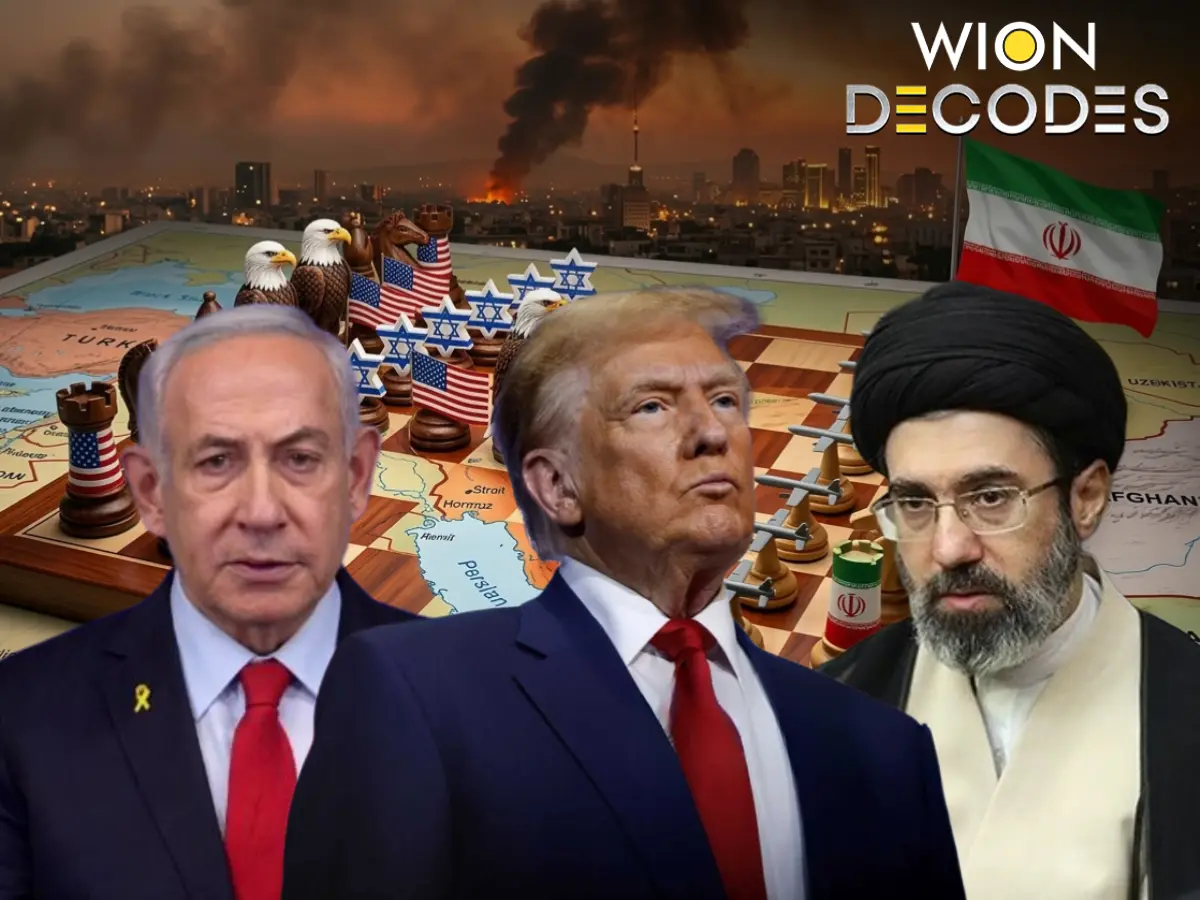
The United States and Iran have agreed to halt hostilities after 108 days of war that drove up oil prices globally. On Truth Social, US President Donald Trump confirmed the truce agreement and announced "Let the oil flow" as he revealed that the US would lift its blockade of Iranian ports. Following the announcement, in what may be the most detailed public account of the Memorandum of Understanding (MoU) between the warring nations, Iran state-affiliated Mehr News has shared the 14 conditions that form the basis of the current agreement. Among them is the condition that the US won't "interfere" in Iran's internal affairs and also withdraw its blockade that, in the past few weeks, has sought to bleed Tehran's coffers dry. Here's a breakdown of the 14-point MoU and what each condition signifies:
Iran and US's 14-point MoU
Citing a source close to Iran's negotiating team, Mehr News reported that the Memorandum has 14 provisions. These are:

1. Permanent and immediate end to war on all fronts, including Lebanon
In the past few days, Lebanon has emerged as a sticking point between the US and Iran, as Israel continued its strikes on the nation. Just a day earlier, on Sunday, Iranian chief negotiator Mohammad Bagher Ghalibaf said that there was "no point" in continuing peace talks with the United States after its ally Israel attacked Beirut's southern suburbs.
"The Zionists' aggression against Dahieh once again showed that the United States either lacks the will to implement its commitments or lacks the ability to do so," he said in a post on X. "If you do not have the will or the ability to fulfil your commitments, then there is no point in talking about continuing down this path," he added.
Trending Stories
)
Did India risk its US trade deal despite softer stance at BRICS?
)
Pakistan puts Pak Rs 70 lakh bounty on UN terrorist Masood Azhar; move draws skepticism in Delhi
)
First naval drone battle? Ukraine says Sargan 3000 sank Russian unmanned boat
)
Practical Magic 2 breaks Spidey spell over North American box office
)
'Huge destructive power': North Korea calls its latest missile launches 'live-fire drill' even as US dismisses 'immediate threat'
)
‘Let’s go’: Newly declassified videos show dramatic rescue of US Air Force officers downed in Iran
)
Ganesh Chaturthi 2026: Devotees throng the iconic Lalbaugcha Raja pandal in Mumbai
)
Delhi’s balancing act: BRICS serves as a stage for West Asia diplomacy
&im=FitAndFill=(700,400))
Why European Meteor missiles use ramjet engines compared to standard US solid rockets
)
Iran, India agree to deepen humanitarian and political ties, President Pezeshkian says
)
‘Want to reset ties with India, have engagement based on mutual interests,’ says Bangladesh minister
)
Trump says Canada eager to reach a deal, it could come ‘fairly soon’ if Ottawa treats US farmers better
)
Turkish Airlines plane flies through a storm three times, triggering severe turbulence
&im=FitAndFill=(700,400))
Why Chinese PL-15 air-to-air missiles use dual-pulse motors compared to European interceptors
)
Orlando Bloom addresses Pirates of the Caribbean comeback and reunion with Johnny Depp
)
China thinned Himalayan troop presence in 2025, India defence report says; terms border situation 'stable'
)
Russia proposes to build 360 kmph Ivolga FG trains in India: What happened on sidelines of BRICS
)
800 million years old - Scientists discover 'fingerprints' of supercontinent Gondwana in ancient rocks
)
Israeli minister calls to strip Gaza film directors of citizenship
)
Natural caffeine sources gain popularity; matcha & botanicals offer calm energy
)
China discovers vast gold and silver 'mine' in the Pacific with unheard-of deposits
)
Russian drone hits Warsaw-bound train near Polish border, Zelensky accuses Moscow of ‘deliberate’ targeting
)
Plane carrying prominent figure crashes at Libya’s Misrata airport: Report
)
Veteran Bollywood actress Nafisa Ali shares health update as Stage 4 cancer progresses, starts targeted therapy
&im=FitAndFill=(700,400))
New OTT releases this week (September 14-20, 2026): Lust Stories 3, Waiting Hai, Irumudi- 5 new titles coming on Netflix, Prime Video and more
)
Liam Neeson sparks romance rumours after holding hands with Stella Stocker at TIFF 2026
)
Saudi Arabia discovers 110 million tonnes of Uranium-rich ore in Madinah region
)
Indian importers urge Bangladesh to lift export ban on 'Hilsa' fish ahead of Durga Puja
)
Video of Pakistani lawmaker struggling to read English tribute to Jinnah goes viral - WATCH
)
Did China give Iran intel before US base strike that killed 3 troops? Trump says, 'You’re right...'
)
Crude oil prices jump more than $107 per barrel following Houthi attacks on Saudi
)
Women's Asia Cup 2026: India denied trophy once again despite winning the title
)
Humans may lose control of AI: Anthropic CEO calls for slowdown, Altman, Musk back him
Also read | 'Enemy had no choice but surrender': Iran claims victory as US agrees to 'permanently' end war
2. US commitment to non-interference in Iran's internal affairs and respect for the sovereignty of the Islamic Republic of Iran
This provision appears to be centred on reports that the US was seeking a regime change in the Islamic Republic. Additionally, this preventive step may have been added to the MoU to avoid a situation similar to Venezuela, where, after triggering a regime change by capturing former president Nicolas Maduro, the US continued to be a party to the nation's internal affairs.
3. Complete lifting of the naval blockade within 30 days
Following the closure of the Strait of Hormuz by Tehran, Trump directed CENTCOM to enforce a blockade of Iranian ports. Subsequently, US troops blockaded all vessels entering or departing Iranian coastal areas and ports, aiming to cripple Iranian oil revenues and deter toll-collection. According to reports, this blockade cost Iran $6 billion in oil revenues.
4. US commitment to withdraw its forces from around Iran
According to reports, since the start of the ongoing conflict on February 28, the US has deployed between 50,000 and 57,000 troops to the Middle East. Additionally, three U.S. aircraft carriers—the USS Abraham Lincoln, USS Gerald R. Ford, and USS Dwight D. Eisenhower—anchored the regional presence, carrying tens of thousands of personnel and specialised air wings.
Also read | 'Let the oil flow': Crude prices down to $81.15 as US, Iran announce 'immediate end' to hostilities
5. Reopening of the Strait of Hormuz within 30 days, under Iranian arrangements
Under this, Iran is expected to retain primary operational control of the strait, through which around 1/5th of the global oil supply passes.
This move is expected to help stabilise the global oil markets. Notably, just after the two nations announced that they've reached an agreement to end hostilities, oil prices tumbled by more than four per cent, reaching $81.15 a barrel.
6. Suspension of sanctions on oil and petrochemical product sales and derivatives, and full Iranian access to its financial resources
Already, the United Kingdom, France, Germany and Italy have said that they are prepared to lift sanctions imposed on Iran and will work "with the US, Iran and regional partners to seize this moment, maintain momentum and achieve a long-term diplomatic settlement."
7. Reconstruction plans to be presented by the US and its allies, totalling at least $300 billion
This fund is expected to help Tehran repair and rebuild its crippled oil export infrastructure, industrial facilities, and public utilities which were damaged during the conflict.
8. A 60-day negotiation period to reach a final agreement on the nuclear issue and the complete removal of US primary and secondary sanctions, UN Security Council resolutions, and IAEA Board of Governors resolutions
Iran said on Monday that it would begin negotiations with the United States within the next two months to pursue a final agreement aimed at formally ending the war between the two countries.
Also read | After ceasefire, Iran reveals roadmap to final US agreement and possible $24 billion payout
9. Reaffirmation of Iran's NPT commitment not to produce nuclear weapons
The US and Israel started the war against Iran alleging that the Islamic Republic was days away from developing a nuclear weapon. Since then, Trump has demanded that Tehran hand over its "nuclear dust".
Now, Iran must explicitly recommit to never seeking, developing, or acquiring any nuclear weapons. This means that Tehran agrees to maintain its status as a non-nuclear-weapon state party to the Nuclear Non-Proliferation Treaty (NPT), binding its program to international law.
10. During the negotiation period, the US commits not to add forces to the region and not to impose new sanctions
The US will have to maintain its regional force presence at current levels and will be barred from deploying any additional soldiers, ships, or aircraft to the Middle East during the talks. Furthermore, Trump cannot introduce any new economic penalties, trade restrictions, or designations against Iranian entities or sectors.
11. Release of $24 billion in Iran's blocked funds during the 60-day final negotiation period, with half of that amount to be made available to Iran before negotiations begin
According to Mehr News, the US would release $24 billion in frozen Iranian assets during the 60-day negotiation period. The report claims that $12 billion, half of the total amount, would be made available to Iran before formal negotiations begin.
12. Establishment of a monitoring mechanism to implement the agreement
The safeguard has been put in place to ensure that both sides honour their commitment. During the conflict, both the US and Iran have accused each other of flouting their commitments.
Also read | Iran again delays Ali Khamenei's funeral: Why the slain supreme leader remains unburied after 100 days
13. The final agreement to be ratified by a UN Security Council resolution
The final step to codify the MoU is its formal ratification through a United Nations Security Council (UNSC) resolution, which will elevate the bilateral deal into binding international law.
14. Final negotiations will not begin until half of Iran's blocked funds are released, oil sanctions are suspended, and the naval blockade is lifted. The final agreement will address only the fate of enriched materials and enrichment, sanctions relief, and Iran's economic reconstruction programme. Talks on Iran's missile programme and its support for Resistance groups have been definitively removed from the agenda
Finally, according to Mehr News, Iran would not participate in any negotiations till the US releases $12 billion of Iran's frozen funds, lifts oil sanctions and lifts its naval blockade.
Notably, as per the report, these provisions are only preliminary and still require "review and finalisation by the relevant institutions in Iran."

