
&imwidth=800&imheight=600&format=webp&quality=medium "582 tonnes, 150 million°C, 60 years: WION Decodes the mind-boggling numbers behind China's 'Artificial Sun'")
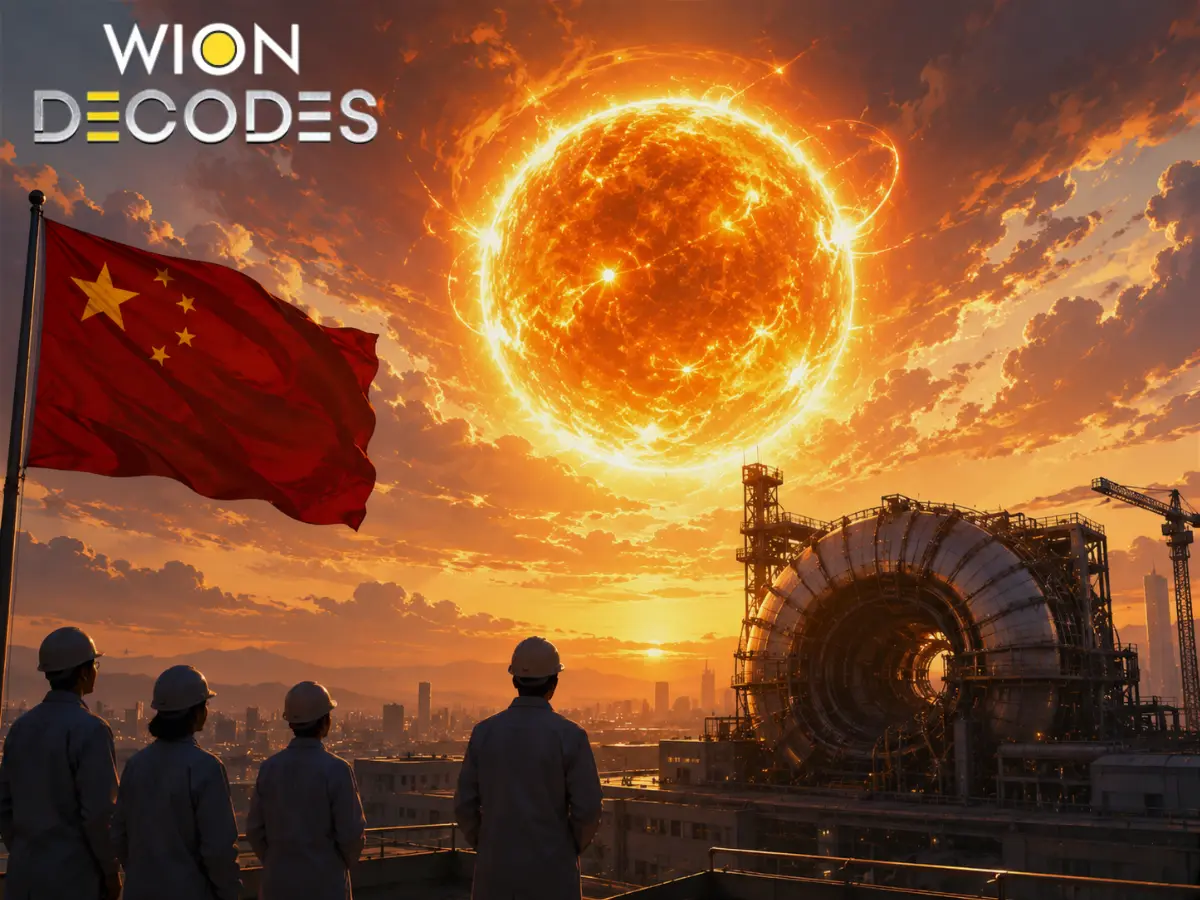
China may soon be able to launch its own private sun. It's 21 metres long. It weighs as much as nearly 100 African elephants. It must survive temperatures colder than outer space while holding plasma that's 10 times hotter than the Sun's core. And it has to keep doing that for six decades.
Beijing, as per reports, has achieved a fusion breakthrough. The nation completed and tested the world's largest superconducting fusion magnet, a critical component designed to create an invisible magnetic cage capable of containing matter at 150 million degrees Celsius. The breakthrough moves Beijing another step closer to its long-term goal of generating commercial fusion power.
Here's all you need to know about what may be one of the most extreme engineering projects humanity has ever attempted.

582 tonnes: Why build a magnet this enormous?
At first glance, it looks like a giant steel ring. In reality, it's a 21-metre-long, 12-metre-wide, D-shaped superconducting magnet weighing 582 tonnes. That's heavier than a fully loaded Boeing 747.
Also read | 'Scary' Rogue AI on the loose? OpenAI agent hit another tech firm's customer, suggests report
Trending Stories
)
No Pandya as Auqib Nabi earns maiden ODI call-up; Mayank returns for WI T20Is| check full squads
)
FBI Director Kash Patel grilled over change of hiring rules on bestiality
)
Sydney Sweeney defends provocative ad choice, the internet is still not impressed
)
War will be ‘completely different and very short’ if Europe attacks Russia, warns Lavrov
)
Shahzad Bhatti Network declared terrorist organisation under UAPA: Govt order
)
US, China dominate global economy: Where does India rank among the world's biggest economies?
)
Finnish president Stubb calls Trump 'good for NATO' as allies increase defense expenditure
)
Bigg Boss 20: Mahhi Vij reveals she lost Yuva role to Kareena Kapoor; 'didn’t work out in my favour'
)
All Indian goods to get duty-free access to New Zealand
)
Alex Saab, ally of Venezuela's Maduro, pleads guilty in US corruption case
)
Lionel Messi for 2026 Ballon d’Or over Mbappe and Yamal, says Diego Simeone
)
Who was Eliana Moreno? NBC LA aerial reporter killed in Chatsworth crash
)
Trump backs PM Modi’s anti-opium push even as India remains on US illicit drug-producing list
)
At least 20 killed after war-damaged apartment building collapses in Gaza; rescuers search for survivors
)
Pakistan naval vessel returns to harbour with 'severe damage' after collision with Indian warship in Arabian Sea
)
Fed raises rates for first time in 3 years, Kevin Warsh defies Trump as inflation mounts
)
What is Article 10 of the 1991 treaty at the centre of Pakistan Navy's 'unprofessional conduct'
)
Ex-CIA officer caught with gold bars worth $40 million seeks plea deal | Gravitas
)
Daayra movie review: Kareena Kapoor, Prithviraj Sukumaran shine in Meghna Gulzar’s cop-versus-cop crime thriller
)
Gurugram biker hit-and-run case: Accused Kalyan Bainsla, cousin sent to 2-day police custody
)
Pakistan: Imran Khan's sons Kasim & Sulaiman claim their father is 'tortured' in jail
)
Trump's Iran war faces fresh House rebuke; 7 Republicans join Democrats in push to end conflict ahead of midterms
&im=FitAndFill=(700,400))
New OTT releases this week (September 14-20, 2026): Lust Stories 3, Waiting Hai, Irumudi- 5 new titles coming on Netflix, Prime Video and more
)
PNS Hunain: All you need to know about Pakistani vessel that hit Indian Navy warship
)
US Treasury rallies global financial institutions for Op Economic Outcast to isolate Iran
)
Saudi vs Houthis: Riyadh claims to have shot Houthi drone targeting Mecca
)
‘There’s no Pak-China boundary’: India rejects ‘so-called’ boundary joint commission, tells Islamabad to stop ‘theatrics’
)
Riyadh warns of ‘red line’ after Mecca targeted; Houthis claim downing Saudi fighter jet – What’s happening?
&im=FitAndFill=(700,400))
Suriya and Jyothika say ‘I do’ again after 20 years! See their dreamy wedding pics
)
Abhishek Sharma rises to No. 2 in T20Is; ENG’s Robinson 3rd after record Pakistan Tests
)
Extreme warming in Indian Ocean added 695 billion tons of ice to Antarctica ice sheet
)
BRICS success stuns White House, Trump targets India with 100% tariff | Gravitas
)
Meghan Markle's phone number leaked from children's WhatsApp group, couple switches Archie and Lilibet's school
)
The Early Spring season 2 is happening, but fans have one request - 'don't change the actors'
Its job isn't to produce electricity. Its job is to do something arguably even harder: stop the hottest material ever created on Earth from touching anything.
Inside a fusion reactor, hydrogen is heated until it becomes plasma, a superheated soup of charged particles. If that plasma touches the reactor walls for even an instant, it cools rapidly, damages the reactor, and the fusion reaction ends.
The only way to prevent that is to suspend the plasma in mid-air using immensely powerful magnetic fields, creating what scientists often call an "invisible magnetic cage."
150 million°C: Ten times hotter than the Sun's core
Here's the number that may surprise most people. The Sun's core reaches roughly 15 million°C. China's fusion reactor aims to operate at around 150 million°C.
That isn't because scientists are trying to outdo the Sun. The Sun's enormous gravity naturally squeezes hydrogen atoms together, allowing fusion to happen at relatively lower temperatures. On Earth, there's no such crushing pressure.
Scientists have compensated by making the plasma dramatically hotter so hydrogen nuclei collide and fuse often enough to release energy.
Also read | India's next terror threat may not cross the border. It may enter through your phone | WION Decodes
Minus 269°C: Hotter than the Sun, colder than space... at the same time
The engineering challenge becomes even more astonishing. While the plasma burns at 150 million°C, the magnet surrounding it must remain at around minus 269°C, just four degrees above absolute zero.
Only at those ultra-low temperatures can superconductors carry enormous electrical currents without resistance.
So, inside a single machine, temperatures differ by nearly 150 million degrees over a relatively short distance. Very few technologies in the world operate across such an extreme thermal range.
100,000 amps: Enough electricity to power a city
The magnet doesn't just need to be cold. It also needs to carry more than 100,000 amperes of current while wasting virtually no energy.
To achieve that, engineers reduced the electrical resistance at critical joints to nearly zero, allowing electricity to flow continuously through superconducting coils.
Without that, sustaining fusion for long periods would be impossible.
60 years: Built to outlive generations
Most cutting-edge scientific instruments need to be upgraded every few years. However, China claims this magnet has been engineered to operate reliably for around 60 years.
During that time, it must repeatedly withstand intense radiation, powerful magnetic forces and enormous mechanical stresses without losing performance.
Designing a machine to survive six decades under those conditions may prove just as difficult as achieving fusion itself.
Why the world is chasing fusion
Nuclear fusion has long been regarded as the ultimate energy prize because it promises electricity without burning fossil fuels. Unlike today's nuclear reactors, which split heavy atoms, fusion combines light hydrogen atoms to release enormous amounts of energy.
The potential rewards are enormous:
- Fuel derived largely from hydrogen found in seawater
- No carbon dioxide emissions during power generation
- No risk of a runaway nuclear meltdown
- Far less long-lived radioactive waste than conventional nuclear fission
That promise has sparked a global race involving China, the United States, Europe, Japan and several private companies investing billions of dollars in fusion research.
When will China's artificial sun be up?
While China hopes to begin fusion power generation around 2030, many experts believe commercial deployment could still take decades.

