
&imwidth=800&imheight=600&format=webp&quality=medium "New speed limits, automatic challans: Big traffic change coming to Delhi-Meerut Expressway. All you need to know")
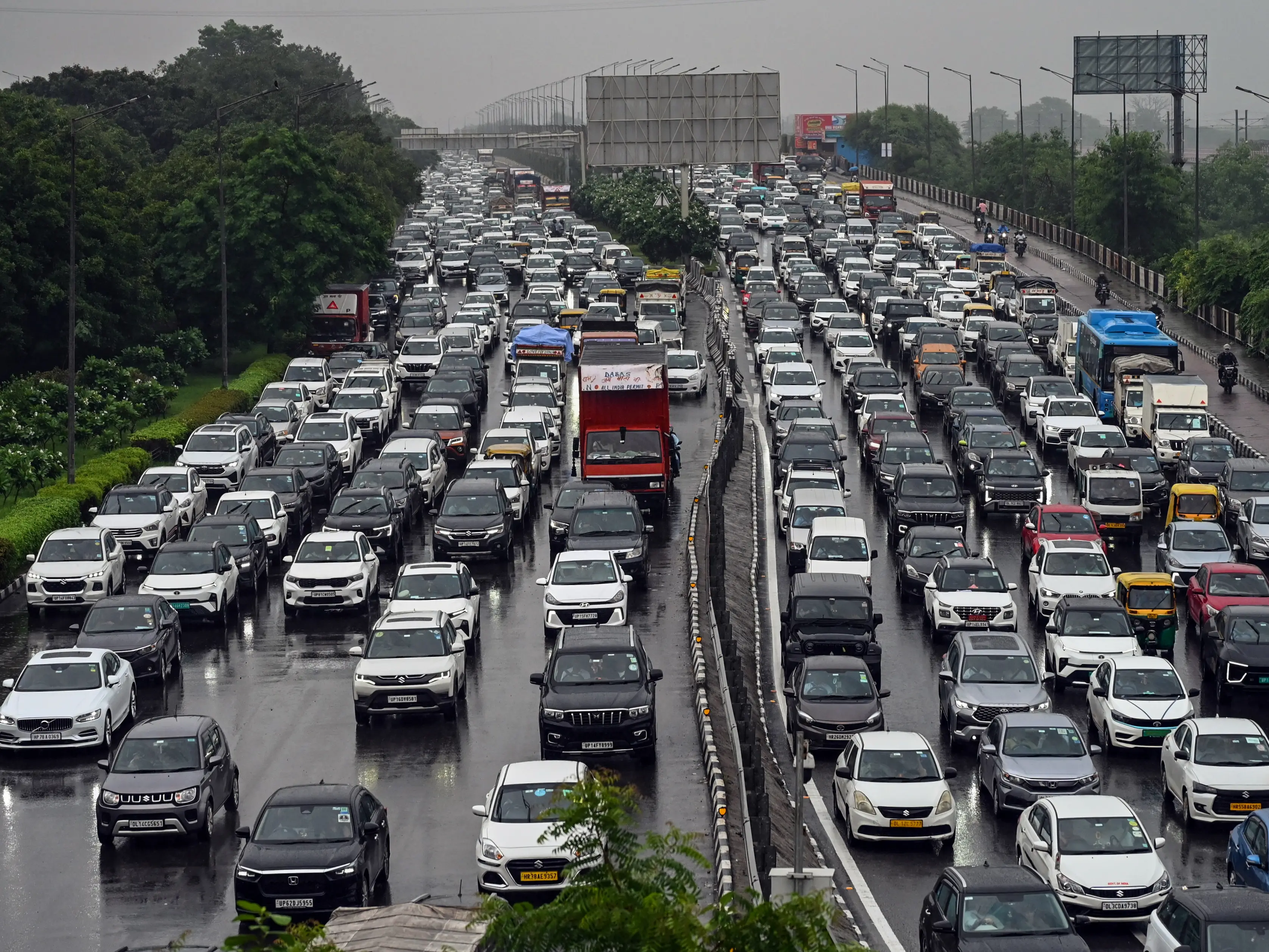
Anyone who has driven on the Delhi-Meerut Expressway during the evening rush knows the feeling. You cruise along at highway speeds, only to slam the brakes near Akshardham as traffic suddenly grinds to a halt.
Now, researchers believe the answer may not be building more lanes. It may simply be asking drivers to slow down earlier.
Beginning around August 15, an 8.7-km stretch of the Delhi-Meerut Expressway between Sarai Kale Khan and the Uttar Pradesh border is set to become India's first real-world test of Variable Speed Limits (VSL), a traffic management system already used in countries such as the US, UK and Germany.

Variable Speed Limits: How slowing down could actually make you reach faster
The idea may sound counterintuitive. Instead of letting vehicles race toward a bottleneck before everyone brakes simultaneously, electronic signboards will lower speed limits in advance when traffic starts building up. The objective is to keep vehicles moving at a steady pace and prevent the stop-and-go waves that create traffic jams.
Think of thousands of people trying to leave a packed stadium. If everyone rushes to the exit together, movement slows dramatically. But if the crowd is staggered before reaching the gates, everyone gets out more smoothly. Researchers say traffic can behave much the same way.
Trending Stories
)
AI kill switch explained: Why shutting down a dangerous AI may not be as simple as pressing a button
)
Putin's United Russia party wins 355 seats in Duma election; 4 other parties cross threshold to enter parliament
)
US ships in Indian Ocean ‘will be attacked’ if war resumes, warns Iran
)
Delhi Air pollution: Strict crackdown on waste burning
)
SNL UK takes aim at Ed Sheeran with AI Princess Diana sketch
)
‘0% chance’: Nvidia CEO Jensen Huang dismisses AI extinction fears by 2030
)
Samay Raina-Mukesh Chhabra controversy explained: What happened over girlfriend joke on India's Got Latent?
&im=FitAndFill=(700,400))
What TSMC's 2nm technology means for Apple
)
Trump says he'll build an 'AI Force' and appoint a czar, for 'high IQ' people only
)
'Were you here to sell chickpeas?': Wasim Akram criticises Babar Azam's captaincy
)
Apple reportedly building AI server with M8 Ultra chips, may use Nvidia technology
)
Glitch in the matrix caught on camera: Woman vanishes after talking to reporter
)
Samsung raises Galaxy S26 prices by Rs 20,000: Here’s what each model now costs
)
Fleming's aspirations as England Test coach include WTC, top ranking and Ashes
)
J&K Assembly Session begins amid chaos: BJP, ruling alliance clash as statehood demand dominates
)
Trump-Xi summit: US Treasury Secretary holds meeting with Chinese Vice Premier
)
Bessent meets China’s He Lifeng to prepare for Trump-Xi summit
)
S Jaishankar, former Army chief among high-profile names issued Delhi SIR notices
)
CDU suffers historic defeat in eastern Germany as AfD surges, Merz vows to stay on
)
Iran sets 7 conditions to end war with US: What are Tehran’s demands?
)
Arvind Kejriwal, family members, Delhi CM Rekha Gupta get SIR notices
)
AI actress Tilly Norwood glitches mid-interview, switches from English to Chinese | Watch
)
Saudi vs Houthis: Houthis claim missiles & drones used in attack on key Saudi sites
)
Punjab man consumes poison outside DC office; Congress, BJP target AAP government
)
Saudi Arabia exits China-led mBridge digital currency platform amid Saudi-Houthi conflict
)
'Lot of things to learn from experienced players': Jayasuriya backs Rohit, Virat for 2027 ODI World Cup
)
Chancellor Friedrich Merz vows to stay on as exit polls signal major poll setback
)
Taylor Swift has a 'proud wife' moment as Travis Kelce scores first touchdown of season: 'That’s my husband!'
)
Several petrol pumps, other businesses to refuse UPI payments above Rs 2,000 from Oct 16: Is it legal?
)
Mahabharat actor Saurav Gurjar arrested in Hyderabad, sent to 14-day judicial custody in sexual exploitation case
&im=FitAndFill=(700,400))
New OTT releases this week (September 21-27, 2026): Shaque: Trust No One, Hunkkaar, Don’t Be Shy- 5 new titles coming to Netflix, Prime Video and more
)
WATCH | Mysterious lights over Tehran caught on video. Drone, aircraft or something else?
)
Noel Tata challenges Chandrasekaran’s reappointment as Tata Sons chairman. What happened at the board meeting
&im=FitAndFill=(700,400))
Kareena Kapoor birthday special: Inside her net worth, best movies, luxurious lifestyle and love story with Saif Ali Khan
)
Pilot recreates Mona Lisa in sky over Oklahoma and Arkansas in four-hour flight: VIDEO
)
Delhi: Flagged voters remain on the draft roll but face hearings
)
China now makes advanced memory chips without the machines it was banned from buying
)
Maharashtra TET paper leak: All 18 accused arrested. How alleged Agra-to-Maharashtra racket unfolded
)
Jailer 2: Vidya Balan joins Rajinikanth's upcoming film as Kantha | Watch
)
Microsoft executive called AI training the ‘largest theft of labour in human history’
)
40-foot waves crash into cruise ship in dangerous stretch near Antarctica. Watch
)
Italy moves to ban face veils in schools as Meloni pushes new integration measures
India's first variable speed limit trial
The pilot is being carried out by Prof. Satish Chandra of IIT Roorkee and Dr Chalumuri Ravi Sekhar, Director of CSIR-Central Road Research Institute (CRRI), with funding from the Ministry of Road Transport and Highways.
Unlike conventional speed limit boards, the new electronic displays will be linked to traffic sensors and cameras. Instead of displaying one fixed limit throughout the day, they will automatically adjust permissible speeds depending on traffic conditions.
Currently, cars on this stretch face a fixed speed limit of 70 kmph, while heavy vehicles are restricted to 50 kmph, regardless of traffic.
- Under the pilot, recommended speeds will change during the day:
- 12 am to 7 am: 65 kmph for cars, 50 kmph for heavy vehicles
- 7 am to 5 pm: 55 kmph for cars, 45 kmph for heavy vehicles
- 5 pm to 12 am: 60 kmph for cars, 40 kmph for heavy vehicles
Built on real traffic data
The proposal is based on an analysis of 72 hours of traffic footage collected near Akshardham Plaza in July 2024.
Researchers found that cars account for over 80 per cent of traffic on the corridor, while heavy vehicles contribute between 4 and 12 per cent.
Traffic rises steadily through the day before peaking during the evening office rush, when the expressway frequently slips into stop-and-go congestion.
Using internationally accepted traffic engineering methods, the team also calculated the speeds at which most motorists naturally travel during congestion, helping design the dynamic limits.
Can you get Challans during the trial?
Electronic VSL boards will be installed near the Akshardham interchange in both directions.
To ensure drivers follow the displayed speeds, Delhi Traffic Police has been asked to enforce the changing limits through challans (traffic tickets) during the pilot.
Researchers will evaluate the system after 30, 90 and 120 days, comparing traffic flow, congestion levels, speed variations and driver compliance.
Could this change how Indian expressways are managed?
If the pilot succeeds, variable speed limits could be introduced on other expressways across the country.
Rather than relying only on expensive road widening projects, dynamic speed management could offer a cheaper way to reduce congestion, improve traffic flow and enhance road safety, while helping shape national guidelines for the technology's wider rollout.

