Archaeologists uncover lost cities which existed 2,000 years ago in Ecuadorian Amazon

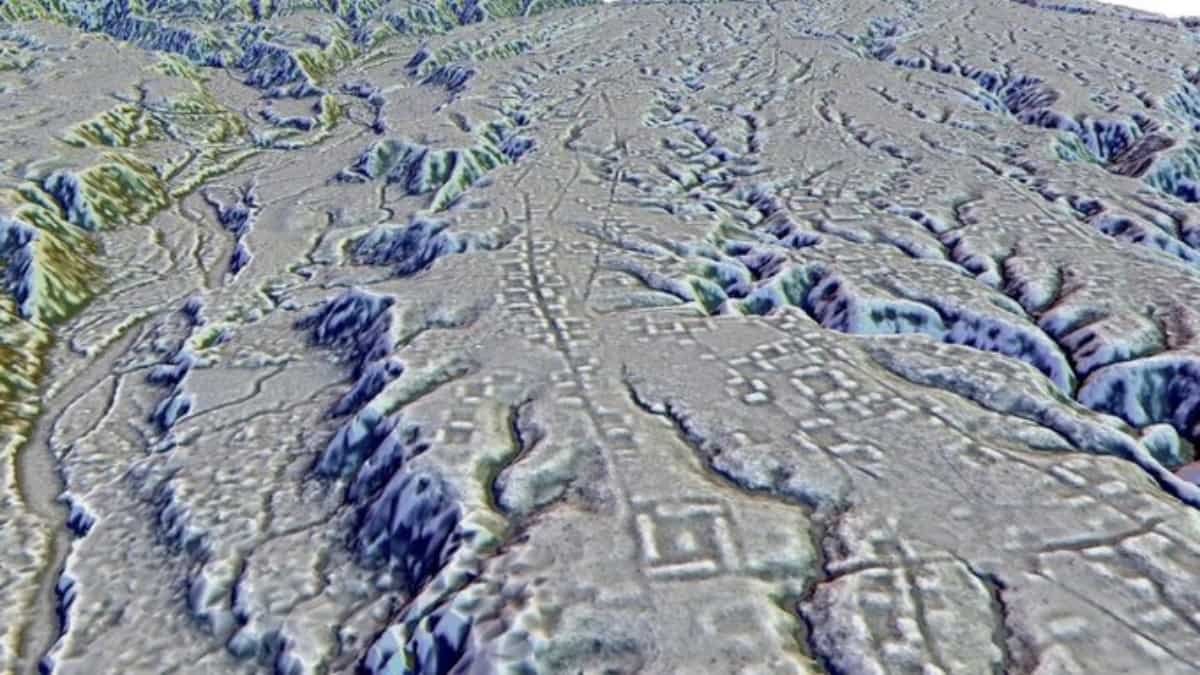
A map of the lost city in the Ecuadorian Amazon reveals ancient streets.
A cluster of lost cities has been uncovered by archaeologists in the Amazon rainforest, which housed at least 10,000 farmers nearly 2,000 years ago.
Archaeologist Stephen Rostain, more than two decades ago, had for the first time noticed a series of earthen mounds and buried roads.
However, at that time, “I wasn’t sure how it all fit together,” said Rostain, who was among the researchers who had for the first time reported about the finding of the lost cities in the journal Science on Thursday (Jan 11), reported the Associated Press.
The recent mapping of the place, using laser-sensor technology, revealed that the sites will be part of the dense network of connecting roadways and settlements, which are hidden in the forested foothills of the Andes, which lasted nearly 1,000 years.
Rostain, who carried out investigations at France’s National Center for Scientific Research, said, “It was a lost valley of cities. It’s incredible.”

'Extremely complicated society' reflected in mapping: Researcher
The researchers discovered that, between about 500 BC and AD 300 to 600, the settlements were occupied by the Upano people – a period which is nearly contemporaneous with the Roman empire in Europe.
Agricultural fields with drainage canals surrounded the ceremonial and residential buildings which were erected on more than 6,000 earthen mounds. The largest roads were stretched for 6-12 miles (10-20km) and were 33 feet (10 meters) wide.
A study co-author at the same French institute, archaeologist Antoine Dorison said that although it is difficult to estimate the population, the site was earlier home to around 10,000 inhabitants.
University of Florida archaeologist Michael Heckenberger, who was not a part of the study, said, “This shows a very dense occupation and an extremely complicated society. For the region, it’s really in a class of its own in terms of how early it is.”
University of Exeter archaeologist Jose Iriarte said that at the time they would have needed an elaborate system of organised labour for building the roads as well as thousands of earthen mounds.
Watch:Scientists stunned as Himalayas get cooler despite global climate crisis
)
India ‘deeply concerned’ as Houthi strikes hit Saudi civilian & energy sites
)
Three labourers killed as DU student loses control of his car, rams into them on Dwarka Expressway
)
Pentagon revives mandatory testosterone testing for male troops aged 30 and above
)
FACT CHECK: Why did PM Modi ask Xi ‘is it okay’ at BRICS Summit? New video reveals...
)
India seeks to build a full semiconductor supply chain
)
North Korea's last nuclear test in 2017 set off 1,399 earthquakes over 8 years, each stronger than previous
&im=FitAndFill=(700,400))
From Abhishek Sharma to Sahil Chauhan, 5 batters with fastest T20I hundreds
)
Indian activist-lawyer Prashant Bhushan's post brings focus on ‘conflict of interest’ appointments of ex-govt officials at Reliance, Adani groups
)
Former India player Diana Edulji wants Smriti Mandhana to replace Harman as skipper at the earliest
&im=FitAndFill=(700,400))
Meet top 5 batters in the latest ICC T20I Rankings
)
UNGA 2026 theme explained: What does ‘Restoring trust, managing transformation: A United Nations that delivers for all’ mean?
)
Godfather of AI Geoffrey Hinton gives US lawmakers a one-year warning on AI
)
US F-16 fighter jet crashes in Michigan during training mission, pilot ejects safely
)
A first in 100 years: New cat species discovered in Bolivia is incredibly tiny
)
Shivakumar attends 79th Kalyana Karnataka Utsav in Kalaburagi
)
Xi-Trump summit may boost military links
)
Hong Kong extends newborn cash support scheme by three years
)
‘Will go to any extent’: Pakistan vows to defend Saudi Arabia amid Houthi attacks
)
'He will always be ahead': India coach Gambhir says Sooryavanshi won't walk into team ahead of Samson
)
The Verdict | When precision fails: US commits war crime in Minab school strike, UN finds
&im=FitAndFill=(700,400))
New Friday OTT releases (September 18, 2026): Lust Stories 3, You+Me, Best of the Best- 8 new titles coming on Netflix, Prime Video and more
&im=FitAndFill=(700,400))
Which country has the most F-35s outside America?
)
Africa is splitting, and a lot sooner than estimated, giving way to a new ocean
)
'Gangsta' crab shoves knife blade at man and his dog in Florida - Watch
)
Trump bans CNN, MS NOW and Politico from White House over ‘FAKE NEWS’
)
Trump 2.0: Dark days ahead for America’s ‘imperial presidency’
)
Laura Wolvaardt sets new world record for most WT20I runs in a year
)
Drone strikes cooling tower at Russia's Kursk Nuclear Plant, IAEA confirms
)
Who is Khalilur Rahman? All you need to know about 81st UN General Assembly President
&im=FitAndFill=(700,400))
Meet top 5 bowlers in latest ICC T20I rankings
&im=FitAndFill=(700,400))
Suriya and Jyothika say ‘I do’ again after 20 years! See their dreamy wedding pics
)
Cristiano Ronaldo returns to Portugal squad for Nations League under new coach
&im=FitAndFill=(700,400))
Meet top 5 Indian batters with fastest T20I centuries
)
Ukraine plans record $109 bn defence spending, nearly two thirds of budget amid Russia war
“The Incas and Mayans built with stone, but people in Amazonia didn’t usually have stone available to build – they built with mud. It’s still an immense amount of labour,” said Iriarte, while speaking to the Associated Press.
The Amazon is generally seen as a “pristine wilderness with only small groups of people. But recent discoveries have shown us how much more complex the past really is,” he said.
“There’s always been an incredible diversity of people and settlements in the Amazon, not only one way to live. We’re just learning more about them,” Rostain added.
(With inputs from agencies)