Researchers reconstruct face of 16-year-old girl who died 1,300 years ago

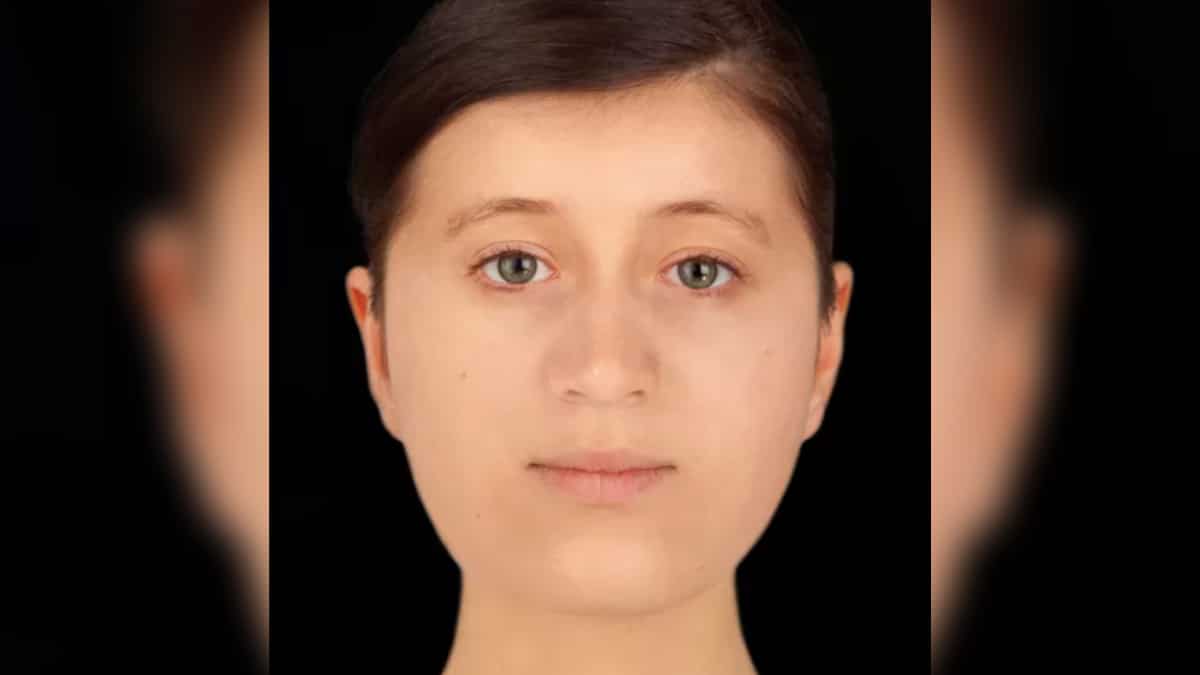
Trumpington girl's face reconstructed (Credits: Hew Morrison)
A little more than a decade after scientists discovered the remains of a 16-year-oldAnglo-Saxon girl in UK's Cambridgeshire who died more than 1,300 years ago, they have managed to reveal her face using facial reconstruction.
To succeed in their endeavour, scientists analysed the girl's skull to create a life-like reconstruction which showed how she looked prior to her untimely death. However, without DNA analysis, forensic artists could not render precise eye and hair colour.
The new image shows she had a fair face with pale skin, a rather petite nose, pronounced cheekbones and one eye slightly lower than the other.

"It was interesting to see her face developing.Her left eye was slightly lower, about half a centimetre, than her right eye; this would have been quite noticeable in life," saidHew Morrison, the facial reconstruction artist who rendered the image.
WATCH |Gravitas: Scientists to create 'lunar time zone'
)
'Hellish' wildfires burned through Europe for 300,000 years after supercontinent Pangea broke up
)
No Pandya as Auqib Nabi earns maiden ODI call-up; Mayank returns for WI T20Is| check full squads
)
Trump praises India’s Opium crackdown, hails anti-drug efforts
Mandakini breaks silence on Dawood Ibrahim photo: 'I was not invited by him'
)
Former India player Diana Edulji wants Smriti Mandhana to replace Harman as skipper at the earliest
)
Trump calls Canada-EU associate membership plan ‘laughable’ and threatens 'very serious tariffs'
)
Protests erupt over migrant housing plan in Piddington
)
India can scale up Finland’s circular solutions, minister Multala says
)
240-million-year-old bizarre 'pig with a tusk' creature creates new dilemma over origin of dinosaurs
)
Europe wants a common playbook for security threats, seeks security beyond NATO
)
All Indian goods to get duty-free access to New Zealand
)
Formula One reveals the 2027 race calendar; Monaco to host sprint race for the first time
)
Bigg Boss 20: Mahhi Vij reveals she lost Yuva role to Kareena Kapoor; 'didn’t work out in my favour'
)
Lionel Messi for 2026 Ballon d’Or over Mbappe and Yamal, says Diego Simeone
)
US House votes 417-3 to pass Ratepayer Protection Act targeting AI data center electricity costs
)
Hong Kong unveils 11 new measures to boost birth rates, offers higher cash bonuses and housing perks
)
Former OpenAI researcher warns of growing risks from Artificial Intelligence
)
Veteran actor Anant Nag honoured with Indian cinema’s highest award
)
Wildfire tears through forests in Spain's Valencia
)
AUS vs SA: Steve Smith still gets 'little flashbacks' from sandpaper gate
)
Pakistan naval vessel returns to harbour with 'severe damage' after collision with Indian warship in Arabian Sea
)
Fed raises rates for first time in 3 years, Kevin Warsh defies Trump as inflation mounts
)
Katrina Kaif’s postpartum weight is not the problem; your gaze is
)
Daayra movie review: Kareena Kapoor, Prithviraj Sukumaran shine in Meghna Gulzar’s cop-versus-cop crime thriller
)
Saudi Vs Houthis: Yemeni military rebels clash with Houthis
)
Pak batter Rizwan's petition against being questioned by cyber crime agency rejected by court
)
US trade tariff: 100% tariff targets Russian buyers amid trade tensions
)
Pakistan: Imran Khan's sons Kasim & Sulaiman claim their father is 'tortured' in jail
&im=FitAndFill=(700,400))
New OTT releases this week (September 14-20, 2026): Lust Stories 3, Waiting Hai, Irumudi- 5 new titles coming on Netflix, Prime Video and more
)
Ebola outbreak: WHO sees encouraging signs in fight against Ebola outbreak
)
Trump gets new power to hit India, China with up to 100% tariffs as US Senate clears Russia sanctions bill
)
‘Imagine 50 AI fighters cornering one manned jet’: India’s mobbing doctrine eyes a new era of air warm
)
Saudi vs Houthis: Riyadh claims to have shot Houthi drone targeting Mecca
)
US Treasury rallies global financial institutions for Op Economic Outcast to isolate Iran
)
Want to get married within a year? Why 18 lakh people rush to Jaipur for ‘sacred henna’
)
Pakistan boycotts chess match against Israel at Olympiad
)
UN General Assembly 2026: What is veto power. Which countries have it and how does it work?
&im=FitAndFill=(700,400))
Suriya and Jyothika say ‘I do’ again after 20 years! See their dreamy wedding pics
)
Abhishek Sharma rises to No. 2 in T20Is; ENG’s Robinson 3rd after record Pakistan Tests
)
Laura Wolvaardt sets new world record for most WT20I runs in a year
)
The Early Spring season 2 is happening, but fans have one request - 'don't change the actors'
)
The girl's skeleton was found buried in a wooden bed with a gold and garnet cross on her chest. Despite being discovered in 2012 by British archaeologists, scientists are unsure about the origins of the 'Trumpington girl'. They posit that she may have migrated from Germany to England as a young girl who was part of an early Christian group, spreading the teaching of Jesus.
Her diet may have changed: Scientists
Some reports indicate that the girl may have died from illness but the true cause remains unknown.The scientists say upon arriving in England, the proportion of protein in the girl's diet decreased by a small but significant amount. Although it is not clear if it had anything to do with her death.
"We now know the proportion of protein dropped, suggesting she was eating more meat and dairy products when in southern Germany than on arrival in Trumpington,"Anglo-Saxon specialist Dr Sam Lucy was quoted as saying by BBC.
The reconstructed image is slated to go on display as part of the University of Cambridge's Museum of Archaeology and Anthropology exhibition which opens on Wednesday (June 21).
Facial reconstruction - a special technology
Facial reconstruction is a fascinating technology through which researchers are able to unveil how certain people looked in the past. Earlier this month,scientists managed to reconstruct King Tutankhamun's face - one of the most prominent pharaohs of ancient Egypt.
Teams from Australia, Italy and Brazil utilised a digital model of his mummified skull and managed to re-create the face of King Tut.
"He looks like a young man with a delicate face. Looking at him, we see more of a young student than a politician full of responsibilities, which makes the historical figure even more interesting," saidBrazilian graphics expert and co-author of the study, Cicero Moraes.
(With inputs from agencies)
WATCH WION LIVE HERE: