
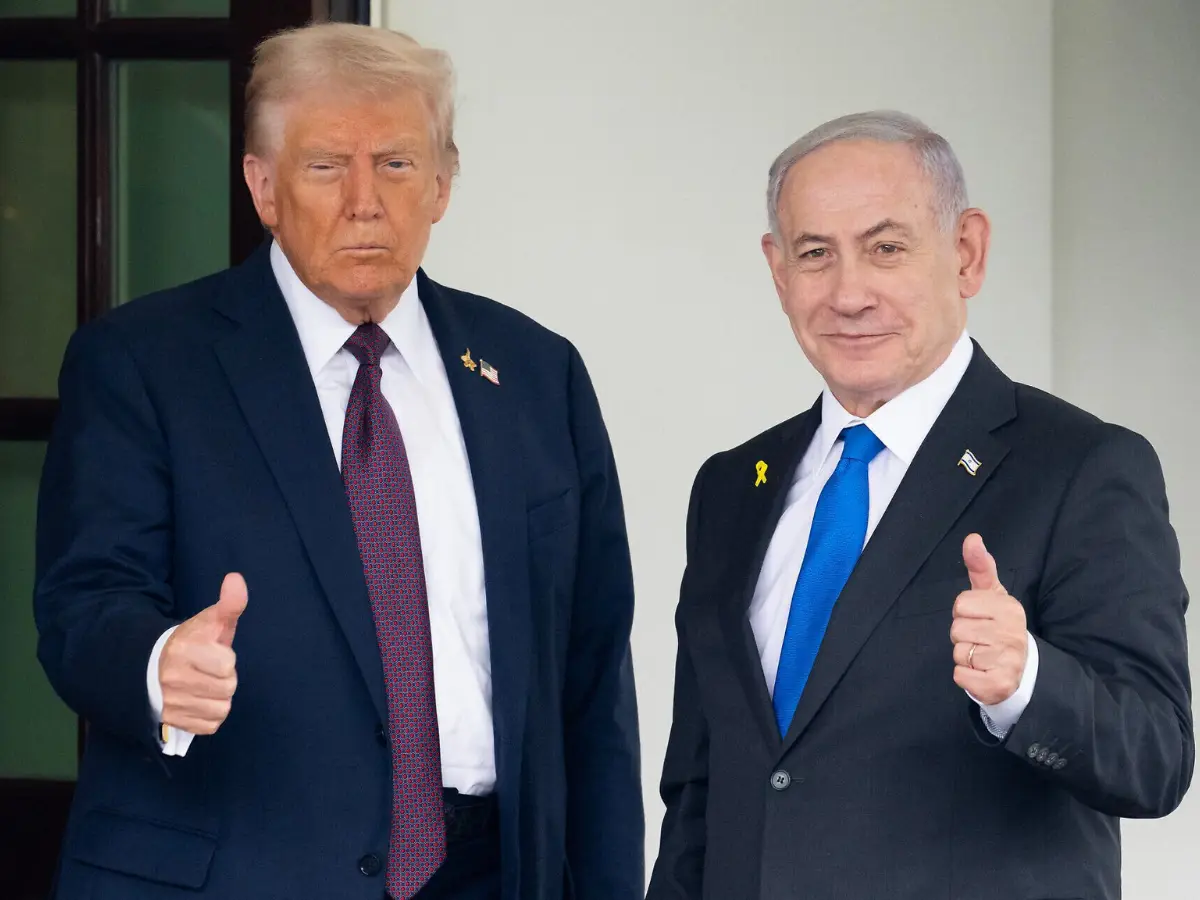
&imwidth=800&imheight=600&format=webp&quality=medium "Gaza plan shows limits of Trump’s influence on Netanyahu")
On September 25, four days before announcing a peace plan for Gaza, U.S. President Donald Trump made a categorical statement on the issue at the heart of the Israeli-Palestinian conflict – the future of territory the Palestinians see as a key part of a future state.
“I will not allow Israel to annex the West Bank. Nope. I will not allow it. It’s not going to happen.”
Trump’s confident assertion implies that he thinks Israeli Prime Minister Benjamin Netanyahu unfailingly follows the wishes of Israel’s most important ally. Particularly where the West Bank is concerned, This is not the case.

For decades, the Israeli leader has defied U.S. policy, international law and even U.N. Security Council resolutions opposing Jewish settlements in the West Bank, occupied by Israel in the 1967 Arab-Israeli war.
From the beginning of the peace process that led to the 1993 Oslo accord, the number of Jewish settlers grew from 110,000 to more than half a million.
Right-wing members of Netanyahu’s cabinet have been clamouring for the annexation of the West Bank or, as they call it by its biblical name, Judea and Samaria.
Trending Stories
&im=FitAndFill=(700,400))
Before Extraordinary Minami Minami, these popular K-dramas got Japanese versions
)
'Were you here to sell chickpeas?': Wasim Akram criticises Babar Azam's captaincy
)
Saudi vs Houthis: Houthis claim missiles & drones used in attack on key Saudi sites
)
‘Will go to any extent’: Pakistan vows to defend Saudi Arabia amid Houthi attacks
)
‘End of my career...’: NSA Doval recalls tense Sikkim mission when China captured Indian intelligence team
)
China now makes advanced memory chips without the machines it was banned from buying
)
Raphinha hat-trick powers Barcelona to 3-1 win over Sevilla in La Liga
66 years of the Indus Waters Treaty: How India and Pakistan settled a bitter river dispute
)
Trump defends AI amid growing alarm, announces new 'AI force' and promises an 'AI czar'
)
Several petrol pumps, other businesses to refuse UPI payments above Rs 2,000 from Oct 16: Is it legal?
)
Trump announces ‘AI Force’ as debate grows over AI risks and regulation
)
Mark Carney mimics Trump in hilarious moment over C$70 billion clean-energy investment; room erupts in laughter
)
Harry Brook targets long reign at top of T20I rankings after Sri Lanka sweep
)
Ed Sheeran addresses Macklemore's removal, Gaza conflict during Philadelphia concert: 'I cannot hide how I feel'
&im=FitAndFill=(700,400))
‘Not the US or China’: These are the countries leading the world in arable land
&im=FitAndFill=(700,400))
How many F-35s does Britain, Japan and Israel have?
)
West Indies Squad for India Series: Hetmyer included for T20Is, Holder rested
)
Arvind Kejriwal, family members, Delhi CM Rekha Gupta get SIR notices
)
Gaza under attack: Health chief's son killed in IDF strikes
)
US-Iran war: Tehran draws red lines — seven demands before any peace talks
)
Reacher star Alan Ritchson opens up about alleged blackmail, suicide attempt during difficult period
)
S Jaishankar, former Army chief among high-profile names issued Delhi SIR notices
)
9 women found dead near Johannesburg: South Africans rally, demand 'enough' to femicide
)
AI actress Tilly Norwood glitches mid-interview, switches from English to Chinese | Watch
)
Russia's deadly Ukraine strikes kill 2 in Sumy, hit Dnipro mall
)
Sikh bus driver assaulted, bus stolen and rammed into cars in England; video surfaces
)
Report: Iran rebuilding Taleghan 2, nuclear site tied to past weapons research, hit twice by Israel
)
Russia holds first parliamentary elections since the beginning of the Ukraine war
)
EXCLUSIVE | Singer Hanita Bhambri on her Toxic debut, working with Vishal Mishra and more
)
Aravana prasadam shortage at Sabarimala temple in Kerala triggers protests, TDB questioned
)
Iran sets 7 conditions to end war with US: What are Tehran’s demands?
)
China may have gained access to US's classified F-35 jets; parts meant for repairs diverted to Hong Kong, sparking Pentagon inquiry
)
Trump says he'll build an 'AI Force' and appoint a czar, for 'high IQ' people only
)
Nigeria: Protesters take to the streets, police fire shots
)
The Verdict | When precision fails: US commits war crime in Minab school strike, UN finds
)
Kampala-Ankara rift deepens: Uganda suspends military ties, seeks Fred Lumbuye's extradition
)
US-Iran war: Tehran sets seven conditions to re-engage in talks with US
)
Man breaks open wall hiding hundreds of books since 15 years
&im=FitAndFill=(700,400))
Meet top 5 Indian batters with fastest T20I centuries
)
Russia-Europe tensions: Polish PM warns Russian attacks could test NATO's unity
)
For decades, Israeli leaders shrugged of criticism of the relentless expansion of Jewish settlements in the West Bank from the United States, which had acted as a facilitator in the Oslo agreement, and most of its allies.
The expansion continues. New construction of bypass roads linking Jewish settlements and isolating Palestinian villages began the day after Netanyahu returned from Washington after announcing, standing alongside Trump, the Gaza peace plan.
Worked out by American and Israeli negotiators, it originally had 21 points. One was removed at the insistence of Netanyahu. It offered amnesty to Hamas members who pledged peaceful coexistence and agreed to lay down their arms. The Israelis argued it would reward terrorism.
Of the remaining 20 points of the plan, number 19 is the most sensitive. It highlighted that Trump and Netanyahu are not on the same page despite the appearance of unanimity conveyed by their joint announcement.
Point 19: “ While Gaza re-development advances and when the PA (Palestinian Authority) reform programme is faithfully carried out, the conditions may finally be in place for a credible pathway to Palestinian self-determination and statehood, which we recognise as the aspiration of the Palestinian people.”
Back home, Netanyahu poured ice-cold water on the phrase “Palestinian self-determination and statehood” which in effect means a Palestinian state side-by-side with Israel. He asserted that he would “forcibly resist a Palestinian state” and insisted it was not implied in the 20-point plan.
There has been no response so far from Hamas, the militant group which started the war in Gaza two years ago by storming across the border, killing more than 1,200 Israelis in an orgy of butchery, and taking 250 hostages.
Israel responded with devastating force. More than 66,000 Palestinians, mostly civilians, have died in bombing raids and artillery strikes that laid waste to much of Gaza and prompted one of the world’s worst humanitarian crisis, complete with famine, lack of medical services and tens of thousands driven from their homes and forced to live in tents.
Stomach-turning images of dying children operated without anesthesia in the ruins of bombed hospitals have prompted a swing of American attitudes towards Palestinians in a country once solidly pro-Israeli. That appears to have prompted Trump to get involved in efforts to stop the war.
On September 30, Trump set a deadline of ‘three or four days” for a Hamas decision, which would mean this Saturday. But the White House has since said the timeline could be flexible.
Meanwhile, Israel has pressed on with a devastating offensive on Gaza City to eliminate pockets of resistance from Hamas, many of whose leaders have already been killed. Even on the day of the announcement of the 20-point plan, 59 Palestinians died, according to the Health Ministry.
Since then, until October 1, another 429 died. The offensive continues.
The complicated 20-point plan includes an immediate ceasefire and a new international body to manage the administration and reconstruction of Gaza. Trump has said he would be chairman of the “Board of Peace” to oversee a “technocratic, apolitical Palestinian committee” charged with reconstructing public services.
Former British Prime Minister Tony Blair has been mentioned as the board’s co-
chair. Blair has extensive experience in the Middle East and worked as a peace envoy after leaving office.
No timeline for establishing the New Gaza has been fixed. It is still unclear whether Hamas will agree to the plan but even if it does, don’t expect swift results. Optimists who do might remember that it took more than a decade to end “the troubles,” Ireland’s sectarian conflict which had none of the complex geopolitical dimensions of the war in Gaza.
Also worth remembering: It took two years from then Egyptian President Anwar Sadat’s ground-breaking visit to Israel to the 1978 Camp David accords – the first peace pact between an Arab country in Israel.
For the emaciated, exhausted Palestinians in the ruins of Gaza, time is short.
