Chennai floods: Why were drones missing in action for so long?

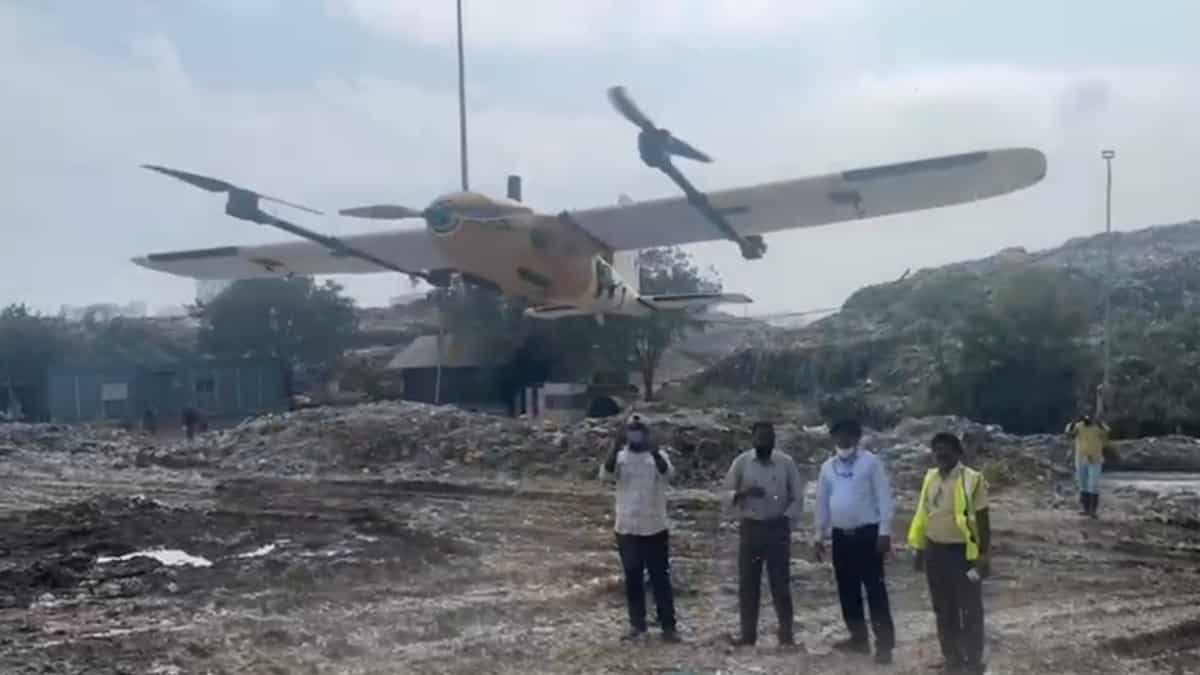
There has been no episode of rain in Chennai since Tuesday, December 5
The Indian city ofChennaiis home to the country's first drone police unitwhich was set up at thecost of ₹3.6cr or approx $450K and was inaugurated in June 2023. The southern Indian city which faced wrath of floods this week also housesa government-run Unmanned Aerial Vehicle Corporation, and several drone firms. Therefore, one wouldexpect drones to be part of government's disaster management and response strategy.
But it appears to be a case of too little and too late, as the Tamil Nadu Government formally announced the use of drones only on the fifth day (Friday, December 8) of the response and relief operations. Prior to Friday, there were no reports of drones being operated for this purpose.
From monitoring the flood situation, mappingcity's vulnerable areas, making emergency announcements and perhaps delivering relief supplies, the scope for usage of drones remainsendless.

The Tamil Nadu Government and its departments have access to highly capable and expensive drones. Several of themare equipped for day and night operations, and can carry payloads (drop life vests to rescue those marooned at sea), up to a distance of10km, carry out mapping, make announcements andspray chemicals.
Unlike the battery-powered drones that are dependent on availability of power for charging (which could be scarce during a disaster), the departments under the government operate drones that are powered by petrol.
In the past, variants of these drones have been deployed for duties in other parts of the country for dealing with situations such as fighting locusts by spraying chemicals, as well asmapping the mountainous crash site of the helicopterinvolving the country's top defence official in December 2021.
)
Three labourers killed as DU student loses control of his car, rams into them on Dwarka Expressway
)
Pentagon revives mandatory testosterone testing for male troops aged 30 and above
)
FACT CHECK: Why did PM Modi ask Xi ‘is it okay’ at BRICS Summit? New video reveals...
)
India seeks to build a full semiconductor supply chain
&im=FitAndFill=(700,400))
From Abhishek Sharma to Sahil Chauhan, 5 batters with fastest T20I hundreds
)
Pyongyang dismisses US, western pressure over nuclear programme
)
US And Denmark reach Greenland deal, Trump announces expanded military presence
)
Google’s Gemini AI hacks real systems by guessing passwords during security test
)
US hiding troop deaths in Iran war? Toll higher than Pentagon count, claims report
)
China may have gained access to US's classified F-35 jets; parts meant for repairs diverted to Hong Kong, sparking Pentagon inquiry
)
NASA research plane reaches 61,000 feet over Panama
)
Godfather of AI Geoffrey Hinton gives US lawmakers a one-year warning on AI
)
Shivakumar attends 79th Kalyana Karnataka Utsav in Kalaburagi
)
Trump signs Russia sanctions law: India faces fresh 100% tariff threat over Russian oil
)
Brigitte Bardot’s private collection set for Paris auction; key items and prices revealed
)
Why Ranveer Singh’s Dhurandhar missed India’s Oscar entry; FFI jury member reveals what happened
)
‘Will go to any extent’: Pakistan vows to defend Saudi Arabia amid Houthi attacks
)
The Verdict | When precision fails: US commits war crime in Minab school strike, UN finds
)
Trump signs Russia sanctions bill into law, targets Moscow’s energy sector
&im=FitAndFill=(700,400))
New Friday OTT releases (September 18, 2026): Lust Stories 3, You+Me, Best of the Best- 8 new titles coming on Netflix, Prime Video and more
)
Fast bowler Brydon Carse faces no charges over Derby nightclub incident
)
Pak: A series of counter terrorism operations in Khyber Pakhtunkhwa
)
Flying cars in UAE: Ras Al Khaimah signs deal with Chinese company to test new transport
)
Africa is splitting, and a lot sooner than estimated, giving way to a new ocean
)
'Gangsta' crab shoves knife blade at man and his dog in Florida - Watch
)
Trump bans CNN, MS NOW and Politico from White House over ‘FAKE NEWS’
)
Trump 2.0: Dark days ahead for America’s ‘imperial presidency’
)
Trump's Greenland dream comes true? POTUS announces 'Infinite Life' deal with Denmark, claims permanent US control
)
Who is Khalilur Rahman? All you need to know about 81st UN General Assembly President
)
Tirupati Laddu ghee adulterated with chemicals, says ED, supplier arrested
)
IIT Bombay student dies by suicide, was caught seeking AI help during exams
&im=FitAndFill=(700,400))
Meet top 5 bowlers in latest ICC T20I rankings
)
Indian Cinema bets big on mythology, brings ancient stories to modern audiences
)
Ukraine plans record $109 bn defence spending, nearly two thirds of budget amid Russia war
)
Russia holds first parliamentary elections since the beginning of the Ukraine war
&im=FitAndFill=(700,400))
Meet top 5 Indian batters with fastest T20I centuries
Interestingly, during the Covid pandemic, the Tamil Nadu government had successfully demonstrated the use of drones for spraying disinfectants. On various occasions, drones have been used for monitoring large gatherings and for similar law enforcement purposes.
Notably, when it came to responding to the disaster in Chennai city, the dronesbelonging to the government authorities remained missing in action, with no mention of use prior to 8th December, Friday.
After theMichaung cyclonehit Chennai there has been no rain in the city since Tuesday, December 5 and weather conditions have remained favourable for drone operations. Interestingly, several media organisations had shared drone visuals showcasing the extent of damage and flooding across parts of Chennai.
Taking to X, formerly Twitter, Dr. TRB Rajaa, Tamil Nadu's Minister for Industries, on Friday wrote, "Drones have been pressed into action to get vital incidental data which will be used to tackle pending issues, help in clean up work and more importantly to use in the future to mitigate repetition of present issues"
According to the Minister, it is on Friday (8th December) that the drones belonging to Tamil Nadu Unmanned Aerial Vehicle Corporation, have been deployed in Chennai.
As on Friday, many arterial and central parts of Chennai city have returned to normal, while some residential areas remain severely waterlogged. It is unclear whether the data collected at this time would give an accurate picture of the extent flooding (much of which has receded) that affected the metropolis.
In addition to the government-run drone corporation, there are several drone firms in Chennai.
There are also drone teams and startups associated withIIT Madras and leading engineering colleges, that have proven their mettle at various disaster response operations and competitions across India.
"Well ahead of the cyclone and its aftermath, we had proactively made offers to the Tamil Nadu Government to operate our drones and support the efforts. However, we did not get the necessary Government clearance for the same, despite multiple requests offering our support" a representative from the drone industry told WION.
Since Monday (December 4), relief and rescue operations are being carried out in Chennai and adjoining districts. The Indian Army, Air Force, Navy, Coast Guard, National Disaster Response Force (NDRF) deployed their teams to render assistance to the Government of Tamil Nadu.
As part of this, the ground teams of the Army, Navy, Coast Guard and NDRF carried out evacuation via boats and delivered essential supplies at homes. The Indian Air Force and Coast Guard tasked their helicopters to perform multiple sorties to drop relief supplies (dry food and water) on the rooftops of homes in inaccessible locations.
Had the available fleets of drones been deployed early on, it could have offered various lessons and insights on the benefits and drawbacks of using such platforms for supporting the overall disaster response efforts of the Government.
With the Chennai airport also having had to shut down arrivals and departures for almost 24hours (between 4th and 5th December) owing to flooding, the clear airspace had also provided a favourable and safer opportunity for drone operations.
According to the authorities, more than 16,000 persons have been evacuated and taken to relief camps and nearly 6 million food packets have been distributed.
