Expert Voice | Account Aggregators: A leap towards financial democratisation

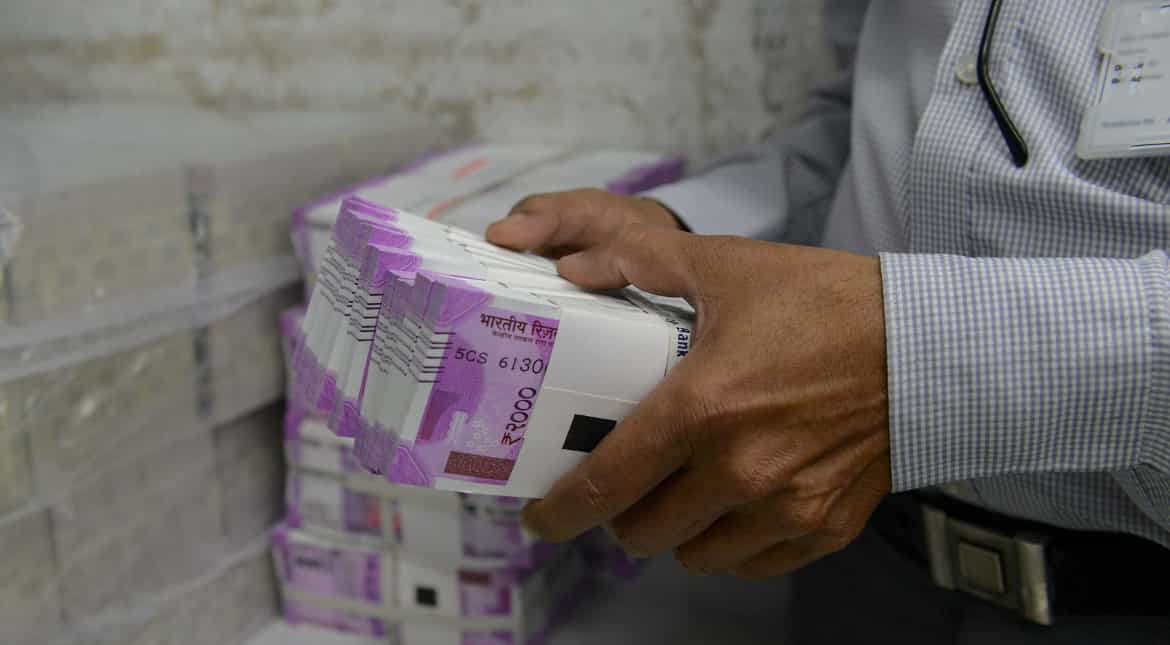
In photo: An Indian bank employee checks stacks of new 2000 rupee notes on November 11, 2016.
India’s digital public goods are powering a transformative shift in the way financial services are delivered. In this regard, the recent arrival of Account Aggregators (AAs) is another shot in the arm for financial inclusion and democratisation.
AAs are streamlining how we manage and share our financial data. The AA framework heralds a new age of financial inclusivity and efficiency. It allows individuals to securely aggregate and share their financial information with banks and other financial institutions. The ease in data-sharing simplifies the process of accessing financial services and empowers consumers by placing them in control of their personal data.
What Are Account Aggregators?

Account Aggregators are digital intermediaries—essentially, non-lending NBFCs.
Their job is to facilitate the secure and consent-based sharing of financial data between individuals and financial institutions. Imagine needing a loan and being able to share your financial history with the bank digitally without the hassle of paperwork. AAs make this possible.
They collect data from various sources—banks, mutual funds, insurance companies—and with your permission share it with entities requiring it, such as lenders.
)
'He will always be ahead': India coach Gambhir says Sooryavanshi won't walk into team ahead of Samson
)
'Gangsta' crab shoves knife blade at man and his dog in Florida - Watch
&im=FitAndFill=(700,400))
Which country has the most F-35s outside America?
)
Andhra Pradesh police pose as FBI to get X to remove tweets
)
Godfather of AI Geoffrey Hinton gives US lawmakers a one-year warning on AI
)
UNGA 2026 theme explained: What does ‘Restoring trust, managing transformation: A United Nations that delivers for all’ mean?
)
US F-16 fighter jet crashes in Michigan during training mission, pilot ejects safely
&im=FitAndFill=(700,400))
Meet top 5 Indian batters with fastest T20I centuries
)
Laura Wolvaardt sets new world record for most WT20I runs in a year
)
Ganpati Visarjan: Alia Bhatt and Ranbir Kapoor bid adieu to Bappa, watch viral videos
)
Who is Khalilur Rahman? All you need to know about 81st UN General Assembly President
)
North Korea's last nuclear test in 2017 set off 1,399 earthquakes over 8 years, each stronger than previous
&im=FitAndFill=(700,400))
New Friday OTT releases (September 18, 2026): Lust Stories 3, You+Me, Best of the Best- 8 new titles coming on Netflix, Prime Video and more
)
Xi-Trump summit may boost military links
)
Pentagon revives mandatory testosterone testing for male troops aged 30 and above
)
Asian Games 2026: Shafali stars as India thump Japan by 8 wickets to book semis berth
)
Marathi film Gondhal is India's official entry for Oscars 2027
)
The Verdict | When precision fails: US commits war crime in Minab school strike, UN finds
)
Shivakumar attends 79th Kalyana Karnataka Utsav in Kalaburagi
)
Three labourers killed as DU student loses control of his car, rams into them on Dwarka Expressway
)
US-North Korea tensions explode, Kim Yo Jong warns of 'more offensive' response
&im=FitAndFill=(700,400))
From Abhishek Sharma to Sahil Chauhan, 5 batters with fastest T20I hundreds
)
Ukraine plans record $109 bn defence spending, nearly two thirds of budget amid Russia war
)
Drone strikes cooling tower at Russia's Kursk Nuclear Plant, IAEA confirms
&im=FitAndFill=(700,400))
Suriya and Jyothika say ‘I do’ again after 20 years! See their dreamy wedding pics
)
Cristiano Ronaldo returns to Portugal squad for Nations League under new coach
)
Trump bans CNN, MS NOW and Politico from White House over ‘FAKE NEWS’
)
Spain Floods: Deadly floods hit Spain as torrential rains trigger widespread flooding
)
How did an Australian river with 500 crocodiles pass the Olympic test? Here's how
)
Hong Kong extends newborn cash support scheme by three years
&im=FitAndFill=(700,400))
Meet top 5 bowlers in latest ICC T20I rankings
)
India ‘deeply concerned’ as Houthi strikes hit Saudi civilian & energy sites
)
A first in 100 years: New cat species discovered in Bolivia is incredibly tiny
)
Africa is splitting, and a lot sooner than estimated, giving way to a new ocean
)
Indian activist-lawyer Prashant Bhushan's post brings focus on ‘conflict of interest’ appointments of ex-govt officials at Reliance, Adani groups
&im=FitAndFill=(700,400))
Meet top 5 batters in the latest ICC T20I Rankings
)
‘Will go to any extent’: Pakistan vows to defend Saudi Arabia amid Houthi attacks
)
Former India player Diana Edulji wants Smriti Mandhana to replace Harman as skipper at the earliest
)
India seeks to build a full semiconductor supply chain
This mechanism significantly reduces the time and cost associated with manual data verification, thus leading to faster loan processing and sanction.
The Need forAAs
AAs address the challenge of financial fraud by ensuring data is directly sourced from financial institutions, mitigating the risk associated with forged documents.
Secondly, they bridge the gap in financial inclusion. For individuals in remote areas or those without a formal credit history, traditional banking services may be out of reach. AAs democratise access to financial services by leveraging digital data.
This is making it possible for more people to access loans and other services based on their financial behaviour rather than just their credit history.
Empowering Consumers Through Consent
Consumer empowerment is central to the AA framework. Before the ongoing digitalisation of finance, sharing personal information was cumbersome and fraught with privacy concerns.
Remember the days of printing several photocopies of your financial statements, and income and address proofs, and sharing them with strangers?
Now, with all this information available digitally, fintech innovation such as AAs is allowing for the data to be shared directly from its source, such as your bank. Also, consumers can dictate who accesses their data, for how long, and for what purpose.
This consent-based model not only protects privacy but also puts individuals in the driver's seat of their financial journey. An example of this empowerment is the ability for consumers to instantly revoke access.
Simplifying Account Openings
The AA ecosystem is streamlining the way financial accounts are opened and managed.
By using AAs, consumers can undergo a digital KYC process, linking their various financial accounts—from savings to investments—under one umbrella.
This consolidation can simplify the process of applying for financial services such as loans, investing, or purchasing insurance. The digital KYC process through AAs can reduce the account opening time from days to mere minutes.
The Future of Financial Services with AAs
The potential of AAs extends beyond just simplifying data sharing; it's about revolutionising finance again—just as UPI had done some years ago.
By integrating more forms of financial data, such as investments and insurance, AAs are set to offer a more holistic view of an individual's financial health.
This broader perspective on consumer data will enable lenders to make more informed decisions, which will help reduce the risks around frauds and NPAs. It's a win-win: consumers enjoy easier access to services, while institutions benefit from a deeper understanding of their customers' financial behaviours.
India's embrace of Account Aggregators is a significant step towards a more inclusive and efficient financial ecosystem. AAs are unlocking new possibilities for consumers and financial institutions alike.