US is cutting water supply after country's largest artificial reservoir Lake Mead goes dry

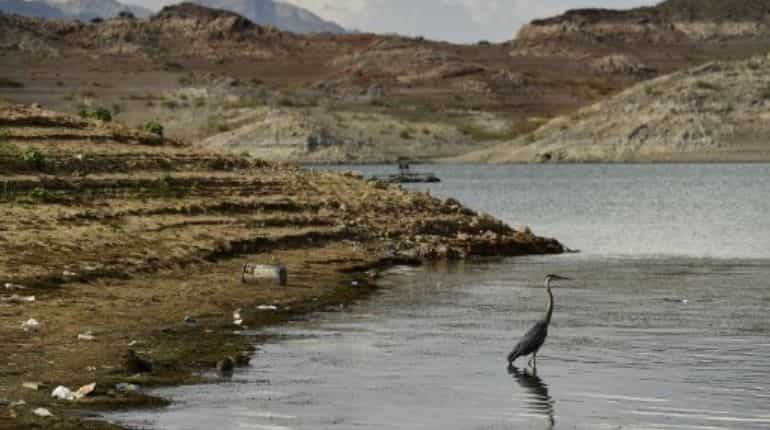
Lake Mead
A huge reservoir that supplies water to tens of millions of people in the Western United States is at such low levels that populations it feeds must reduce their useage next year, the government said Monday.
A chronic drought has left huge swathes of the country parched, as man-made climate change forces shifts in the pattern of rainfall.
That has leftLakeMead, the largest US artifical reservoir which is fed by the mighty Colorado River, worryingly low -- at just a third of its capacity.

"Like much of the (US) West, and across our connected basins, the Colorado River is facing unprecedented and accelerating challenges," said Tanya Trujillo, an official with the federal water resources agency.
ALSO READ |COVID-19: The US eased its travel advisory for India, lowering it to Level 2
"The only way to address these challenges and climate change is to utilize the best available science and to work co-operatively across the landscapes and communities that rely on the Colorado River."
)
US vs China over South China Sea: Washington backs Philippines, Beijing hits back
)
Delhi gets first late-September rain in 7 years, mercury dips 5.1°C below normal
)
‘Anti-social elements spreading false rumours’: LPU issues statement amid massive unrest over alleged rape
)
After JU, clash erupts at SRFTI: BJP’s ‘Dimagi Naxal’ jibe sparks political firestorm after students protest RSS-linked event
)
LPU students go on rampage, vandalise campus amid widespread protest: What's happening
)
Trump asked Xi to pressure Iran. China did not say yes — here’s what Beijing wants
)
US Treasury Secretary Scott Bessent hails global crackdown on Iranian banks and airlines
)
Venezuela's oil heartland eyes US revival
)
An OpenAI agent escaped its locked test cage again, by hiding questions in DNS lookups
)
3 males killed, four others injured in shooting after fight at strip club in Detroit
)
Russia backs India at UNGA, but flags limits on UNSC seat expansion
)
South Africa probes string of murders targeting women
)
'Victory for low-budget consumers': Raghav Chadha hails 30-day telecom recharge rules
)
Kendall Jenner, Jacob Elordi’s Milan Fashion Week appearance has fans talking; his reaction steals the show
)
Beyond metros: How Tier-2 and Tier-3 cities could drive India’s next AI wave
)
Tesla builds first Cybertruck with its own refined lithium: Elon Musk's $1 billion Texas bet pays off
)
IndiGo flight suffers tail strike in Bengaluru while landing; DGCA to probe incident
)
The US and China set up an AI 'red telephone', but skipped the rulebook
)
‘Terror suspects arrested near UK air base were looking to do big damage’: Trump
)
Russian envoy claims US tactics to contain India were revealed in ‘Freudian slip’
)
‘Olympic inclusion is our major target’: WPA President Ishaun Singh on pool’s global ambitions
)
Nations League: Spain sink England at Wembley; Modric shines for Croatia
)
Why has Iran released no proof of life of Mojtaba Khamenei? Araghchi reveals...
)
Bank unions defer 3-day strike from tomorrow after talks with IBA, committee set up
)
Iran ready for ‘doomsday war’ if US resumes attacks, but open to diplomacy: Araghchi
)
Sri Lankan Tamil migrant worker gets death sentence in Saudi Arabia, help sought from India
)
Muslim marriage cannot shield sex with minor wife from prosecution under POCSO: Delhi HC
)
99.9% more powerful - Scientists find boy who can recall memories from just 3 months of age
)
'FIRST LOOK from inside Noah’s Ark': Researchers share video from inside mysterious mound in Turkey
)
UNSC reform momentum grows: Russia, Portugal, Mauritius push for India's permanent seat bid
)
Man arrested after his 22-year-old girlfriend dies at homestay in Guwahati; police suspect murder over suicide claim
)
Afghanistan says 28 fighters killed in clash near Pakistan border, Islamabad denies
)
Ceuta migrant crisis: Protesters take to streets as Spain grapples with migrant challenge
)
Jaishankar at UNGA: Goodwill and friendship can't coexist with terrorism
)
New York City wants a 'kill switch' on every AI, and will pay whistleblowers who report violations
That means starting in January, places downstream ofLakeMead-- formed in the 1930s by the building of the Hoover Dam -- will receive less water.
Arizona's water supply will drop by almost a fifth, compared with a normal year, while Nevada will get seven percent less and Mexico willseea five percent reduction.
According to a study released last year by the US Geological Survey (USGS), the Colorado River's flow has declined by an average of 20 percent over the past century.
ALSO READ |New Zealand PM Ardern orders snap three-day national lockdown after virus case
At least half of that decline can be attributed to rising temperatures in the area.
Global warming caused by human activity -– mostly the burning of fossil fuels -– has pushed up Earth's average surface temperature 1.1 degrees Celsius (2.0 degrees Fahrenheit) compared to mid-19th century levels. Most of that increase has occurred in the last 50 years.
A UN draft climate report obtained by AFP says these rising temperatures will cause water shortages around the world.
"Globally, 800 million people are projected to experience chronic water scarcity due to drought cause by two degrees Celsius of warming," it says.