

&imwidth=800&imheight=600&format=webp&quality=medium "Subcritical tests: Is China exploiting this loophole in non-proliferation treaties to expand its nuclear arsenal? A reality check")
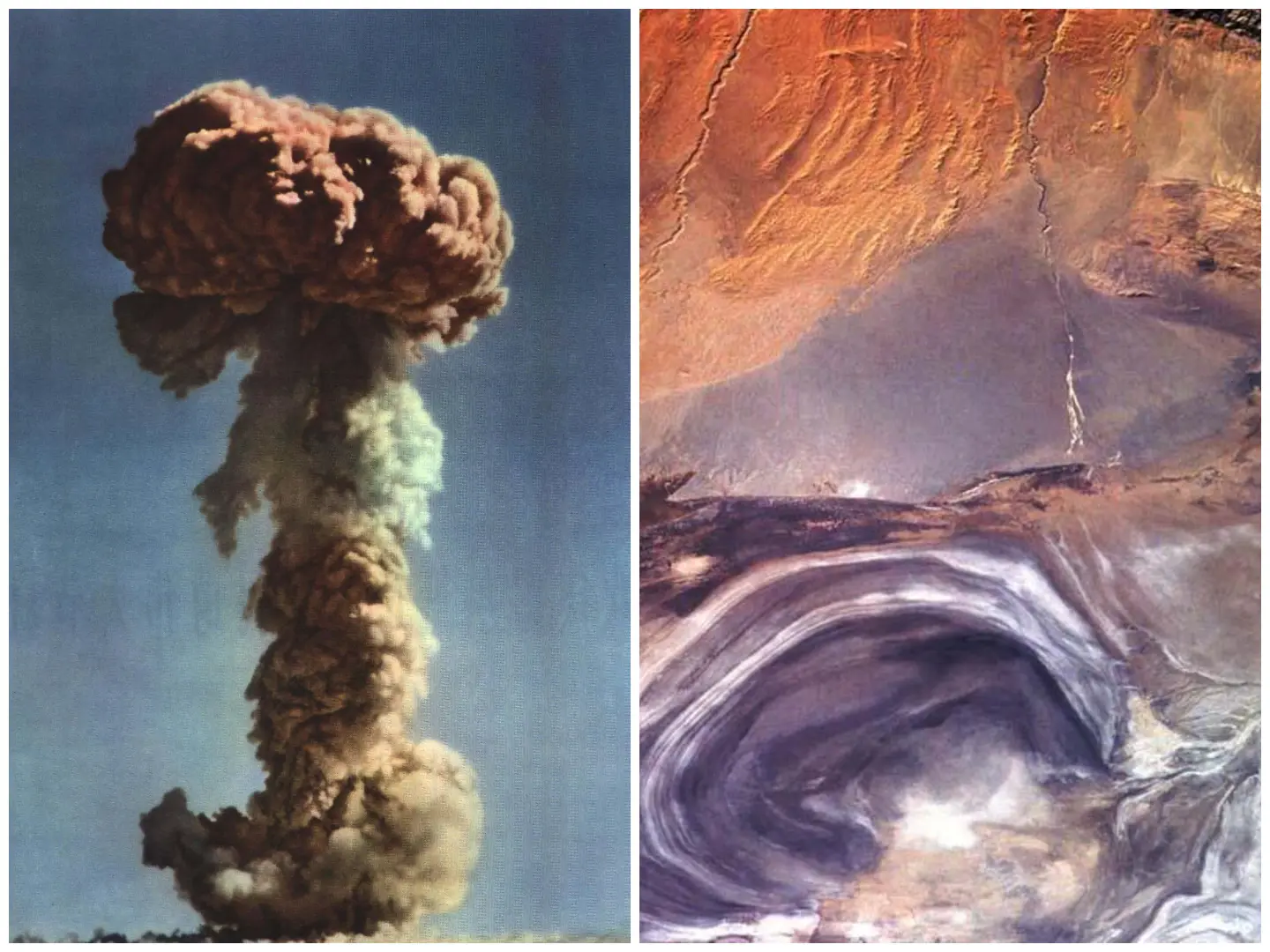
US President Donald Trump has claimed that China might be secretly conducting underground nuclear tests ‘without telling the world.’ His comments can be dismissed as political rhetoric. Or not. Recent research and satellite imagery have shown signs of activity at China’s long-dormant nuclear test facility at the Lop Nur site in Xinjiang. Does it mean Beijing has resumed full-scale nuclear explosions? No, there is no verifiable evidence for this. But reports and studies have suggested that China may be preparing, or already conducting so-called 'subcritical' nuclear tests. Here is what you should know:
What are subcritical nuclear tests?
Subcritical tests, as opposed to supercritical tests, are 'experiments' that fall outside the scope of international bans and treaties on nuclear testing. These experiments could potentially allow China and other countries to modernise its nuclear arsenal without formally violating non-proliferation treaties. Subcritical tests are designed to study how plutonium and other nuclear materials behave under extreme pressure, without causing an actual chain reaction, and thereby an explosion.
The treaty loophole allowing subcritical tests
Subcritical tests are not prohibited by the Comprehensive Nuclear-Test-Ban Treaty (CTBT) since they do not produce an explosive yield. Still, these tests can help refine nuclear weapon designs. This treaty loophole is a grey zone in global arms control, enabling major nuclear powers to conduct such experiments 'legally'.
And it's not only China. Reportedly, the US and Russia have also conducted such experiments. The US is thought to have conducted more than 30 subcritical tests since 1997 at sites like the Nevada National Security Site. Russia has conducted at least 25 at Novaya Zemlya, according to statements by US Department of Energy and Russian authorities.
Trending Stories
Also read: Trump claims Russia, China conducting nuclear tests; check how many nations lead in explosions
Significant construction at Chinese nuclear facility in Xinjiang
Citing satellite images and analysis by think tanks like the Sasakawa Peace Foundation, several media reports said between 2023 and 2024 that there is significant new construction at Lop Nur. Commercial satellite imagery of the area in Xinjiang from Planet Labs, analysed by Deciphering Mycroft and others in 2023–2025 confirmed horizontal tunneling and infrastructure.
The work there includes excavation for what could be a sixth underground tunnel, ventilation shafts, new roads, spoil piles, and expanded support buildings. Experts like Jeffrey Lewis of the Middlebury Institute of International Studies said the construction is consistent with preparations for subcritical testing. Ventilation stacks and sealed tunnel entrances are generally used for containing radiation, leading to this assessment. But the opposing view is that this could be for 'peaceful purposes like hydrodynamic experiments or storage.
China's growing capabilities for controlled nuclear experiments
As per a 2025 paper published by the China Institute of Atomic Energy, China has made advances in accelerator-driven subcritical systems or ADS. Officially, the research focused on energy applications. But the underlying technology is similar to the one used in subcritical nuclear weapons tests. This includes use of accelerators or high-powered lasers to simulate explosions without creating them. This has made experts conclude that China has the technical means and infrastructure to conduct subcritical experiments. The paper specifically refers to civilian thorium reactor research, like the TMSR programme of China, but dual-use concerns persist.
Also read: ‘They test underground where no one knows’: Trump accuses Russia, China of secret nuclear testing
Pentagon’s repeated warnings about China’s expanding nuclear arsenal
In its annual reports to Congress from 2020 to 2024, the US Department of Defense said that China’s nuclear warheads, estimated at low-200s in 2020, are on track to exceed 1,000 by 2030 and potentially reach 1,500 by 2035.
The projections are based on satellite data showing the construction of new nuclear fuel reprocessing plants and fast breeder reactors that can produce weapons-grade plutonium.
The Nonproliferation Policy Education Center (NPEC) estimated that, by the late 2020s to early 2030s, China could possess enough weapons-grade plutonium - up to three tonnes - for hundreds of additional warheads beyond its current stockpiles.
The FAS or Federation of American Scientists assessed that as of 2024, China has around 3–5 kg per new silo-based warheads. NPEC's three tonnes assessement is from potential production at new facilities at Jiuquan and Guangyuan, according to SIPRI and US intelligence inputs.
China may be quietly exploiting the loopholes of CTBT and NPT to advance its nuclear weapons programme
Through subcritical tests- instead of explosive supercritical ones - China can improve warhead reliability, develop smaller and more efficient designs, maintain its deterrent credibility, even as it avoids international scrutiny and appears to comply.
As mentioned, China is in fact following the method of the US and Russia, who already use such testing to modernise their arsenals.
How China will benefit from subcritical tests
Subcritical tests could help China grow its nuclear weapons capabilities, and thus reshape the global balance of power. If China achieves nuclear parity with the US, it may feel more confident in deterring American intervention in regional issues such as Taiwan.
But do note that there has been no confirmed Chinese subcritical tests announced or detected. The speculations are based mainly on infrastructure parallels to American and Russian facilities.
No seismic or radionuclide evidence of Chinese subcritical tests has been publicly detected by international watchdogs, like the CTBTO's International Monitoring System.
Revival of a nuclear arms race
China's nuclear arsenal growth could prompt an arms race by other nuclear states. India, for one, which last tested in 1998 with the explicit mention of China as the main threat, could go back to the drawing board on nuclear testing, as per some expert analysis.
Chinese advances might further embolden North Korea to conduct nuclear detonations. As a result, its key adversaries like South Korea and Japan could either deploy American nuclear weapons in the region or locally develop indigenous nuclear programmes and capabilities.
Treaties could become irrelevant
Article 6 of the Nuclear Non-Proliferation Treaty (NPT) commits nuclear powers to pursue disarmament in good faith, but slowly, nations are straying away from it.
Note that China has not ratified the CTBT, though it signed in 1996 and maintains a testing moratorium since 1996. The US signed CTBT but did not ratify, while Russia ratified but withdrew in 2023. None of these countries are legally bound to zero-yield, but all observe moratoriums on supercritical tests, as of now.
If China, the US and Russia all expand their arsenals through subcritical tests or other means, the credibility of the NPT and CTBT could erode. More nations could question its value, or withdraw entirely, leading to a further arms race.
It is not possible to say with available evidence that China has resumed underground nuclear testing in violation of international law, as indicated by Trump.
But subcritical tests may be the path used by Beijing to modernise its nuclear forces while staying 'clean' with regards to international treaties. Such actions, whether done by China, Russia or the US, challenge the spirit of the CTBT and could ignite a new era of nuclear arms race.
Trump’s warning is not just speculation or rhetoric, in spite of China's sharp rejection of his claims. It is essential now to look at plugging the loophole on subcritical testing, or the global non-proliferation regime could unravel.

